These commercials work because they tap into real fears: falling in the bathroom, losing independence, becoming a burden on family. Those concerns are valid. CDC data shows more than 14 million adults 65 and older fall each year, and bathroom injuries represent a significant share of those incidents.
What the commercials don't tell you is how to evaluate what's actually in the tub — the certifications, construction, jet systems, and after-sale support that determine whether a $10,000 purchase delivers on its promises for years to come.
This guide cuts through the marketing and gives you a practical framework for making an informed decision.
Key Takeaways
- Walk-in tub commercials sell emotion — base your decision on certifications (UL 1795, ASME A112.19.15) and verifiable specs
- Low-entry thresholds, outward-swinging doors, anti-scald controls, and quick-drain systems are the safety features that matter most
- Original Medicare generally does not cover walk-in tubs; some Medicare Advantage plans and Medicaid waivers may help
- Total costs typically run $4,500–$32,000+, covering both the unit ($2,000–$20,000+) and installation ($2,500–$12,000)
- Penner Bathing's 40+ years supplying long-term care facilities means residential buyers get the same proven equipment standards
What Walk-In Tub Commercials Are Really Selling
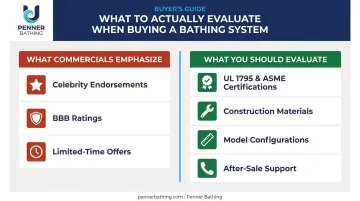
Safe Step, American Standard, and Kohler all run emotionally driven campaigns. Celebrity endorsements, dramatic before-and-after scenarios, and limited-time offers are advertising strategies. They say nothing about product quality.
A few things worth knowing about how these brands present themselves:
- BBB ratings reflect business practices, not tub safety or therapeutic effectiveness. Safe Step holds an A+ rating — that tells you something about complaint resolution, not whether the product is the best on the market.
- No current independent comparative product testing from Consumer Reports or similar organizations covers these brands head-to-head. The most-cited CR article on aging-in-place bathrooms dates to 2015.
- Heavy ad spend doesn't equal best product. Brands that invest less in TV campaigns often invest more in manufacturing, materials, and support infrastructure.
What You Should Actually Evaluate
Instead of responding to emotional appeals, focus on:
- Certifications: Does the product carry UL 1795 (the electrical safety standard for hydromassage tubs) and ASME A112.19.15-2012 for pressure-sealed doors?
- Construction quality: Where is it made? What materials are used in the shell, door seal, and jet components?
- Available models: Does the provider offer configurations that fit your bathroom dimensions, mobility needs, and budget?
- After-sale support: Who services the unit? How are parts shipped? Does the company offer 24/7 live phone support when something goes wrong?
Manufacturers whose primary market is hospitals, nursing homes, and assisted living facilities tend to build to a higher standard — because institutional clients cannot tolerate product failures or extended downtime. Penner Bathing, for example, has supplied healthcare facilities across the US and Canada since 1980, and that same institutional build quality carries into its residential Dream Spa Walk-In Bath line.
Essential Safety and Comfort Features to Look For
Door Entry and Threshold Design
The entry threshold is the first safety variable. Most walk-in tubs advertise a low step-in height, typically in the 2–4 inch range, though specific measurements vary by model and manufacturer. Equally important is how the door swings.
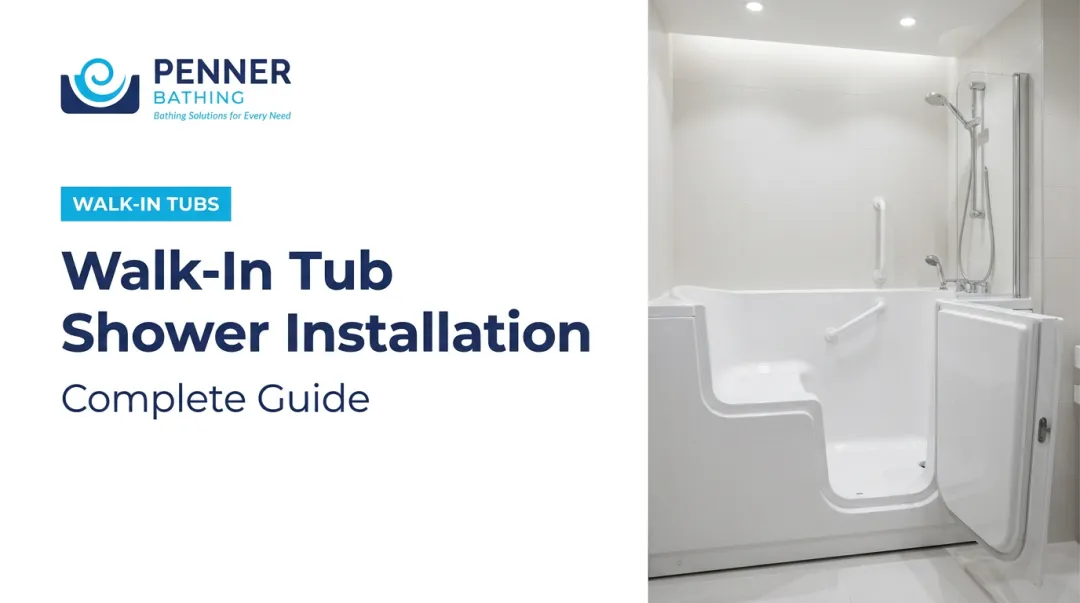
Outward-swinging doors offer a meaningful safety advantage: the user can sit on the tub edge first, then swing their legs inside — rather than stepping over a threshold while balancing. Penner Bathing's Dream Spa Walk-In Bath uses this swing-out design specifically because it eliminates the need to step over a wall entirely. By contrast, inward-swinging doors require the user to step in before sitting, which increases fall risk during entry.
Door seal quality also matters. Look for compliance with ASME A112.19.15-2012, which sets mechanical, material, and testing requirements for pressure-sealed tub doors.
Built-In Safety Features
Historical CDC bathroom injury data found that among adults 85+, nearly 39% of bathroom injuries occurred in or around a tub or shower — and over 80% of all bathroom injuries resulted from falls. The design features below address these risks directly:
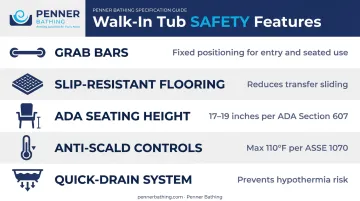
- Grab bars: Should be fixed, not removable, positioned for both entry and seated bathing
- Slip-resistant flooring: Textured surfaces on the tub floor reduce sliding during transfers
- ADA-compliant seating height: ADA Section 607 specifies 17–19 inches above finished floor for permanent bathtub seats — verify that any tub you consider meets this spec
- Anti-scald controls: ASSE 1070 governs temperature-limiting devices for bathtubs; look for a maximum water temperature cap and, ideally, automatic compensation. ASSE's domestic guideline recommends setting bathtub protection to 110°F
- Quick-drain systems: Users must remain seated inside a walk-in tub until it drains fully after bathing. A slow drain means sitting in cooling water — a real hypothermia risk for users with circulation issues
Jet Systems: Air vs. Water
Both jet types provide therapeutic benefits, but they work differently:
| Feature | Air Jets | Water Jets |
|---|---|---|
| Sensation | Gentle, full-body bubble massage | Targeted, higher-pressure stream |
| Best for | General relaxation, sensitive skin | Muscle and joint pain relief |
| Hygiene | Easier to keep clean (no recirculating water) | Requires more rigorous cleaning protocol |
Combination systems offer both air and water jets. Whichever type you choose, ask about jet count, placement, and how the jet lines are cleaned and disinfected between uses — the CDC flags recirculating hydrojet systems as favorable to biofilm growth when not properly maintained.
Antimicrobial Protection
Some manufacturers, including Penner Bathing, integrate BioCote antimicrobial technology into tub surfaces. This provides ongoing surface-level protection against bacterial growth. The EPA classifies this as product protection — it doesn't replace regular cleaning and disinfection protocols, but works as a supplementary hygiene layer on top of them.
Residential vs. Commercial Walk-In Tubs: What's the Difference?
Two Different Markets, Different Standards
Residential walk-in tubs are designed for private home use — one or two users, infrequent daily cycles, installation in a standard bathroom footprint.
Commercial/institutional bathing systems are built for nursing homes, hospitals, and assisted living facilities. They operate under a completely different set of requirements:
- Multiple bathing cycles per shift, often with different residents
- Staff-assisted operation requiring intuitive controls and ergonomic caregiver workspace
- Mandatory disinfection between users, per CDC infection control guidelines and CMS facility regulations under 42 CFR 483.80
- Fast-fill systems to maintain workflow efficiency across an entire shift
- Compliance with CMS Appendix PP requirements for bathing facilities (F918) and infection control (F880)
Who Should Consider a Commercial-Grade Provider
Facilities aside, residential buyers aging in place long-term should also consider providers with commercial expertise. A manufacturer who builds systems for 100-resident nursing homes — where a unit failure disrupts daily care schedules — has stronger incentives for durability, serviceability, and rapid parts availability than one whose primary focus is TV advertising.
Penner Bathing has served the long-term care market since 1980. Their commercial systems are built around caregiver workflow and include:
- Fast-fill reservoirs to maintain shift efficiency
- Automatic disinfection between residents
- Integrated patient transfer mechanisms
- Height-adjustable designs for staff ergonomics
- 38+ models, including bariatric options, multiple door orientations, and integrated scale systems
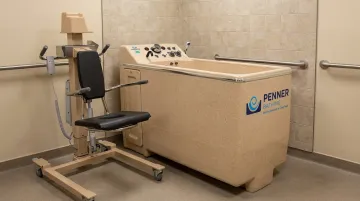
In 2019, the company brought this institutional knowledge into the home market with the Dream Spa Walk-In Bath, a residential product built on the same manufacturing platform as their healthcare systems, produced in Aurora, Nebraska, and UL/CUL Listed.
After-Sale Support: What to Demand
Commercial providers typically include:
- On-site staff training and installation guidance
- 24/7 live phone access for troubleshooting
- Fast parts shipping — Penner Bathing ships parts next-day air for orders placed before 2:00 PM CST
Residential buyers should demand the same. Ask any provider directly: who handles service calls? How long do parts take to arrive? Is there a live person available by phone?
Walk-In Tub Cost, Insurance, and Financing
Realistic Cost Ranges
| Cost Component | Low End | High End |
|---|---|---|
| Equipment (basic soaking) | ~$2,000 | ~$3,000 |
| Equipment (full hydrotherapy) | ~$8,000 | ~$20,000+ |
| Installation | ~$2,500 | ~$12,000 |
These ranges come from manufacturer-published guides by Safe Step and Kohler — actual installed prices require itemized quotes. Penner Bathing's Dream Spa Walk-In Bath starts at $5,950 for the unit itself; contact them directly for installation estimates based on your bathroom configuration.
Always request itemized written bids that separate equipment cost, labor, plumbing modifications, and any finish work. Compare line-item quotes, not advertised discounts.
Medicare and Insurance Coverage
Original Medicare (Parts A & B) does not cover walk-in tubs as durable medical equipment. There is no established Medicare coverage pathway for standard walk-in tub purchases. CMS NCD 280.1 denies bathtub lifts as convenience items and bathtub seats as comfort or hygienic equipment.
Medicare Advantage plans with Special Supplemental Benefits for the Chronically Ill may cover structural home modifications when expected to improve or maintain health. Walk-in tubs are not named or guaranteed, and eligibility varies by plan. Call your specific plan administrator to confirm coverage before purchasing.
Other Funding Sources
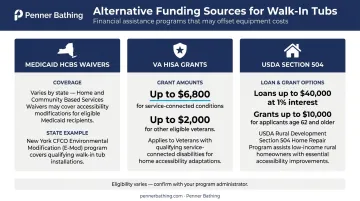
If Medicare doesn't apply, several other programs may help cover costs depending on your location and circumstances:
- Medicaid HCBS 1915(c) waivers: Available in some states for home modifications providing direct medical benefit. New York's CFCO E-Mod guidelines specifically list accessible tubs as a covered modification, but this is state-specific, not nationwide.
- VA HISA grants: Up to $6,800 lifetime for service-connected conditions; $2,000 for other eligible conditions. Spas and hot tubs are excluded — verify that a walk-in tub qualifies under your specific rating.
- USDA Section 504: Rural homeowners with very low income may qualify for loans up to $40,000 at 1% interest, or grants up to $10,000 for those 62+ who cannot repay and need to remove health or safety hazards.
Financing Red Flags
Some brands bundle aggressive financing offers with their TV campaigns. Watch for:
- Promotional 0% interest periods that convert to high rates if the balance isn't paid in full
- Deferred payment structures that obscure total cost of ownership
- Pressure to sign before receiving multiple written estimates
The FTC's Cooling-Off Rule gives you three business days to cancel qualifying in-home sales — don't let any salesperson tell you otherwise.
How to Choose the Right Walk-In Tub Provider
Ask every provider these questions before signing anything:
- What certifications does this specific model carry? Ask for UL 1795 verification and, for the door, ASME A112.19.15-2012 compliance. Request the certification directory entry and model number — not just a generic "certified" claim.
- Where is it manufactured? American manufacturing isn't automatically superior, but it often means faster parts availability and more transparent quality control. Verify written parts availability, authorized service area, and response times.
- What does the warranty cover? Get specific terms: duration, parts vs. labor, who administers service, and what voids coverage.
- Who handles service calls? An 800 number that reaches a live technician is different from a web form that routes to a third-party contractor.
- What does installation include? Confirm whether the quoted price covers plumbing modifications, wall finishing, and removal of the existing tub.
Penner Bathing manufactures entirely in Aurora, Nebraska, with same-day parts shipping for orders placed before 2 PM CST. Their live phone support, on-site evaluations, and staff training are services most residential buyers don't know to ask for — but they make a real difference when something goes wrong after installation.
Those specifics matter because accountability is easy to promise and hard to verify. Before signing any contract, follow the FTC's guidance: verify license and insurance, get multiple written estimates with itemized materials and completion dates, and never make full payment before the work is complete to your satisfaction.
Frequently Asked Questions
How much does a walk-in tub cost?
Equipment ranges from roughly $2,000 for basic soaking models to $20,000+ for full hydrotherapy systems. Installation typically adds $2,500 to $12,000 depending on plumbing, bathroom configuration, and region. Always get itemized quotes — advertised prices rarely reflect total installed cost.
Will Medicare pay to convert a tub to a shower?
Original Medicare does not cover tub-to-shower conversions as a standard benefit. Some Medicare Advantage plans and state Medicaid waivers may cover medically necessary home modifications, but neither is guaranteed nationwide — confirm with your specific plan before budgeting.
What is the difference between a walk-in tub and a standard bathtub?
Walk-in tubs feature a watertight door with a low step-in threshold, a built-in seat, grab bars, slip-resistant flooring, and anti-scald controls. These features make entry and exit significantly safer for seniors and individuals with limited mobility compared to stepping over a standard tub wall.
Are walk-in tubs safe for people with limited mobility?
Yes — they're designed for exactly this purpose. Standard safety features include low-threshold entry, outward-swinging doors, fixed grab bars, slip-resistant flooring, and anti-scald controls. Look for models meeting ADA seating height specs (17–19 inches) as a baseline.
What is the difference between air jets and water jets in a walk-in tub?
Air jets deliver a gentle full-body bubble massage and are easier to keep clean since they don't recirculate water through jet lines. Water jets offer more targeted pressure for muscle and joint relief. Combination systems provide both — just ask about cleaning protocols before you buy.
How long does it take to install a walk-in tub?
Professional installation typically takes one to two days, depending on bathroom configuration, existing plumbing, and whether structural modifications are needed. Manufacturer timelines vary — Safe Step cites under one day for most projects, while American Standard estimates up to two days.