Introduction
The bathroom is consistently ranked among the most dangerous rooms in the home for older adults. According to CDC data on nonfatal bathroom injuries, an estimated 83,426 adults age 65 and older were treated in U.S. emergency departments for bathroom injuries in 2008 alone — and falls accounted for the majority of bathroom injury mechanisms across all adult age groups.
Those numbers reflect a real, preventable problem. Wet surfaces, high tub walls, and the absence of stable handholds create a hazardous environment for anyone whose balance or strength has changed with age.
The good news: the right shower aids address this risk directly. Used well, they support daily independence and make aging at home a realistic, safe option. This guide covers the most effective aids available, how to choose the right combination, and when a more complete solution — like a walk-in tub or dedicated bathing system — is worth considering.
Key Takeaways
- Bathroom falls are among the most preventable senior injuries — the right aids make a real difference.
- The five most impactful shower aids are grab bars, shower chairs, non-slip mats, handheld showerheads, and transfer benches.
- Choosing the right aid depends on mobility level, bathroom layout, and whether care is independent or assisted.
- For seniors with significant mobility decline, a walk-in bath may be a safer long-term solution than aids alone.
Why Shower Safety Is a Critical Concern for Seniors
Aging brings physical changes that make wet bathroom environments genuinely hazardous — not carelessness, but a natural result of biology.
Reduced lower-body strength, diminished balance, joint stiffness, and slower reflexes all affect how quickly someone can catch themselves on a slippery surface. A 2021 biomechanics study found that grip strength and lower-limb strength are directly tied to reaction time. Weaker muscles don't just make a fall more likely — they make recovery from a near-fall harder too.
Shower environments compound these challenges in specific ways:
- Smooth tub surfaces offer almost no traction when wet
- High step-in thresholds require single-leg balance during entry and exit — the highest-risk moment
- Standard fixtures provide nothing stable to hold during position changes
- Limited floor space leaves little room to recover from a stumble
The Fear Factor
There's also a psychological dimension that's easy to overlook. Research on fear of falling in adults over 65 shows that seniors who fear falling often restrict daily activities — including bathing — to avoid the perceived risk. This avoidance correlates with lower independence across activities of daily living, creating a cycle where reduced activity leads to further physical deconditioning.
The right shower aids break that cycle — restoring confidence in the bathroom and keeping seniors active in their daily routines.
Essential Shower Aids for Seniors
Grab Bars and Rails
Grab bars are the single most recommended shower safety upgrade for older adults. Properly installed, they provide a secure, weight-bearing handhold during the highest-risk moments: stepping into the shower, changing position while bathing, and exiting on wet feet.
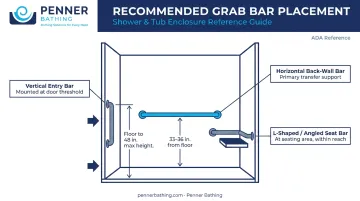
Placement matters as much as the bar itself. General guidance from accessibility standards recommends:
- A vertical bar at the shower or tub entry point, to support initial entry and exit
- A horizontal bar along the back wall at 33–36 inches from the floor
- An L-shaped or angled bar near any shower seat, which serves both positions at once
One critical distinction: wall-stud-mounted grab bars and suction-cup handles are not equivalent. AARP explicitly states that suction-cup handles are not suitable substitutes for properly anchored grab bars. Under real body-weight pressure — especially during a fall attempt — suction mounts can fail. Bars should be anchored into wall studs or appropriate backing, ideally by a professional installer.
Shower Chairs and Bath Seats
For seniors who struggle to stand for an extended period, a shower chair changes the entire bathing dynamic. Seated bathing eliminates the sustained balance demand of standing in a wet enclosure and sharply reduces fatigue for those with limited stamina or lower-limb weakness.
Key features to evaluate before purchasing:
- Non-slip rubber feet (critical on wet shower floors)
- Height adjustability to fit the individual and the shower
- Drainage holes in the seat to prevent water pooling
- Weight capacity verified against the user's actual weight
- Backrest for users who need trunk support; armrests for those who need help lowering and rising
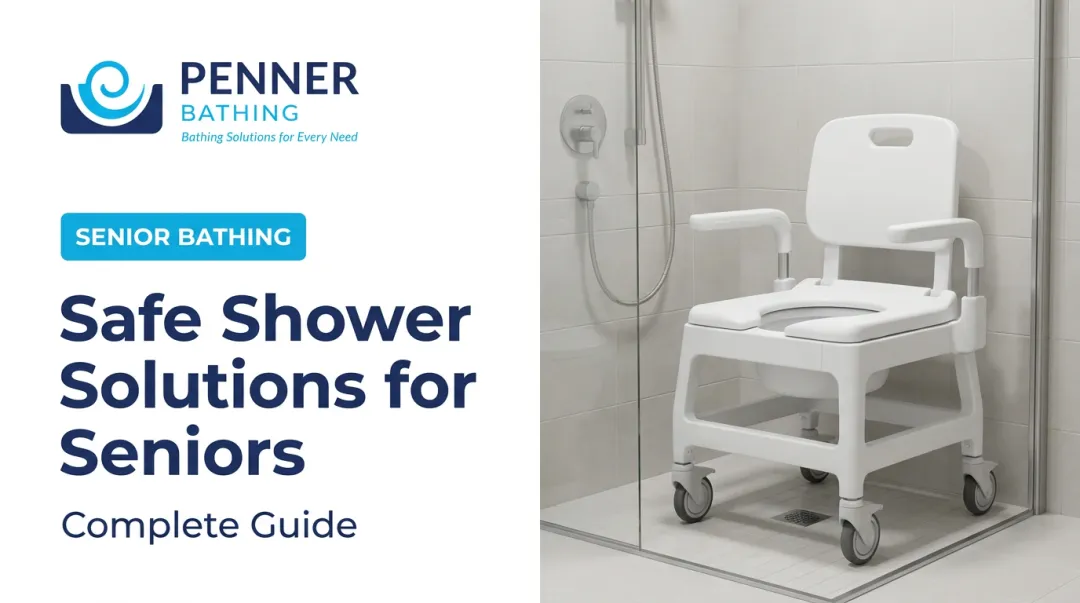
The right type depends on the user's needs. A backless stool suits relatively mobile seniors who just need a rest option. A chair with backrest and armrests provides support for those with weaker core stability. A wall-mounted fold-down seat saves floor space in smaller showers and works well when the chair is used only occasionally.
Non-Slip Mats and Flooring
Non-slip surfaces address two distinct hazard zones: inside the shower or tub during bathing, and on the bathroom floor during the wet exit. Both matter. Many bathroom falls happen not in the shower itself, but in the seconds afterward, when someone steps out onto a hard floor with wet feet.
What to look for in a bath mat:
- Suction-cup backing that grips the tub or shower floor securely
- Textured surface with adequate coverage area
- Antimicrobial materials to resist mold and mildew
- Appropriate sizing — a mat that barely covers the standing area creates gaps
For seniors who find loose mats uncomfortable or unstable underfoot, adhesive textured strips applied directly to the tub floor offer a permanent alternative. AARP's fall prevention guidance flags curled mat edges and mats without non-slip backing as tripping hazards in their own right. A poorly secured mat can be worse than no mat at all.
Handheld Showerheads
A handheld showerhead on a flexible hose lets the user — or a caregiver — direct water precisely without contorting, reaching, or shifting weight. This is especially useful when bathing from a seated position, where a fixed overhead head often misses the target entirely.
Features worth prioritizing:
- Pause or flow-control function to conserve water and improve control
- Adjustable spray pressure for comfort sensitivity
- Magnetic docking so the head can be returned one-handed
- Hose length of at least 60 inches for seated reach
Installation is straightforward: most handheld heads thread directly onto the existing shower arm with no tools required. For families just beginning to adapt a bathroom, this is usually the right first step — the upfront cost is low, the impact is immediate, and the existing plumbing stays untouched.
Transfer Benches
When stepping over the tub wall is no longer safely possible — even with grab bars — a transfer bench removes that obstacle entirely. The bench straddles the tub edge, with two legs inside and two outside. The user sits on the outer portion, then slides laterally over the wall while staying seated, bypassing the single-leg balance demand of standard tub entry.
Selection factors to consider:
- Adjustable leg heights to match different tub rim heights
- Swivel seat option for easier lateral movement
- Non-slip seat texture or a padded surface for pressure sensitivity
- Bariatric capacity if the user exceeds standard weight ratings
Transfer benches are particularly well-suited for seniors recovering from hip or knee surgery, those with significant balance deficits, and wheelchair users who need to transition from chair to tub without standing.
How to Choose the Right Shower Aid for Your Needs
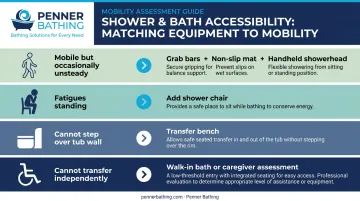
No single aid works for every situation. The right starting point is an honest assessment of the senior's current mobility level, because the gap between "unsteady but mobile" and "cannot stand independently" calls for very different solutions.
When in doubt, consult an occupational therapist first. The American Occupational Therapy Association recommends OT involvement in home modification decisions — they assess functional status, equipment fit, bathroom layout, and training needs in ways that a product list simply cannot replicate.
Matching Aid to Mobility Level
| Mobility Profile | Recommended Starting Point |
|---|---|
| Mobile but occasionally unsteady | Grab bars + non-slip mat + handheld showerhead |
| Fatigues standing; balance declining | Add shower chair to the above |
| Cannot step over tub wall safely | Transfer bench as primary solution |
| Cannot transfer independently | Walk-in bath or professional caregiver assessment |
Layout and Budget Considerations
Bathroom layout shapes what's practical. A walk-in shower with tile walls requires different grab bar anchoring than a fiberglass tub surround. A small bathroom may not accommodate a transfer bench without blocking access.
From a cost perspective, aids fall into three broad tiers:
- Entry level, no installation: Handheld showerheads, non-slip mats
- Moderate investment: Shower chairs, professionally installed grab bars
- Larger modification: Walk-in baths
Most families start at the entry level and add equipment as needs change — there's no need to over-invest upfront.
Common mistakes to avoid:
- Purchasing suction-mounted grab bars and treating them as structurally secure
- Choosing a shower chair without checking height adjustability for the user's specific dimensions
- Focusing only on the shower interior and ignoring the wet bathroom floor on exit
Caregiver Tips for Safer, More Dignified Shower Routines
Caregiver technique matters as much as the equipment. A well-set-up bathroom with poor caregiver practices still carries significant fall risk.
Preparation is the most important habit. Gather towels, soap, clothing, and any other supplies before the shower begins. A senior should never be left unattended mid-routine while a caregiver retrieves something. Rushing and improvising mid-session are among the most common causes of bathroom incidents.
Dignity is also a safety matter. The National Institute on Aging's bathing guidance recommends explaining each step before acting, covering the senior with a towel between steps, and preserving their participation wherever possible. A senior who knows what's coming next is more likely to cooperate calmly than one who feels startled or rushed.
Signs that the current setup needs re-evaluation:
- Increased anxiety or resistance around bathing
- A recent near-miss or minor fall
- Visible fatigue during or after the routine
- Physical strain on the caregiver during transfers
Reassessing the setup before an incident — not after — keeps both the senior and caregiver safer over the long term.
When Shower Aids Aren't Enough: Is a Walk-In Bath Right for You?
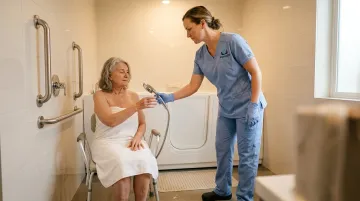
There's a point at which layered aids no longer address the underlying problem. When a senior cannot safely step over a tub wall even with grab bars, when transfer bench use requires significant caregiver assistance, or when recurring near-falls happen despite a well-equipped bathroom, the tub-and-aid approach has reached its practical limit.
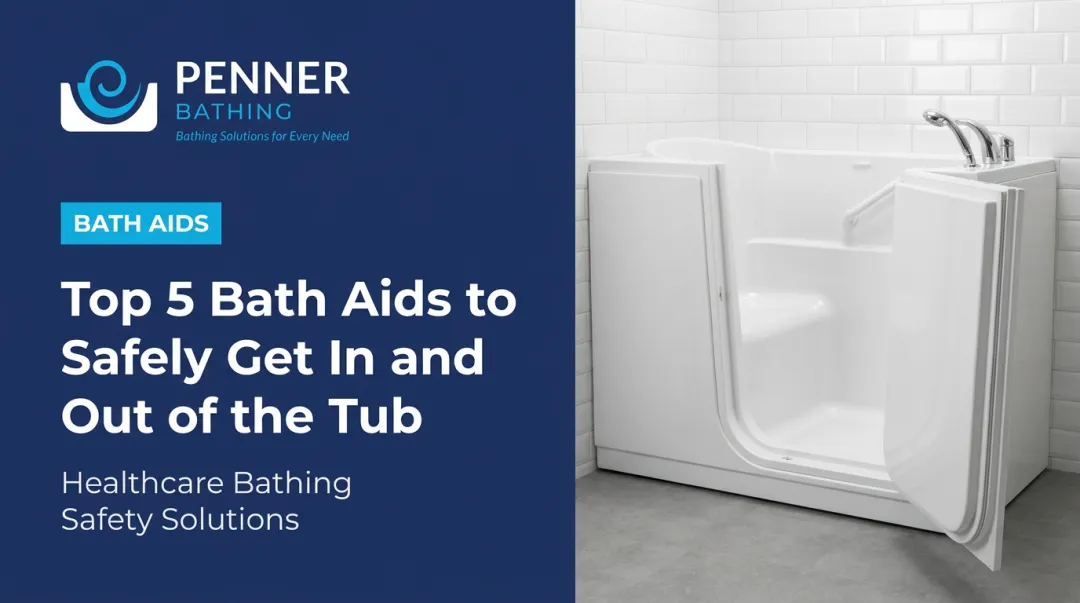
A walk-in bath changes the equation by eliminating the high step-in threshold entirely. The defining feature is a watertight door set into the tub wall, with a low entry point that allows users to enter while remaining upright or seated. Built-in seating, integrated grab bars, and therapeutic water features come standard on most models, making each session safer and easier on the body.
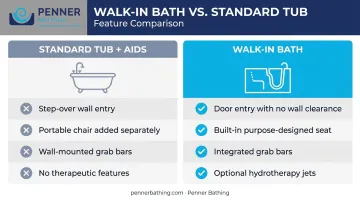
What Sets Walk-In Baths Apart from Standard Aids
| Feature | Standard Tub + Aids | Walk-In Bath |
|---|---|---|
| Tub entry method | Step over wall (with grab bar support) | Walk through door; no wall to clear |
| Seating | Portable chair added separately | Built-in seat, purpose-designed |
| Grab bars | Wall-mounted separately | Integrated into the unit |
| Therapeutic features | Not available | Hydrotherapy jets optional |
One practical consideration specific to walk-in tubs: the user must enter before filling and remain inside while the tub drains after bathing. This wait can be uncomfortable without proper temperature management. Quality units address this with heated seats, heated backrests, and heated air systemsthat maintain warmth throughout the fill and drain cycle.
Penner Bathing's Dream Spa Walk-In Bath
Penner Bathing has served long-term care facilities, hospitals, and assisted living communities since 1980. That commercial engineering experience carries directly into their residential product. The Dream Spa Walk-In Bath was designed specifically for seniors aging at home, with a swing-out door that lets users sit on the tub edge and swing their legs inside, removing the step-in motion entirely.
Key features include:
- Aqua-Aire Jet System for hydrotherapy
- PennAire Microbubble Technology for enhanced skin cleansing
- Heated seat and back support
- Handheld shower wand
- Optional automatic door close for users with limited grip strength
The unit is available across the U.S. and Canada.
Regarding cost: NCOA estimates walk-in bath installation at $3,000–$17,000+, depending on model, features, and installation complexity. Penner's Dream Spa starts at $5,950. For context, the average monthly cost of nursing home care exceeds $8,000. A walk-in bath that extends independent living by even a few months can offset its cost quickly.
For specific pricing, model options, or a free evaluation, Penner Bathing can be reached at 1-800-732-0717 or at pennerbathing.com.
Frequently Asked Questions
How do you make showering easier for the elderly?
Start with the combination that addresses the most common risks: grab bars at the shower entry and along the wall, a shower chair so the senior can sit while bathing, a handheld showerhead for better water direction, and non-slip mats inside and outside the shower. Add aids incrementally as needs change.
What is the best shower aid for seniors with limited mobility?
The best single aid depends on the degree of limitation. Grab bars suit seniors who are mobile but unsteady. A shower chair or transfer bench is the right choice for those who cannot stand safely. For seniors who can no longer step over a tub wall at all, a walk-in bath is the safest option.
Are shower chairs safe for elderly people to use?
Yes, shower chairs are among the most widely recommended safety aids for seniors. Proper fit is what determines safety: the chair must be height-adjusted for the individual, have non-slip feet, sit on a non-slip surface, and have a weight capacity that matches the user. Backrests and armrests add stability for those with weaker trunk control.
What is the difference between a shower chair and a transfer bench?
A shower chair sits entirely inside the shower for seated bathing. A transfer bench straddles the tub edge, allowing the user to sit outside the tub and slide over without stepping over the wall — making it the better choice for seniors who cannot clear a tub rim safely.
How should grab bars be installed in a senior's shower?
Grab bars must be anchored into wall studs or appropriate structural backing (never tile adhesive or suction cups). Standard accessibility guidance recommends horizontal placement at 33–36 inches from the floor, with a vertical bar at the entry point. Professional installation is strongly recommended so bars can safely bear body weight during a fall.