
Introduction
Healthcare administrators and long-term care operators face a persistent challenge: patients move through complex, multi-stage care processes where handoffs fail, needs go unaddressed, and preventable incidents occur. AHRQ's long-term care safety primer reports that 22% of Medicare SNF beneficiaries experienced an adverse event, with roughly half preventable — a sobering indicator of what happens when care delivery lacks a coherent, patient-centered framework.
Addressing this starts with understanding the patient journey: a practical map of every interaction, transition, and touchpoint a patient encounters, from the moment they first recognize a health need through months or years of ongoing care.
This article is written for healthcare administrators, long-term care professionals, and assisted living operators — covering what the patient journey is, how it unfolds stage by stage, and which factors most determine its quality in long-term care settings.
Key Takeaways
- The patient journey spans every touchpoint from initial health awareness through discharge and long-term care — not just clinical visits.
- In long-term care, the journey unfolds over years and multiple settings, making care continuity essential.
- Poor journey management leads directly to adverse events, care gaps, and declining satisfaction.
- Physical care infrastructure, including bathing and hygiene systems, is a critical touchpoint that directly affects resident dignity and safety.
- Mapping the patient journey helps facilities identify gaps, align care teams, and deliver more consistent person-centered care.
What Is the Patient Journey in Healthcare?
The Formal Definition
Carayon and Wooldridge define the patient journey as the "spatio-temporal distribution of patients' interactions with multiple care settings over time." This framing treats the journey not as a single visit or episode but as the full arc of a patient's movement across organizations, geographies, and care teams.
The patient is the only constant across the entire sequence. Physicians, nurses, aides, and facilities all rotate in and out. The patient stays — and that continuity is what makes the journey clinically meaningful.
Journey vs. a Single Clinical Encounter
A single clinical encounter captures one moment — a physician visit, an admission assessment, a therapy session. The patient journey captures everything around it: what came before, what happens between appointments, how information transfers across settings, and what the patient needs next.
This distinction matters because care gaps almost never occur within a single encounter. They occur in the transitions between them.
Journey vs. Patient Experience
These terms are often conflated, but they describe different things:
- Patient journey — the objective sequence of events and touchpoints across the care continuum
- Patient experience — the subjective perception of quality, dignity, and satisfaction at those touchpoints
The Beryl Institute defines patient experience as "the sum of all interactions, shaped by an organization's culture, that influence patient perceptions across the continuum of care." The journey tells you what happened; the experience tells you how it felt. Improving care means addressing both.
Why the Patient Journey Matters in Long-Term Care Settings
A Uniquely Extended Journey
Long-term care — nursing homes, assisted living communities, rehabilitation hospitals — presents a version of the patient journey that acute care settings rarely encounter. Patients don't stay for days; they stay for months or years. Every touchpoint accumulates, and every gap compounds.
In this context, consistency and continuity are structural requirements, not aspirational ideals. A care plan that works on admission day must remain responsive six months later.
What Poor Journey Management Costs
When the patient journey is fragmented or poorly understood, the consequences are concrete:
- Care gaps emerge between shifts, particularly during handoffs
- Avoidable incidents — falls, pressure injuries, healthcare-associated infections — increase
- CDC data shows approximately 1 in 43 nursing-home residents has at least one healthcare-associated infection on any given day
- Patient and family satisfaction erodes, often without staff awareness of why
None of these are random. Each reflects a breakdown at a specific, predictable point in the care continuum — which is exactly why facilities increasingly ask whether structured journey management is a regulatory obligation.
Is Journey-Based Care a Regulatory Requirement?
No federal regulation mandates a named "patient journey framework." What CMS does require is person-centered assessment and care planning — including MDS assessments within 14 days of admission, baseline care plans within 48 hours, and regular reassessments throughout the stay.
Journey mapping is the organizing method that makes those requirements coherent in practice. Facilities that actively manage their patient journey tend to see fewer preventable incidents, stronger survey outcomes, and a clearer path to performance within CMS's SNF Value-Based Purchasing program.
The Stages of the Patient Journey in Long-Term Care
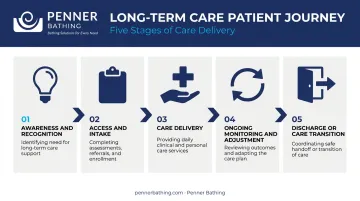
The journey moves through interconnected stages, each with distinct touchpoints, decision points, and care team responsibilities. Stage names vary by setting, but the core arc is consistent.
Awareness and Recognition
The journey begins before any clinical contact. A patient or family member notices symptoms, receives a worrying diagnosis, or begins researching assisted living options. This stage is frequently driven by urgency, confusion, or emotional distress.
Facilities that make information accessible and compassionate at this stage — clear admissions processes, responsive intake staff, plain-language resources — build the trust that carries through every later interaction.
Access and Intake
Access and intake covers scheduling, assessment, eligibility determination, and initial care planning. In long-term care, it includes reviewing clinical history, functional status, social determinants of health, and family caregiver availability.
Delays or friction here are among the most common pain points. A 2024 AHCA/NCAL provider survey found 46% of nursing homes limiting new admissions and 57% maintaining a waiting list, with staffing shortages cited as the primary driver. That means access barriers can undermine trust before care has even started.
Care Delivery
At this stage, the patient is actively receiving care: physician visits, nursing assessments, therapy, and daily personal care routines including hygiene, nutrition, and mobility support.
Each of these interactions is a touchpoint that shapes the patient's sense of dignity and safety. For elderly and mobility-limited residents, daily bathing is not peripheral to care — it is central to skin integrity, infection prevention, and emotional comfort.
Facilities that invest in purpose-built bathing infrastructure address this directly. Penner Bathing's therapeutic systems, for example, incorporate features that target each dimension of this touchpoint:
| Feature | Primary Benefit |
|---|---|
| Fast-fill reservoir | Reduces patient wait time, preserves dignity |
| Rail-free design with three-point access | Safe, flexible patient positioning |
| Automatic disinfection | Hygiene compliance between every use |
| BioCote® Antimicrobial Protection | 24/7 surface bacterial reduction |
| PennAire Microbubble Technology | Deep cleansing, skin health, therapeutic comfort |
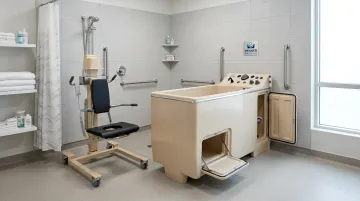
Beyond the equipment itself, Penner provides on-site facility evaluation and staff training to ensure the right system is installed for each room configuration and that care staff operate it consistently.
Their 24/7 live phone support and next-day air parts shipping mean equipment failures are resolved within 24 hours, minimizing disruption to structured bathing schedules.
Ongoing Monitoring and Adjustment
In long-term care, care doesn't stabilize after a single treatment course. It must be continuously reassessed. CMS requires comprehensive reassessment at least every 12 months, after any significant change, and quarterly reviews at minimum — creating recurring checkpoints across the resident's stay.
This stage involves care plan updates, interdisciplinary coordination, family communication, and adjustments based on changing functional status and patient preferences. Reassessments that happen on time and drive real action keep the journey responsive. Delayed or checkbox-only reviews leave preventable decline unaddressed.
Discharge or Care Transition
Care transitions — to home, a specialized facility, or hospice — are the highest-risk moments in the patient journey. Communication failures, medication discrepancies, and loss of continuity concentrate here.
A well-managed transition requires:
- Clear, complete documentation shared across receiving care teams
- Family education on medication regimens and follow-up appointments
- Scheduled follow-up contact within days of discharge
Discharge is not the end of the facility's responsibility. The patient's journey continues, and readmission risk is directly shaped by how well this transition is managed.
Key Factors That Shape the Patient Journey in Long-Term Care
Communication Quality Across Care Teams
Fragmented handoffs between nurses, physicians, aides, and specialists are among the most documented sources of care gaps. Standardized documentation and structured communication protocols — such as SBAR handoff tools and shared care plans — reduce these risks significantly.
Patient and Family Engagement
The patient is present across the entire journey; care teams are not. AHRQ's long-term care safety program explicitly treats residents and families as members of the facility safety team, particularly in infection prevention. Family involvement provides continuity that staffing alone cannot guarantee.
Physical Care Environment
Room design, adaptive equipment, and hygiene infrastructure directly affect patient safety and dignity. NASEM's nursing home environment review identifies bathing spaces specifically — noting that design should facilitate safe transfers, prevent infection, maintain resident warmth, and protect privacy.
Penner Bathing's 38+ model lineup addresses this across a range of patient populations:
- Left-side, right-side, and end-opening door configurations match existing room layouts and transfer approaches
- Bariatric-rated models and transfer chairs (rated to 600 lbs) accommodate patients with higher weight requirements
- Recumbent systems support fully dependent residents who cannot be seated upright
- Integrated scales on transfer systems allow clinical weight monitoring during the bathing process

Matching equipment to the room's actual spatial and clinical constraints removes the improvised workarounds — repositioned chairs, propped doors, narrowed pathways — that introduce measurable fall and injury risk.
Staffing Consistency and Training
A national Health Affairs study found mean annual nursing staff turnover of approximately 128% in 2017–2018, with higher turnover associated with lower quality ratings. Rotating staff break care relationships, reduce consistency, and create knowledge gaps that translate into real safety risks.
Penner's staff training program addresses the bathing touchpoint directly — providing in-person equipment training, model-specific instructional videos, and intuitive equipment design that reinforces correct procedures even as staff composition changes.
"Their service on their equipment is excellent. They want to make sure you are satisfied with their products." — Central City Care administrator, 20+ year Penner customer
Regulatory and Reimbursement Context
MDS assessments, care plan documentation, and CMS quality measures all connect directly to the patient journey. Administrators who understand how journey touchpoints map to compliance requirements — particularly under SNF Value-Based Purchasing — can prioritize operational improvements that serve both residents and regulatory standing .
Common Misconceptions About the Patient Journey
Three assumptions consistently distort how healthcare organizations plan and measure care delivery.
"The journey starts at admission and ends at discharge."
It doesn't. The journey begins with awareness: family research, physician referrals, the recognition of a health need. It continues after discharge through follow-up care and readmission risk. Facilities that treat their four walls as the boundary of the journey miss the moments where they have the most influence.
"Patient satisfaction scores are the same as patient journey analysis."
HCAHPS or CoreQ data captures perceptions at a point in time. It doesn't map the sequence of events, decisions, and gaps that produced those perceptions. Journey analysis requires examining the full arc, not just the endpoint.
"Patient journey and clinical pathway mean the same thing."
A clinical pathway defines a standardized protocol for a specific medical condition. The patient journey encompasses the full human experience surrounding that protocol — emotional, logistical, social, and environmental. It includes every factor that causes patients to deviate from the protocol, not just the protocol itself.
Frequently Asked Questions
What is the patient journey in healthcare?
The patient journey is the full sequence of interactions a patient has with the healthcare system — from first recognizing a health need through ongoing or post-discharge care. It encompasses every touchpoint across all care settings, with the patient as the only constant throughout.
What are the 5 P's of patient experience?
There is no single authoritative definition. The phrase most commonly refers to a nursing rounding mnemonic — typically covering Pain, Position, Personal needs, Placement/possessions, and a fifth variable depending on the source. It should be understood as a local practice tool, not a universal industry framework.
What is the difference between patient journey and patient experience?
The patient journey is the objective sequence of events and touchpoints across the care continuum. Patient experience is the subjective quality and perception associated with those events. Understanding both matters: the journey reveals what happened, while the experience captures how it was received.
What are the stages of the patient journey in long-term care?
The core stages are: awareness and recognition, access and intake, active care delivery, ongoing monitoring and adjustment, and care transition or discharge. In long-term care, this journey typically spans months or years across multiple care teams and settings.
What is patient journey mapping and why does it matter?
Patient journey mapping is a structured exercise that visually charts every touchpoint a patient experiences across the care continuum. It helps care teams identify gaps, reduce risks, and build more consistent, person-centered delivery. The value is operational: mapping reveals what's actually happening across handoffs, not just what protocols assume.
How does the physical care environment affect patient outcomes in long-term care?
The physical setting — including room design, adaptive equipment, and hygiene and bathing infrastructure — directly impacts patient safety, dignity, and comfort. For elderly or mobility-limited residents who rely on these supports every day, appropriate equipment is a clinical requirement, not an optional upgrade.