Key Takeaways
- Nursing compliance spans three tiers: federal CMS regulations, state Nurse Practice Acts, and facility-specific policies — each must align daily.
- CMS F726 requires demonstrated competency, not just training attendance records.
- Mandatory reporting under §483.12(c) has hard federal deadlines: 2 hours for abuse with serious injury, 24 hours for other covered allegations.
- Effective compliance training combines scenario-based learning, spaced repetition, and incident-triggered retraining.
- Strong safety culture measurably improves resident outcomes — including lower rates of falls and pressure ulcers.
Introduction
Long-term care administrators are managing a compliance environment that keeps getting harder. Survey scrutiny is tightening, nursing shortages strain staffing ratios, and CMS updates its State Operations Manual without a fixed schedule — meaning the regulatory floor can shift at any time.
For nursing home administrators, compliance officers, Directors of Nursing, and charge nurses, the margin for error is narrow. A missed mandatory report, a scope-of-practice violation, or a documentation gap uncovered during survey can trigger deficiency citations, CMS remedies, or Board of Nursing action — consequences that follow a facility, and individual nurses, for years.
That's exactly what this guide addresses: what nursing compliance actually requires, what a compliance nurse does, how to build a training program that holds up under scrutiny, and how to tackle the most persistent challenges in long-term care settings.
What Is Nursing Compliance?
Nursing compliance is the ongoing obligation of nurses and their employing facilities to adhere to federal and state law, accreditation standards, professional codes of conduct, and facility-specific policies — with the goal of protecting patients, staff, and the organization.
That obligation carries real weight: non-compliance can result in patient harm, license actions, or loss of federal certification. In clinical settings, you'll hear it described interchangeably as regulatory adherence, practice standards, or standards of care — though each term carries a distinct legal meaning depending on context.
The Three-Tier Framework
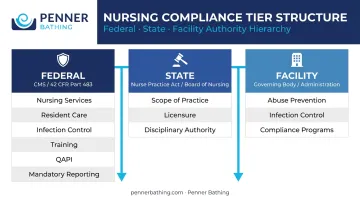
Compliance operates at three interconnected levels. Every nursing procedure should be mapped against all three, not treated as satisfying one at the expense of another.
| Tier | Governing Authority | Key Requirements |
|---|---|---|
| Federal | CMS, 42 CFR Part 483 | Nursing services, resident care, infection control, training, QAPI, mandatory reporting |
| State | Nurse Practice Act, Board of Nursing | Scope of practice, licensure, disciplinary authority |
| Facility | Governing body, administration | Abuse prevention policies, infection control, compliance programs |
One important boundary: 42 CFR Part 483 governs Medicare/Medicaid-certified SNFs and NFs. It does not automatically apply to assisted living facilities unless they carry federal certification. Assisted living nursing requirements are primarily state-specific.
Key Nursing Compliance Requirements
Licensure and Scope of Practice
Every nurse must hold an active, unencumbered license and practice strictly within the boundaries their state's Nurse Practice Act defines. Those boundaries differ by role — LPNs, RNs, and APRNs operate under distinct scope definitions — and crossing those lines is among the most common causes of Board of Nursing disciplinary action.
The National Council of State Boards of Nursing makes clear that Board rules have the force of law. "I didn't know" is not a defense.
Patient Privacy and Documentation
HIPAA requires nurses to handle protected health information with strict access controls, minimum necessary disclosures, and breach-notification protocols. Documentation obligations go further than privacy alone.
Under CMS F842 (§483.70(i)), clinical records must be complete, accurate, accessible, systematically organized, and authenticated. Regulators and courts interpret sparse or missing records as evidence that care was not provided. Every entry needs to be timely, objective, and tied to the resident's actual condition.
Credentialing, Background Screening, and Continuing Education
Facilities must verify education and licensure through primary sources — not self-reported credentials. Additional requirements include:
- Screen all employees monthly against the OIG's List of Excluded Individuals/Entities — the 2024 Nursing Facility Compliance Program Guidance flags that employing excluded persons who furnish federally reimbursed services creates payment risk and civil monetary penalties.
- Run background checks for findings involving resident abuse, neglect, or misappropriation under §483.12(a)(3).
- Complete continuing education in state-mandated topics — infection control, abuse prevention, and mental health are common renewal conditions.
- Maintain role-specific certifications; BLS/CPR is baseline, with specialized credentials varying by role and patient population.
Infection Control, Medication Safety, and Resident Safety
CMS F880 (§483.80) requires an infection prevention and control program covering routine cleaning and disinfection of resident-care equipment. This is distinct from F881, which governs antibiotic stewardship — surveyors audit equipment hygiene practices specifically under F880.
Resident hygiene intersects two separate F-tags:
- F677 requires that residents unable to perform ADLs receive necessary bathing and grooming services.
- F584 requires a safe, clean, comfortable, homelike environment.
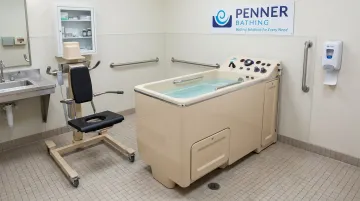
Bathing equipment plays a direct role in both F-tags. Penner Bathing's healthcare bathing systems — the Premier, Cascade, Pacific, and Contour series — incorporate BioCote® antimicrobial technology that continuously inhibits bacterial growth on surfaces for the lifetime of the unit, paired with automatic disinfection cycles on every model. Penner is clear that BioCote® supplements rather than replaces proper cleaning protocols. That combination of passive antimicrobial protection and automated disinfection gives facilities a more complete, documented hygiene process under F880 and F584 audits.
Mandatory Reporting
Nurses are mandated reporters. Under §483.12(c), federal reporting timelines are firm:
- 2 hours for alleged violations involving abuse or serious bodily injury
- 24 hours for other covered allegations
The Elder Justice Act (42 U.S.C. §1320b-25) imposes separate criminal reporting requirements to law enforcement, with civil penalties reaching $200,000 — or up to $300,000 when the failure exacerbates harm — plus possible federal program exclusion.
Failure to report is itself a compliance violation, regardless of whether the underlying incident caused harm. Facilities should treat timely reporting as a non-negotiable protocol — not a judgment call made after the fact.
The Role of a Compliance Nurse in Long-Term Care
A compliance nurse — sometimes titled nurse compliance officer — is the operational hub of a facility's regulatory accountability structure. The role is not purely administrative. It requires clinical knowledge, regulatory fluency, and the ability to function as a credible liaison during state and federal surveys.
Core Responsibilities
Day-to-day duties in a long-term care setting include:
- Tracking license and certification renewal dates for all clinical staff
- Reviewing documentation for completeness and accuracy under F842 standards
- Conducting internal audits and investigating complaints or incident reports
- Updating policies in response to regulatory changes
- Coordinating and delivering staff education on new or revised standards
- Serving as the primary contact during CMS or state health department surveys
The OIG's 2024 guidance recommends that the compliance officer have sufficient authority, resources, and direct access to the governing body. For larger chains, that officer belongs at the corporate level. Standalone facilities should designate a facility-level officer who reports to ownership or the governing body, with a clear reporting line that bypasses middle layers of administration.
When There Is No Dedicated Officer
Not every facility can support a dedicated compliance officer. Smaller nursing homes often distribute these duties across the Director of Nursing and charge nurses — a workable approach, provided accountability is explicit. Someone must own every renewal date, every audit cycle, and every policy update. Diffuse responsibility leads to gaps that surveyors find.
Nursing Compliance Training: Building an Effective Program
Start With a Risk-and-Role Analysis
Before designing curriculum, map the facility's highest-risk workflows — medication administration, fall prevention, resident hygiene, restraint use — to specific competencies by role. LPNs, RNs, CNAs, and per diem staff carry different scopes and different training requirements under §483.95.
CMS F726 is clear: training attendance alone does not establish competency. Performance-based evidence must be tied to the resident population and staff duties identified in the facility assessment (F838).
Build a Multi-Modal Curriculum
Passive video-only training produces unreliable retention. A virtual simulation randomized clinical study published in JMIR found a 20.4% improvement in knowledge retention and clinical reasoning compared to standard instruction. A scoping review of microlearning in health-professions education found positive effects on knowledge and confidence — though direct comparison to single annual LTC compliance sessions has not been formally tested.
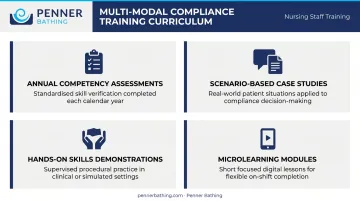
Effective programs combine:
- Annual competency assessments with demonstrated performance components
- Scenario-based case studies tied to the facility's actual incident history
- Hands-on skills demonstrations for high-risk procedures
- Short microlearning modules for policy updates and regulatory reminders
Onboarding vs. Ongoing Training
New-hire orientation must cover each of the following before a nurse touches a resident:
- Nurse Practice Act and scope-of-practice boundaries
- HIPAA requirements
- Mandatory reporting obligations
- Facility-specific policies and procedures
That foundation should not be rushed.
Ongoing training works best with spaced repetition — short, frequent refreshers rather than one annual marathon. A single all-day compliance session each year is more checkbox than education.
Trigger-Based Retraining
Compliance training should activate after:
- Adverse events or near misses
- Failed internal audits or survey findings
- Significant regulatory updates
- Documentation deficiencies identified in record reviews
Targeted refreshers following incidents address the actual gap while it is still relevant — far more effective than waiting for the next annual training cycle.
Verifying and Documenting Competency
Surveyor interviews will ask staff to demonstrate knowledge, not just produce certificates. Build your validation system around:
- Pre/post knowledge testing with passing thresholds
- Return demonstrations for hands-on skills
- Direct observation checklists
- Simulation debriefs with documented outcomes
Keep all competency validation records — they are your primary evidence when surveyors arrive.
Best Practices for Maintaining Nursing Compliance
Build Psychological Safety and Open Reporting
AHRQ defines Just Culture as balancing a nonpunitive learning environment with accountability based on behavior — not outcome. Staff who fear blame stay quiet about errors. That silence compounds risk.
A 2019 cross-sectional study of 1,152 staff across 41 nursing homes found that stronger perceived safety culture dimensions — including communication openness and nonpunitive response to error — were significantly associated with fewer falls and pressure ulcers. The design was associative, not causal, but the direction is consistent with what high-performing facilities actually do.
Practical mechanisms:
- Anonymous incident hotlines give staff a low-barrier way to report before they're comfortable going to supervisors directly
- Regular leader rounding keeps dialogue visible and ongoing, beyond formal reporting channels
- Incident reviews that clearly distinguish honest mistakes, at-risk behavior, and recklessness — so staff know accountability is fair
Conduct Regular Internal Audits and Mock Surveys
Risk-based internal reviews find gaps before surveyors do. JCI's 2024 Long-Term Care guide endorses tracer methodology for exactly this purpose. Structure mock surveys to replicate real conditions:
- Direct observation and documentation sampling under time pressure
- Staff interviews using the same question framing surveyors use
- Evidence retrieval drills to test how quickly staff can produce required records
Keep Communication Clear and Timely
Regulatory updates must reach nurses in plain, actionable language — not as policy document dumps. Use:
- Daily huddles to surface high-priority or time-sensitive changes before shifts begin
- Just-in-time reference cards that state what changed and what staff should do differently — in plain language
- Designated policy update owners responsible for translating regulatory changes into floor-level instructions
Track and Measure Compliance Performance
Monitor both leading and lagging indicators on shared dashboards, reviewed at least quarterly:
| Leading Indicators | Lagging Indicators |
|---|---|
| Training completion rates | Survey citations |
| Credential renewal status | Incident rates |
| Internal audit findings | Complaint trends |
| Near-miss reports | CMS quality measure scores |
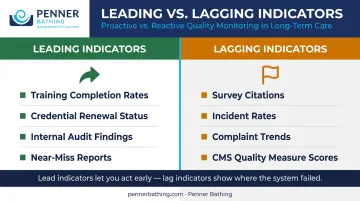
Leading indicators let you act before the problem reaches a surveyor. Lagging indicators tell you where last quarter's system failed.
Common Compliance Challenges in Long-Term Care Settings
System-Level Barriers
A 2021 Health Affairs study using Payroll-Based Journal data from 15,645 nursing homes found mean annual total nursing-staff turnover of approximately 128% (2017–2018 data). At that churn rate, compliance programs built around individual retraining cannot keep pace. Workarounds become normalized when staffing is thin and acuity is high.
Facilities must address root-cause system problems, not just retrain individuals after infractions:
- Chronic understaffing that forces shortcuts under pressure
- Inconsistent policy enforcement across shifts and units
- Inadequate onboarding for agency and contract staff
Documentation Gaps
Incomplete, vague, or auto-populated EHR entries remain frequent survey findings. Specific risks include:
- Copy-paste documentation: The Joint Commission identifies note bloat, internal inconsistency, and error propagation as direct hazards; policies, training, and monitoring are all recommended.
- Missing provider notification records: Undocumented calls are treated by surveyors as calls that never occurred, creating an immediate F-tag citation risk.
- Charting that does not match the resident's actual condition: This is the gap surveyors are specifically trained to catch.
Keeping Up With Regulatory Change
CMS does not update Part 483 on a fixed schedule: Appendix PP Rev. 225 was issued August 8, 2024. State Nurse Practice Acts and accreditation standards shift on their own timelines. Facilities that treat compliance as a once-a-year exercise will always be behind.
Assign clear ownership of regulatory monitoring before the next revision drops:
- Designate a compliance nurse, DON, or charge nurse to track the CMS revision page and state Board of Nursing updates
- Set a standing review cadence (monthly at minimum)
- Build a fast-track update process so changes reach practice within days, not months
Frequently Asked Questions
What is nursing compliance?
Nursing compliance refers to a nurse's and a facility's ongoing adherence to federal and state laws, professional standards, and facility policies governing safe, ethical patient care. It encompasses licensure, documentation, privacy, scope of practice, and mandatory reporting obligations.
What does a compliance nurse do?
A compliance nurse monitors regulatory adherence, coordinates staff training, conducts internal audits, manages incident reporting, and serves as the lead contact during state or federal surveys. In smaller facilities, these duties are often shared with the Director of Nursing.
What are examples of nursing compliance requirements?
Key examples include:
- Maintaining an active license within scope of practice
- Completing required continuing education
- Adhering to HIPAA privacy rules
- Following infection control protocols under F880
- Fulfilling mandatory reporting deadlines under §483.12(c)
- Meeting facility-specific credentialing requirements
What is another word for compliance in nursing?
Common related terms include regulatory adherence, standards of care, professional accountability, and practice standards. Each refers to the obligation nurses and facilities have to follow applicable laws, professional rules, and ethical guidelines in clinical practice.
What are the consequences of non-compliance in nursing?
Consequences can include:
- Board of Nursing disciplinary action (reprimand, suspension, or license revocation)
- CMS survey citations and deficiency findings
- Loss of Medicare/Medicaid certification
- Civil monetary penalties or civil liability
- Direct harm to resident safety and facility reputation
How often do nursing compliance requirements need to be renewed?
Renewal timelines vary by requirement:
- State licensure: renewal periods differ by state
- BLS/CPR: typically every two years
- Continuing education: resets each renewal cycle
- LEIE screening: OIG recommends monthly checks
- Background checks and competency validations: generally annual or per facility policy