These barriers carry real weight. According to KFF's 2024 analysis, roughly 17% of U.S. adults delayed or skipped needed care due to cost in the prior 12 months. In long-term care settings, the stakes are even higher: elderly and disabled residents often face several compounding barriers at once, and gaps in care can escalate quickly into serious health events.
This article breaks down the main types of barriers, what happens when they go unaddressed, and what facility administrators and healthcare leaders can do about them.
Key Takeaways
- Barriers to patient care span financial, geographic, staffing, language, physical, and cultural dimensions
- 17% of U.S. adults skipped or delayed care due to cost in 2024, with rates even higher among underinsured populations
- Unaddressed barriers lead to delayed diagnoses, preventable hospitalizations, and avoidable cost increases
- Early warning signs include missed appointments, staff complaints about tools, and patient grievances
- Solutions require a layered approach: policy, environment, staffing, and technology
What Are the Main Barriers to Patient Care?
The most widely used framework for understanding care access was developed by Penchansky and Thomas in 1981. Their five-category model — Affordability, Availability, Accessibility, Accommodation, and Acceptability — remains the clinical standard for identifying access gaps. Each dimension represents a distinct root cause that can independently delay or deny care.
Barriers operate at multiple levels simultaneously:
- Systemic — insurance gaps, reimbursement policy, workforce regulations
- Institutional — facility design, staffing ratios, available equipment
- Individual — language, mobility, health literacy, transportation access
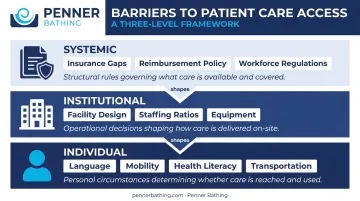
Long-term care environments are particularly vulnerable because they sit at the intersection of all three. Here's how each barrier type manifests.
Financial and Insurance Barriers
High out-of-pocket costs remain one of the most direct barriers. Among continuously insured but underinsured working-age adults, 57% avoided needed care due to cost in the past year. For elderly residents on fixed incomes, coverage gaps create difficult tradeoffs between prescriptions and specialist co-pays.
Medicare covers medically necessary skilled services but explicitly excludes several categories residents routinely need:
- Long-term custodial care
- Routine dental and vision services
- Hearing aids
- Many specialist referrals under certain plan types
When a resident's plan doesn't cover a referral, that referral often simply doesn't happen.
Geographic and Transportation Barriers
Rural access gaps are severe and well-documented. As of mid-2026, HRSA designates 9,003 primary-care shortage areas affecting 108.6 million people, with 92% of rural counties qualifying as primary-care Health Professional Shortage Areas.
Transportation makes the problem worse. A 2020 study estimated that 5.8 million Americans delayed care in 2017 due to lack of transportation — and adults with functional limitations faced 2.58 times the odds of transport-related delays compared to those without. For a nursing home resident needing specialist care hours away, geography alone can become the deciding factor.
Staffing Shortages and Provider Availability
The workforce gap is widening. AAMC's 2024 projections estimate a national shortage of 13,500 to 86,000 physicians by 2036. The shortfall is most acute in primary care and behavioral health — where the average wait for a new appointment now stands at 48 days nationally.
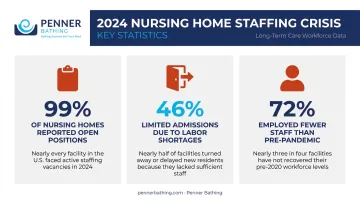
In long-term care specifically, the picture is stark:
- 99% of surveyed nursing homes reported open positions in 2024
- 46% were limiting admissions because of labor shortages
- 72% employed fewer people than before the pandemic
Understaffing doesn't just mean slower service. It means missed care events, reduced monitoring, and higher error rates — outcomes that fall hardest on residents who already have limited ability to self-advocate or self-manage.
Language, Literacy, and Communication Barriers
More than 22% of people age 5 and older in the U.S. speak a language other than English at home, according to 2017–2021 Census data. When patients and providers don't share a language, the consequences are clinical — medication errors, missed diagnoses, and patients who disengage from care rather than navigate confusion.
Low health literacy compounds this. Patients who don't fully understand discharge instructions, treatment plans, or consent forms are less likely to follow through — and less likely to return.
Physical and Environmental Barriers
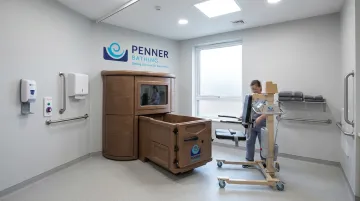
In long-term care and assisted living, the physical design of the care environment can itself become a barrier. Inaccessible bathing areas, lack of appropriate transfer equipment, unsafe flooring, and inadequate hygiene facilities all limit what care is possible — and create risk for both residents and staff.
For residents with mobility limitations, every element of the bathing environment matters: how they enter the unit, how they're transferred, and whether staff can assist safely without injury risk to either party. Purpose-built bathing systems — like those Penner Bathing has manufactured for long-term care facilities since 1980 — address these requirements directly, with features like height-adjustable transfers, bariatric capacity, and rail-free designs that reduce fall risk. The right equipment doesn't expand the care budget; it makes safe care delivery physically possible.
Bias, Stigma, and Cultural Barriers
Discrimination in healthcare has measurable consequences. In a 2023 KFF survey, 39% of LGBT adults said negative healthcare experiences made them less likely to seek care — compared to 15% of non-LGBT adults. Minority patients who perceive discrimination are significantly less likely to return to that provider.
At the facility level, disparities are built into how resources are distributed. Nursing homes with higher proportions of Black residents had 45% lower odds of offering an Alzheimer's disease special care unit compared to facilities with the lowest Black-resident share — a gap that reflects systemic inequity in care access.
What Happens When Barriers Go Unaddressed?
Unresolved access gaps don't stay contained. The consequences compound quickly:
- Delayed diagnoses become advanced disease by the time treatment starts
- Worsening chronic conditions require costlier, more intensive interventions
- Preventable hospitalizations increase — CMS research found that nearly 45% of hospitalizations among nursing-facility residents were avoidable
- Regulatory exposure grows as facilities face compliance scrutiny for missed care standards
The financial stakes are enormous. Deloitte's modeling estimates health inequities currently cost approximately $320 billion annually, with projected costs exceeding $1 trillion by 2040 if left unaddressed.
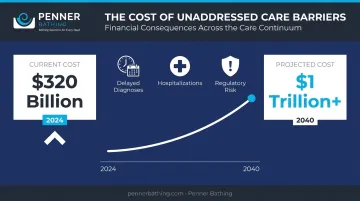
Catching these problems early — before they reach the financial or regulatory threshold — depends on knowing what to look for.
Warning Signs You're About to Experience a Breakdown in Care Access
Both systemic and facility-level barriers tend to show early signals before they become crises:
- Rising missed appointments or incomplete care plans — patients are failing to follow through, often because a logistical or financial barrier is blocking them
- Staff complaints about inadequate tools or unsustainable workloads — a frontline signal that equipment or staffing gaps are compromising care delivery
- Patient or family grievances about delays, confusion, or inaccessibility — indicating systemic issues in communication, environment, or cultural responsiveness
Each signal maps to a specific, addressable barrier. The earlier a facility identifies the pattern, the more options it has to intervene.
How to Address Barriers to Patient Care
No single fix resolves every access barrier. What works is a layered approach that matches interventions to root causes.
Expand Financial Assistance and Coverage Pathways
Financial counselors and Medicaid care coordinators, engaged at intake, can identify coverage gaps before they become crisis decisions for patients or families. Key pathways include:
- Connecting patients to sliding-scale programs and FQHC services — federally qualified health centers must provide a full discount for patients at or below 100% of the federal poverty guideline, with partial discounts up to 200%
- Applying for FQHC designation or partnerships if your facility serves underserved populations
- Re-evaluating coverage gaps during annual assessments, when patients begin delaying recommended care
This intervention has the most immediate impact during patient intake and at the first sign that a patient is deferring needed services.
Leverage Telehealth and Flexible Scheduling
Virtual care has real potential for overcoming geographic and scheduling barriers. SNFs using telemedicine surged from 5% in 2019 to 91% in 2020 — and high-use facilities saw a 20% relative increase in psychiatry visits compared to low-use facilities.
That said, telehealth isn't a universal solution. Adoption dropped to 61% by early 2022, and it showed no meaningful increase in new specialist visits overall. Implementation requires:
- Ensuring patients have device access and digital literacy support
- Integrating virtual visits into existing care workflows (not running them in parallel)
- Training staff to facilitate remote encounters for residents with cognitive or sensory limitations
Address Staffing Gaps Through Team-Based Care
Nurse practitioners, physician assistants, and community health workers extend care capacity without requiring proportional physician hiring. Rural primary-care NP presence grew from 17.6% to 25.2% of practices between 2008 and 2016. CHW programs have demonstrated a 30% relative reduction in hospital admissions with an ROI of $2.47 per $1 invested in at least one randomized trial.
Cross-training staff in:
- Culturally competent communication
- Interpretation support and multilingual materials
- Implicit bias awareness
...directly addresses the language and cultural dimensions of care access. Facilities that invest here see measurable improvements in patient trust, appointment adherence, and care plan follow-through.
Improve the Physical and Operational Care Environment
Facility administrators should conduct regular environmental audits focused on:
- Bathing and hygiene area accessibility
- Transfer equipment availability and condition
- Mobility aid storage and floor safety
- Staff ergonomic risks during patient-handling routines
Purpose-built bathing equipment plays a direct role in both resident safety and staff injury prevention. Penner Bathing's long-term care systems, for example, include height-adjustable transfer options and automatic disinfection designed for high-frequency use. For facilities serving bariatric populations, dedicated systems with 600 lb capacity address a gap that standard equipment cannot safely fill.
Partner with Community and Transportation Resources
Non-emergency medical transportation (NEMT) partnerships directly address the geographic and transportation dimension. Work with:
- NEMT providers for specialist and outpatient visits
- Community health organizations for home-based outreach
- Local Medicaid managed care plans, which often have NEMT as a covered benefit
Long-Term Strategies for Reducing Barriers in Care Settings
One-time interventions don't hold. Sustainable barrier reduction requires ongoing operational commitment — built into annual planning cycles, staff education, and equipment review processes rather than treated as a reactive fix.
Facilities that maintain consistent access practices tend to catch problems before they affect care quality. These four strategies provide a practical framework:
- Conduct periodic access audits — survey residents and families about barriers they face, and track utilization data for patterns that signal unmet needs. CMS's 2024 mandatory facility assessment framework — covering resident acuity, staffing competencies, contracted services, cultural factors, and technology — provides a strong structural model for annual review.
- Invest in ongoing staff training — build culturally competent care, implicit bias awareness, and communication standards into both onboarding and continuing education. Training improves provider knowledge, but organizational policy changes are what actually shift patient outcomes — so pair education with updated protocols and accountability measures.
- Document and monitor barrier-related incidents — missed care events, grievances, and near-misses tied to access issues create the documentation needed to justify infrastructure investment and meet regulatory requirements.
- Schedule equipment evaluations on a defined cycle — patient handling, bathing, and hygiene systems should be reviewed regularly to confirm they remain current, safe, and suited to the evolving needs of your resident population.
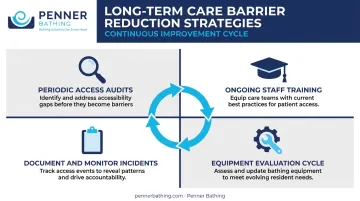
These strategies work because they embed accountability into standard operations. When access issues are tracked, trained around, and reviewed on schedule, gaps get addressed before they compound into systemic care failures.
Conclusion
Barriers to patient care are identifiable, driven by multiple factors, and — above all — addressable. Whether the obstacle is a coverage gap, a missing specialist, a language difference, or a bathing area that wasn't designed for residents who use wheelchairs, each barrier has a corresponding solution that can be implemented at the facility, organizational, or policy level.
The facilities that consistently deliver better outcomes treat barrier reduction as a standing operational priority, not a response to a complaint or a citation. That means sustained investment in:
- Regular audits to catch access gaps before they become citations
- Staff training on communication, mobility assistance, and cultural competency
- Equipment upgrades that match the actual needs of current residents
- Community partnerships that extend care beyond the facility walls
Facilities that commit to this ongoing work — rather than treating it as a one-time fix — see measurable results: fewer incidents, stronger survey outcomes, and care environments that residents and families trust.
Frequently Asked Questions
What is a barrier to patient care?
A barrier to patient care is any factor — financial, geographic, physical, linguistic, or cultural — that prevents or delays a person from receiving needed healthcare. The Penchansky and Thomas framework organizes these into five categories: Affordability, Availability, Accessibility, Accommodation, and Acceptability.
What are the biggest barriers to patient care?
The most commonly cited barriers include insufficient insurance coverage, provider shortages, lack of transportation, language and literacy gaps, and physical or environmental limitations in care settings. Most patients dealing with one barrier face several at once, compounding the difficulty of getting consistent care.
How do staffing shortages create barriers to patient care?
When facilities are understaffed, individual patients receive less frequent attention, appointment availability shrinks, and care aides become overburdened. With 46% of nursing homes limiting admissions due to labor shortages, the effect on access is direct and measurable.
What are examples of physical barriers to patient care?
Physical barriers include inaccessible building layouts, inadequate bathing or hygiene facilities for disabled or elderly patients, lack of mobility and transfer equipment, and insufficient space for assistive devices — all of which can delay or compromise care in long-term care settings.
How can long-term care facilities reduce barriers to patient care?
A combined approach works best:
- Conduct regular access and environment audits
- Train staff in culturally competent communication
- Partner with transportation and community organizations
- Invest in accessible equipment matched to your resident population's needs
Why is it important to identify warning signs of care barriers early?
Early identification — through patient feedback, missed appointment patterns, and staff reports — allows facilities to intervene before barriers escalate into adverse outcomes, compliance violations, or avoidable hospitalizations. Proactive monitoring is far less disruptive than responding to a crisis after the fact.