
Introduction
Most people agree that "good care" matters. Fewer can define it precisely, and fewer still can measure it. That gap between intention and practice is where patient harm happens — and where it often goes undetected longest.
The Institute of Medicine defines quality care as "the degree to which health services for individuals and populations increase the likelihood of desired health outcomes and are consistent with current professional knowledge." This means doing the right thing, for the right person, at the right time — and getting results.
That definition applies across care settings — hospitals, outpatient clinics, rehabilitation centers, and long-term care facilities. But in nursing homes and assisted living communities, where residents depend on consistent daily care for months or years, the stakes are especially high.
This post covers the six core domains of quality care, why they matter in long-term care settings, and what facilities can do to deliver on them.
Key Takeaways
- Quality patient care is defined by six domains: safe, effective, patient-centered, timely, efficient, and equitable
- HHS OIG found adverse events in 22% of short-stay SNF residents — 59% of which were judged preventable
- Poor care quality increases hospitalizations, staff burden, and family distrust — especially in long-term care
- CMS publicly reports nursing home quality through Care Compare, tracking inspections, staffing, and clinical outcomes
- In long-term care, quality extends to daily routines — including safe, dignified bathing — not just clinical treatment
What Is Quality Patient Care?
The Institute of Medicine identifies three distinct ways care can fall short — all three are considered failures:
- Overuse: providing care whose risks outweigh its benefits
- Underuse: failing to provide care that would genuinely help
- Misuse: preventable complications from otherwise appropriate care
A 2021 JAMA Network Open study found that an estimated 10%–20% of healthcare spending is low-value, and that over one-third of fee-for-service Medicare beneficiaries received at least one of 32 measured low-value services in 2018. More services do not equal better care.
How Quality Is Measured
Healthcare organizations track quality using three categories of measures:
| Measure Type | What It Tracks | Long-Term Care Example |
|---|---|---|
| Structure | Resources and systems available | Staffing levels, equipment, skill mix |
| Process | What providers actually do | Medication reviews, care plan completion |
| Outcome | Effect on patient health | Falls with injury, pressure ulcers, readmissions |
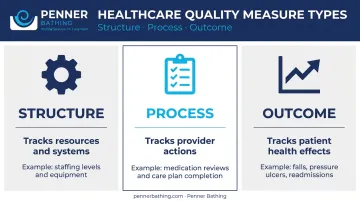
All three matter. Strong staffing (structure) does not guarantee good outcomes if processes are inconsistent. And outcomes need case-mix context to be interpreted fairly.
Patient Experience Is Part of Quality
Patient experience is a clinical concern, not a courtesy. Patients who understand their treatment, feel respected, and participate in decisions about their own health have measurably better outcomes. It's a core component of how AHRQ and CMS define and evaluate quality across all care settings.
The Six Domains of Quality Patient Care
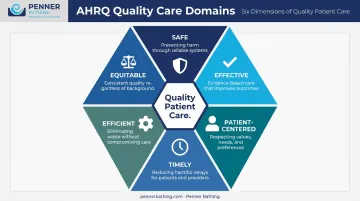
The Agency for Healthcare Research and Quality (AHRQ) defines healthcare quality through six domains. These serve as the national standard for evaluating care across all settings, including long-term care.
Safe
Safe care means protecting patients from harm caused by care itself — preventable infections, medication errors, falls, and avoidable complications. Safety is not just a baseline.
Standardized safety measurement has produced real results: AHRQ's national Hospital-Acquired Conditions scorecard documented a 13% decline in HACs from 2014–2017, with an estimated 20,700 lives saved and $7.7 billion in costs avoided. Long-term care facilities continue to lag behind acute-care settings on most safety indicators.
Effective
Effective care delivers services grounded in current evidence — and withholds services unlikely to help. This domain targets both underuse (failing to treat what should be treated) and overuse (intervening when the evidence doesn't support it).
Patient-Centered
Patient-centered care respects individual values, needs, and preferences, and actively involves patients and families in decisions. It encompasses communication, empathy, cultural responsiveness, and informed consent. A facility that dictates care without asking residents what they want is not delivering patient-centered care, regardless of clinical outcomes.
Timely
Timely care reduces delays that harm outcomes: waiting for a diagnosis, a medication, or a response to a changed condition. In long-term care, this also means prompt attention to daily physical needs, including repositioning, toileting, pain management, and hydration.
Efficient
Efficient care eliminates waste of time, supplies, and effort without sacrificing quality. Efficiency benefits facilities financially and reduces the burden on care staff. Resources lost to waste are resources taken from direct patient care.
Equitable
Equitable care delivers the same quality regardless of race, ethnicity, gender, age, language, disability, or socioeconomic background. A 2023 peer-reviewed analysis found that nursing homes serving vulnerable populations are less likely to earn quality bonuses and more likely to receive penalties — meaning quality payment programs can inadvertently remove resources from already disadvantaged facilities.
Why Quality Patient Care Matters in Long-Term Care
The Scale of Preventable Harm
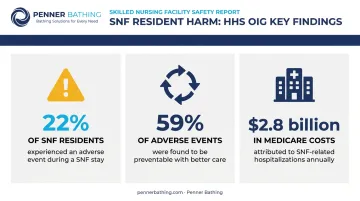
The HHS Office of Inspector General reviewed Medicare skilled nursing facility stays and found that 22% of residents experienced an adverse event — and another 11% experienced temporary harm. Reviewers judged 59% of all events preventable. Sixty percent of harmed residents were hospitalized, and adverse events contributed to deaths in an estimated 1.5% of cases.
The associated hospitalizations cost Medicare an estimated $2.8 billion in a single fiscal year.
Behind every statistic is a resident who was harmed during a stay intended to help them recover.
Long-Term Care Is Different
Unlike acute care, where patients recover and leave, nursing home and assisted living residents depend on consistent daily care for months or years. Quality in this context is not a single event — it is an ongoing commitment to every interaction, every shift, every routine.
Facilities that treat residents as individuals — involving them in care decisions, honoring their preferences, and coordinating across their care teams — see measurable differences:
- Reduced pain and faster functional recovery
- Higher resident satisfaction and mental well-being
- Fewer preventable hospitalizations
Regulatory and Reputational Consequences
CMS publicly reports nursing home performance through its Care Compare tool, using three domains: health inspections, staffing, and quality measures. Quality measures include fall-related major injuries, pressure ulcers, infection rates, antipsychotic medication use, and hospitalization rates — tracked separately for short-stay and long-stay residents.
A low star rating does not automatically trigger payment cuts, but it does create real consequences. Homes with persistent serious deficiencies can enter CMS's Special Focus Facility program, facing more frequent surveys and escalating enforcement. Documented noncompliance can lead to:
- Civil monetary penalties
- Denial of payment for new admissions
- Termination from Medicare in the most serious cases
For families choosing care for a loved one, a public quality rating is often the first thing they see.
Key Principles for Delivering Quality Patient Care
Prioritize Communication at Every Level
Care gaps — missed medications, undetected condition changes, preventable readmissions — often trace back to communication failures between providers, or between providers and patients.
The evidence is specific: a study of hospital-to-SNF admissions found medication discrepancies in 21.3% of medications reviewed, with at least one discrepancy in 71.4% of admissions. These are not rare edge cases. They are the predictable result of incomplete information transfer at transitions.
Communication quality matters inside facilities too. When staff don't share what they observe across shifts, conditions go undetected. When care plans aren't explained to residents or families, compliance suffers.
Coordinate Care Across Providers and Transitions
Care coordination is the deliberate organization of patient activities so that the right information reaches the right people at the right time. Hospital-to-SNF transitions are high-risk. A 2013 qualitative study identified poor discharge communication as the primary barrier to safe transitions, with gaps most common around:
- Medication reconciliation and dosing changes
- Pending diagnostic tests and outstanding results
- Follow-up appointments and care plan continuations
Federal regulation (42 CFR 483.21) requires a baseline care plan within 48 hours of SNF admission and a comprehensive person-centered plan involving the interdisciplinary team, the resident, and their representative. The regulation does not treat family involvement as optional — it requires documentation when participation is not practicable.
Engage Patients and Families as Partners
AHRQ's long-term care engagement framework treats residents and families as members of the facility safety team, not passive recipients of care. Practical approaches include:
- Regular care conferences with residents and family members present
- Clear, jargon-free explanations of treatment options and goals
- Open channels for feedback that are actually acted on
- Involving residents in daily decisions — schedules, preferences, routines
When residents feel heard and involved, they're more likely to follow care plans — and staff are quicker to catch changes they might otherwise miss.
The Role of Physical Environment and Daily Comfort in Care Quality
Quality in long-term care extends beyond clinical treatment to the physical environment where residents live every day. Hygiene routines, mobility support, and physical comfort are not peripheral concerns — they are direct expressions of a facility's care standards.
Consider bathing. Approximately 50% of nursing home residents fall each year, with about 10% of those falls causing significant injury. Standard bathing setups are among the highest-risk points in a resident's daily routine — involving transfers, wet surfaces, and mobility limitations all at once.
Research adds another dimension: a randomized study on person-centered bathing techniques found an 18.6% reduction in physical aggression and a 17.8% reduction in verbal aggression during bathing, along with a 30% decline in antipsychotic use. The bathing experience itself affects resident behavior, medication needs, and staff-resident interaction.
Purpose-built equipment addresses those exact risks. Penner Bathing designs healthcare bathing systems specifically for nursing homes and assisted living facilities, with features that target the real fall-risk mechanics of the bathing process:
- Rail-free spa configurations that reduce transfer obstacles
- Three-point access (left, right, and end-opening doors) for flexible caregiver positioning
- Height-adjustable transfer posts for resident stability
- Integrated transfer chair compatibility for smoother, safer transitions
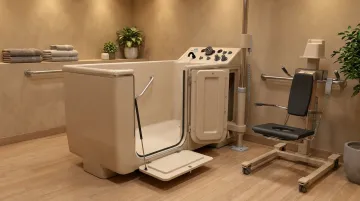
Beyond fall prevention, these systems are designed to preserve resident dignity. Neutral aesthetics, integrated dispensers, and clean spatial design make the bathing environment feel closer to a private bathroom than a clinical setting — which matters for residents who may already feel that institutional care has stripped away their sense of home.
Facilities that upgrade their bathing infrastructure see the impact in daily routines — fewer incidents, calmer interactions, and residents who feel their comfort was considered, not just their clinical needs.
Frequently Asked Questions
What is good quality patient care?
Good quality patient care is care that is safe, effective, patient-centered, timely, efficient, and equitable. It achieves the best possible health outcomes while respecting each patient's values and involving them in decisions about their own care.
What are the six domains of quality patient care?
The six domains — as defined by AHRQ — are safe, effective, patient-centered, timely, efficient, and equitable. These serve as the national standard for measuring and improving healthcare quality across all care settings.
How can healthcare providers ensure quality patient care?
Providers can follow evidence-based protocols, communicate clearly with patients and families, and coordinate care carefully during transitions between settings. Consistently measuring outcomes against established benchmarks helps identify gaps and sustain improvement over time.
Why does quality patient care matter in long-term care facilities?
Long-term care residents rely on consistent daily care over months or years, so quality is an ongoing commitment — not a one-time event. Gaps in that care carry real consequences: preventable hospitalizations, avoidable deaths, and harm to residents' dignity and safety.
How is quality of care measured in nursing homes?
CMS publicly reports nursing home quality through its Care Compare tool, evaluating facilities across health inspections, staffing levels, and quality measures such as fall-related injuries, pressure ulcers, infection rates, and hospitalization and emergency department use.