Introduction
Clinical outcomes get most of the attention in nursing homes, assisted living facilities, and hospitals — but patients and residents also have deeply personal views about how they want to receive care. Those views shape their daily experience in ways that satisfaction scores and readmission rates don't fully capture.
Patient care preferences cover everything from when a resident wakes up and bathes, to how much information they want about their condition, to whether they prefer quiet evenings or communal activities. When facilities treat these preferences as secondary to clinical tasks, the impact shows up directly in resident wellbeing, engagement, and quality of life.
This guide covers:
- What patient care preferences are and how they're defined
- Key frameworks (3 types, 5 P's, 4 C's) care teams use
- Why honoring preferences produces measurable outcomes
- The most common preferences in long-term care settings
- Practical methods for assessing, documenting, and meeting preferences
Key Takeaways
- Patient care preferences cover treatment choices, daily routines, communication styles, and physical environment
- A study of 163 nursing-home residents found preference satisfaction directly predicted overall care satisfaction
- Federal regulations (42 CFR 483.10 and 483.21) require preference documentation in person-centered care plans
- Bathing and privacy are among the highest-salience preferences for long-stay residents
- Structured tools like CAHPS surveys and the PELI inventory make preference-gathering consistent and reliable
What Are Patient Care Preferences?
AHRQ defines patient preferences as the views patients hold about how they want to receive and participate in care — covering interactions with professionals or systems, specific courses of action, and the priority they assign to different healthcare dimensions or outcomes. Examples include preferred communication methods, tolerance for side effects, medication frequency, and affordability concerns.
Preferences are shaped by a combination of:
- Personal values and cultural background
- Health literacy and past experiences with care
- Social determinants of health (SDOH)
- Current functional status and cognitive capacity
No two patients share the same preferences — and that variation is exactly what makes standardized care routines inadequate.
PROMs vs. PREMs: Two Distinct Measures
Understanding preferences requires distinguishing two types of patient-reported data:
- PROMs (Patient-Reported Outcome Measures) capture how patients feel about their health status — pain levels, mobility, fatigue, anxiety
- PREMs (Patient-Reported Experience Measures) capture how patients experience the care delivery process — communication quality, shared decision-making, respect, and coordination
Both matter. PROMs tell you whether a resident's health is improving; PREMs tell you whether the experience of receiving care aligns with what they actually want.
Why This Matters in Long-Term Care
In nursing homes and assisted living facilities, preferences extend well beyond treatment choices. Residents have strong views about:
- Daily schedules (when to wake, eat, bathe, sleep)
- Privacy during personal care
- Social engagement or time alone
- Physical comfort and pain management
The data reinforces how much this matters in practice:
- A national analysis of 536,989 long-stay residents found 43.5% belonged to a high-salience group — rating nearly every measured preference as important, challenging the assumption that most residents have only one or two strong priorities
- A separate 163-resident study found that daily-care preference satisfaction was a significant predictor of overall care satisfaction (B = 1.779, p < .001)
Key Frameworks: The 3 Types, 5 P's, and 4 C's of Patient Care
The Three Types of Patient Care
Most care settings organize services around three broad categories:
- Preventive care — maintaining health, reducing disease risk, and monitoring chronic conditions before they worsen
- Acute care — short-term, intensive treatment for urgent conditions, injuries, or sudden health events
- Long-term/chronic care — ongoing support for residents with persistent conditions or functional limitations
Most nursing home and assisted living residents fall in the third category. This matters for preference-honoring: long-term care residents aren't passing through — they're living there. Their preferences around daily rhythm, environment, and personal care carry the same weight as clinical preferences, because quality of life is the primary goal.
The 5 P's of Patient Care
The 5 P's framework gives care teams a structured approach to routine check-ins that proactively address common patient needs:
| P | What It Covers |
|---|---|
| Pain | Current pain level and comfort |
| Position | Body positioning and pressure relief |
| Personal needs | Toileting and hygiene assistance |
| Placement | Call light, water, and belongings within reach |
| Prevention | Fall risk and pressure ulcer monitoring |
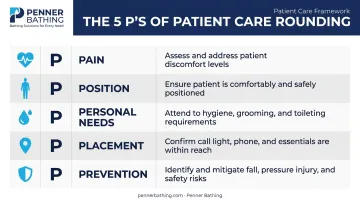
Originally developed as a hospital rounding tool by AHRQ, this framework is now used across acute and long-term care settings alike. Rounding with the 5 P's helps staff anticipate discomforts before they escalate — catching a repositioning need or an empty water cup before it becomes a complaint or a clinical event.
The 4 C's of Patient Care
The 4 C's describe the behavioral pillars that underpin patient-centered care delivery. While the NHS formally uses a Six C's framework (adding Care and Courage), the four most commonly cited in care team training are:
- Communication — actively listening to, documenting, and acting on patient preferences
- Compassion — acknowledging the emotional dimensions of receiving care, particularly in vulnerable moments like bathing or personal hygiene
- Competence — having the clinical and operational skills to honor preferences, not just the intention
- Commitment — following through consistently, not just during assessments or inspections
Each C translates into concrete daily actions. Good intentions mean little if a staff member lacks the skills to carry them out. Skills mean little if they're only applied during inspections. When all four are present consistently, residents stop bracing for inconsistency — and start expecting to be heard.
Why Patient Care Preferences Matter for Outcomes
Preference fulfillment connects directly to clinical, operational, and regulatory outcomes — and the evidence is specific enough to act on.
Clinical and Satisfaction Evidence
Research consistently links preference fulfillment to better resident experience. Beyond the satisfaction findings noted earlier, a separate study of 39 residents found that perceived choice correlated with satisfaction at r = .47 (p < .001) — with rigid schedules and policies most commonly associated with residents feeling they lacked control.
Person-centered care models that systematically honor resident preferences show measurable results. Green House model adoption — which combines private rooms, elder-directed routines, and redesigned staffing — was associated with:
- 5.5-percentage-point fewer 30-day readmissions
- 3.9-percentage-point fewer avoidable hospitalizations
- $7,746 lower annual Medicare Part A and hospice spending per resident
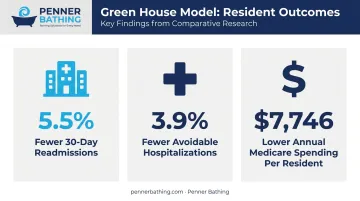
These are bundled-model results; preference alignment alone didn't produce them. They do indicate what's possible when facilities restructure around resident priorities — and federal regulations make that restructuring a requirement, not a choice.
Regulatory Requirements
Preference documentation isn't optional. Federal regulations establish clear requirements:
- 42 CFR 483.10 protects resident rights to self-determination regarding activities, schedules, healthcare, and other significant aspects of facility life
- 42 CFR 483.21 requires a person-centered comprehensive care plan developed with the resident, reflecting their goals and desired outcomes
Surveyors and accrediting bodies incorporate these requirements into quality evaluations. Facilities that approach preference documentation as a compliance checkbox — rather than an active practice — face survey exposure and the downstream reputational damage of low satisfaction scores.
Operational and Financial Implications
Facilities that consistently fail to meet resident preferences face lower retention, harder family referrals, and increased survey scrutiny. One Ohio study covering 1,300 nursing-home-year observations found that complete implementation of the PELI preference inventory was associated with a 6-percentage-point greater probability of achieving a 4- or 5-star CMS deficiency rating — a direct link between preference practice and public quality standing.
Common Patient Care Preferences in Long-Term Care Settings
Long-stay residents express strong, consistent preferences across several domains. These preferences sit at the center of quality of life, not the edges of it.
Daily Routine and Schedule
National MDS data shows that among high-salience residents, the modeled probability of rating bedtime choice as important was .99, and bath-type choice was .98. Waking and sleeping on one's own schedule, eating at preferred times, and choosing how to start the day all preserve the sense of autonomy that institutional life often erodes.
Care plans should document and protect these rhythms rather than bending them to fit shift schedules.
Privacy and Dignity During Personal Care
Bathing and grooming assistance are among the most sensitive care interactions. Residents often feel physically and emotionally vulnerable during these moments, making the physical environment and staff approach equally important.
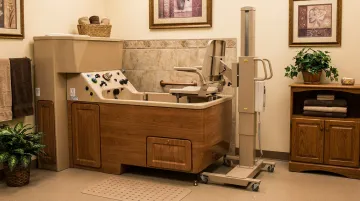
Care settings that invest in purpose-built bathing environments signal respect for resident dignity. Equipment designed for this context — rather than adapted from general use — makes a practical difference. Key features that support dignified bathing care include:
- Fast-fill reservoir technology that reduces the time residents spend waiting in a vulnerable position
- Bariatric-capacity options and height-adjustable transfer posts that accommodate a range of physical needs safely
- Textured, home-like finishes that move away from a clinical white aesthetic and can reduce resident anxiety
Penner Bathing, a Nebraska-based manufacturer serving long-term care facilities since 1980, builds systems specifically around these requirements across 38+ models.
A foundational nursing home trial found that person-centered bathing techniques (adjusted showering approach and towel bath method) reduced aggressive incidents during bathing by 53% and 60% respectively — underscoring how much the approach to bathing affects resident experience.
Social and Environmental Preferences
Not all residents want more social engagement. National data shows:
- 27.2% of long-stay residents are socially engaged, with a high modeled probability (.92) of valuing group activities
- 20.6% are socially independent — preferring quieter, more private arrangements
Care plans should reflect these differences. Assuming that group activities benefit all residents equally leads to either over-scheduling introverted residents or leaving socially engaged ones under-stimulated.
Pain Management and Physical Comfort
18% of residential care community residents have a documented arthritis diagnosis, and pain prevalence estimates among nursing home residents with dementia range from 8.6% to 79.6% depending on measurement method. Many residents live with chronic musculoskeletal conditions that affect every bathing, positioning, and mobility interaction.
Preferences around pain management — whether a resident prefers heat application, repositioning, specific pain medication timing, or therapeutic bathing — should be assessed and written into care routines, not assumed.
Communication and Information Preferences
Residents vary considerably in:
- How much detail they want about their diagnosis and care plan
- Whether they prefer verbal explanations, written summaries, or family-mediated communication
- Who they want involved in care decisions
Documenting these preferences prevents mismatches — like over-explaining to a resident who finds it distressing, or under-communicating with one who values detailed information.
How to Assess and Document Patient Preferences
Formal Assessment Methods
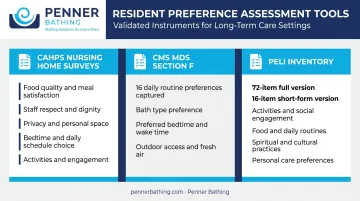
Several validated tools are available for structured preference-gathering:
- CAHPS Nursing Home Surveys — cover food and mealtimes, staff respect, privacy during dressing and bathing, choice of bedtime and clothes, and activity availability
- CMS MDS Section F — records 16 daily-routine and activity preferences including bath type, bedtime, snack preferences, outdoor access, and religious practice
- PELI (Preferences for Everyday Living Inventory) — a validated 72-item tool covering social contact, personal development, leisure, living environment, and daily routine. Its 16-item version aligns directly with MDS Section F
For research or program evaluation, discrete choice experiments (DCEs) can quantify how much weight residents place on specific care attributes — though these are better suited to population-level planning than individual care planning.
Informal Preference-Gathering
Formal assessments capture a snapshot — but preferences evolve, and some residents open up more in conversation than in structured interviews.
Training staff to note preference-relevant observations from daily interactions — mealtimes, activities, care handoffs — builds a richer, more current picture of each resident's priorities. A resident who mentions disliking morning showers in passing has given the care team actionable information worth recording.
Documentation That Actually Works
Collecting preferences means little if that information stays on an intake form. Effective documentation requires:
- Recording preferences in the care plan in accessible language, not just intake forms
- Sharing findings across all shifts and all care team members — not just the admissions coordinator
- Revisiting preferences regularly, since health changes, seasonal shifts, and new relationships all affect what residents want
These requirements are increasingly codified in formal standards. Canadian standard CAN/HSO 21001:2023 explicitly requires that individualized care plans address resident goals, needs, and preferences — and that staff consult residents before tests or interventions, not just at admission.
Frequently Asked Questions
What are patient care preferences?
Patient care preferences are the specific values, priorities, and conditions patients want in their healthcare experience, covering how they interact with providers, what treatments they choose, and which aspects of care matter most to them personally. They span clinical decisions, daily routines, and environmental factors.
What are the three types of patient care?
The three types are preventive care (maintaining health and avoiding illness), acute care (treating immediate or urgent conditions), and long-term or chronic care (ongoing support for residents with persistent conditions or functional limitations). Most nursing home residents fall into the third category.
What are the 5 P's of patient care?
The 5 P's are Pain, Position, Personal needs, Placement, and Prevention. Care teams use this structured rounding framework to proactively check in with patients and address common discomforts before they require more intensive intervention.
What are the 4 C's of patient care?
The 4 C's are Communication, Compassion, Competence, and Commitment — behavioral principles that guide patient-centered care delivery. Together, they help care teams move from knowing resident preferences to consistently honoring them in practice.
How do you assess patient care preferences in a long-term care facility?
Preferences can be gathered through structured admission assessments, standardized tools like CAHPS Nursing Home surveys and the PELI inventory, staff observations during daily care, and regular care plan reviews. Findings should be documented and shared across the full care team — not siloed in admissions records.
Why is respecting patient preferences important for health outcomes?
When preferences are honored, residents cooperate more readily with care routines, report greater satisfaction, and experience better quality of life. Facilities also see stronger retention, improved survey ratings, and reduced hospitalization rates as a result.