Introduction
Missing the right tools creates a genuine patient safety risk. AHRQ research found that hospital nurses encountered roughly one operational failure per hour, including broken equipment and missing supplies, with workarounds that often shifted risk elsewhere rather than eliminating it.
Gaps in your kit translate directly into slower assessments, missed clinical findings, and greater infection exposure — for you and your patients.
This guide breaks nursing equipment into four clear categories: clinical assessment tools, patient care and safety supplies, personal organizational gear, and long-term care-specific equipment. Whether you're a nursing student building your first kit or an experienced nurse moving into a new care setting, this list gives you a practical baseline to build from.
Key Takeaways
- Core tools — stethoscope, penlight, blood pressure monitor, pulse oximeter, scissors — apply across nearly every nursing setting
- PPE requirements vary by setting; most is employer-supplied, but knowing where it's stored and carrying extras matters
- Long-term care nurses need mobility, transfer, and hygiene equipment beyond what acute care requires
- 75% of residential care community residents need bathing assistance, making therapeutic bathing systems a clinical necessity for long-term care staff
- Comfort items like compression socks and supportive footwear are equipment, not accessories
What Is Nursing Equipment and Why Does It Matter?
Nursing equipment covers every device, tool, supply, and protective item nurses use to assess patients, deliver care, maintain safety, and document accurately — across all healthcare settings.
The consequences of equipment gaps are concrete: delayed diagnoses, assessment errors, infection exposure, and reduced patient safety. Federal regulations reflect this reality. CMS requires hospitals to maintain facilities and equipment at an acceptable level of safety and quality under 42 CFR 482.41(c)(2), with similar requirements for nursing facilities under 42 CFR 483.90(d)(2).
Nursing equipment is not universal. An ICU nurse's toolkit looks nothing like what a pediatric home health nurse carries — or what a long-term care nurse reaches for daily. Knowing your care setting is the starting point for building the right kit.
Clinical Assessment and Diagnostic Equipment
These are the instruments nurses use to gather objective data during initial assessments, routine monitoring, and head-to-toe evaluations.
Stethoscope
The stethoscope is the single most essential diagnostic tool in nursing. It's used to assess heart sounds, lung sounds, and bowel sounds across every patient encounter.
What separates a good stethoscope from a mediocre one comes down to acoustic clarity, durable tubing, and comfortable ear tips. Price is a reasonable proxy for quality:
| Model | Best For | Approximate Price |
|---|---|---|
| Littmann Lightweight II S.E. | Nursing students, LPNs, LVNs | ~$57 |
| Littmann Classic III | General wards, clinics, urgent care | ~$110–$117 |
| Littmann Cardiology IV | ED, ICU, cardiac environments | ~$199–$235 |
| Welch Allyn Harvey Elite | Full cardiology/pulmonology | ~$230 |
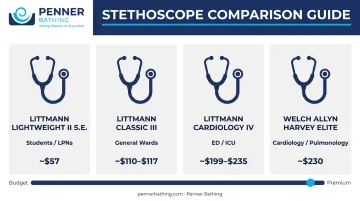
Research the right model for your specialty before purchasing — a cardiology stethoscope in a pediatric home health role is overkill; a lightweight model in a cardiac ICU is insufficient.
One practical note: stethoscopes disappear in busy clinical settings. Engrave or tag yours with your name before your first shift.
Vital Signs Monitoring Tools
This subcategory covers the equipment that establishes and tracks baseline health status:
- Blood pressure monitors (sphygmomanometers) — manual and automated, depending on setting
- Thermometers — oral, tympanic, and temporal artery types are all common
- Pulse oximeters — measure blood oxygen saturation and pulse rate; especially critical in nursing homes, ICUs, labor and delivery, and home health settings
On pulse oximeters specifically: the FDA recommends accuracy within 3.0% Arms for standard sensors. Readings can be affected by poor circulation, skin pigmentation, nail polish, and tobacco use. Any reading that conflicts with clinical symptoms warrants further assessment rather than automatic acceptance.
Most facilities provide bedside or portable vital signs equipment. Home health and community nurses often need personal portable units.
Examination Tools
Two simple tools pull more weight per shift than their size suggests:
- Penlights — used to assess pupil response, inspect the oral cavity and throat, examine wounds, and provide task lighting without waking sleeping patients; a clip-on penlight in your scrub pocket is among the most-used tools per shift
- Tongue depressors — disposable and essential for oral and throat examinations; stocked by virtually all facilities
Patient Care, Safety, and Personal Nursing Supplies
This category covers everything nurses use to deliver hands-on care, protect against infection, manage clinical tasks, and stay functional across long shifts.
Personal Protective Equipment (PPE) and Infection Control
PPE is non-negotiable. Core items include:
- Disposable gloves (correct sizing matters — poorly fitted gloves compromise dexterity)
- Surgical masks and N95 respirators
- Face shields for aerosol-generating procedures
- Isolation gowns
- Shoe covers when indicated
CDC guidance notes that healthcare workers may clean their hands up to 100 times per shift. That frequency takes a toll: a 2022 systematic review found that handwashing at least 8–10 times daily was associated with hand eczema (RR 1.51). Carry a facility-approved hand moisturizer compatible with your gloves and sanitizer — it's a legitimate part of your kit, not an indulgence.
Under OSHA's Bloodborne Pathogens Standard, employers must provide required PPE at no cost. Know your facility's storage locations, and if you work in home or community settings, carry a personal supply of extras.
Wound Care, IV, and Clinical Supplies
A few essentials deserve specific attention:
- Bandage scissors or trauma shears — cut tape, dressings, and clothing during emergencies; label your personal pair, they're easy to lose mid-shift
- Pocket reference cards (vital sign ranges, lab draw order, EKG rhythms, drug interactions) — keep them current; outdated reference material is its own category of risk
- Clinical consumables (syringes, IV tubing, saline flushes, alcohol pads, tourniquets) — employer-provided in most settings; your responsibility is proficiency, not procurement
Personal and Organizational Nursing Supplies
The items that keep you functional across a 12-hour shift:
- Waterproof nurse-grade watch with a second hand (for timing respirations and pulse)
- Clipboard or foldable clipboard for bedside documentation
- Pocket notebook for real-time notes during assessments and handoffs
- Durable nursing bag with multiple compartments and washable materials
On footwear: this isn't optional. A cross-sectional study at a Korean university hospital found varicose vein prevalence among nurses at 16.18%, and NIOSH-authored research linked prolonged standing to lower-back pain, muscle pain, leg swelling, and fatigue. Treat supportive footwear and compression socks as clinical investments — because that's exactly what they are.
Nursing Equipment for Long-Term Care and Assisted Living Settings
Long-term care nursing shifts the equipment focus away from acute intervention toward daily routines built around mobility, comfort, hygiene, and resident dignity. The tools required here are purpose-built for those routines — not adapted from acute care.
Patient Transfer and Mobility Equipment
OSHA reported a musculoskeletal disorder rate of 166.3 per 10,000 workers for nursing assistants — more than five times the all-industry average. Safe patient handling equipment isn't optional; it's a staff injury prevention imperative.
Core mobility and transfer equipment in LTC settings includes:
- Wheelchairs and walkers for ambulatory and semi-ambulatory residents
- Transfer belts for safe repositioning
- Mobile transfer chairs — wheeled, height-adjustable, with safety belts
- Ceiling-mounted and overhead patient lifts for residents with limited or no weight-bearing capacity
- Stretchers for non-ambulatory transfers
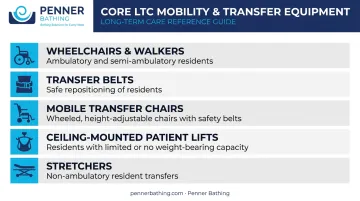
Every piece of this equipment directly protects both residents and nursing staff.
Therapeutic Bathing Systems
CDC data shows that 75% of residential care community residents required assistance with bathing in 2022. In a facility where bathing is a daily, high-volume care activity, the equipment used for that task directly determines care quality, infection risk, and staff efficiency.
Purpose-built therapeutic bathing systems address problems that standard tubs simply can't: cross-contamination between residents, physical strain on caregivers during transfers, and the time burden of manual disinfection between baths.
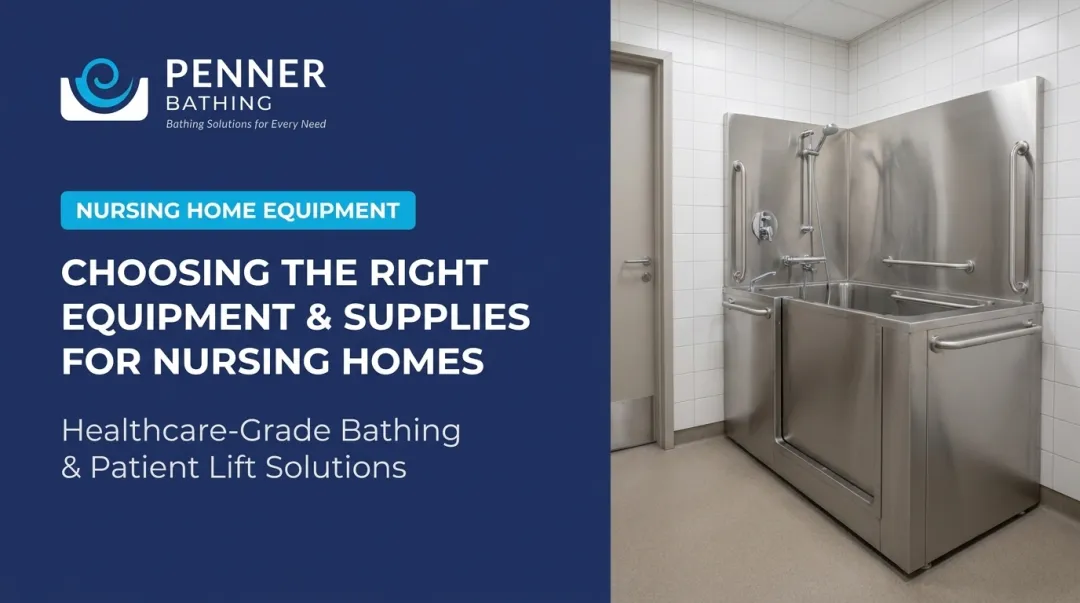
Penner Bathing manufactures a full range of UL-listed healthcare bathing systems built specifically for long-term care and assisted living facilities. Key features relevant to nursing staff include:
- Automatic disinfection — consistent between every resident use, reducing healthcare-associated infection risk without relying on manual cleaning routines
- Fast-fill reservoirs — reducing turnaround time between resident baths without compromising care quality
- Integrated transfer systems — height-adjustable mobile chairs rated up to 400 lbs standard and 600 lbs for bariatric models, with optional integrated scales
- Multiple entry configurations (left, right, and end-opening) — matching the system to the facility's existing room layout rather than the reverse
- 38+ models including recumbent and bariatric options to accommodate the full range of resident acuity
For nursing staff, the automatic disinfection cycle removes a time-intensive manual task and shifts hygiene compliance from individual staff to the system itself. In facilities with high caregiver turnover, that shift is practical: consistent infection control no longer depends on remembering a protocol at the end of a long shift.
How to Build and Maintain Your Nursing Equipment Kit
Starting Your Kit
Begin with universally essential items, then layer in setting-specific tools based on what your employer provides:
- Confirm employer provisions first — facilities supply most clinical equipment (BP monitors, IV supplies, PPE). Avoid duplicating what's already available.
- Purchase your personal essentials — stethoscope, penlight, watch, bandage scissors, compression socks, and supportive footwear.
- Add setting-specific items — home health nurses may need portable vital signs equipment; LTC nurses should understand what mobility and transfer tools are available on their unit.
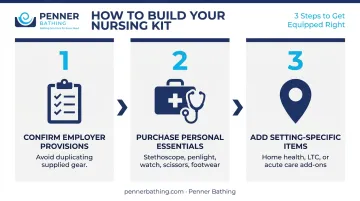
Once you've assembled the basics, keeping them functional matters just as much as the initial purchase.
Maintaining Your Kit
Gear wears down faster than most nurses expect. Audit your kit at the start of each new position and at least once a year:
- Stethoscopes lose acoustic quality over time, as tubing cracks and ear tips wear down with regular use
- Scissors dull with regular use
- Reference cards become outdated as protocols and drug information change
- PPE supplies in a personal bag need rotation to stay within expiration dates
Common Mistakes to Avoid
- Buying advanced or specialty tools before confirming what the employer provides
- Choosing based on brand recognition rather than clinical fit for your specialty
- Underestimating comfort-focused items — compression socks and supportive footwear reduce fatigue and injury risk across years of long shifts
Frequently Asked Questions
What equipment is needed for a nurse?
Core nursing equipment includes a stethoscope, penlight, watch with a second hand, bandage scissors, clipboard, PPE, and vital signs monitoring tools. Compression socks and supportive footwear are standard necessities, not afterthoughts. Additional tools vary by clinical setting and what the employer provides.
What is the most important piece of equipment for a nurse?
The stethoscope is the most essential individual tool a nurse carries. It enables assessment of heart, lung, and bowel sounds across virtually every nursing setting and specialty — no other single item gets as much consistent use across a shift.
What tools do nurses use in long-term care facilities?
LTC nurses use standard assessment tools alongside mobility and transfer equipment — including walkers, transfer belts, lift systems, and mobile transfer chairs — plus hygiene-focused tools like therapeutic bathing systems designed to support resident dignity, infection control, and daily care routines.
What PPE do nurses typically need?
Core PPE includes disposable gloves, surgical masks, N95 respirators, face shields, isolation gowns, and hand sanitizer. Requirements vary by setting and patient population. Most PPE is employer-supplied under OSHA's Bloodborne Pathogens Standard, but nurses in home or community settings should carry personal supplies.
What is the difference between employer-provided and personal nursing equipment?
Facilities typically supply clinical equipment — IV supplies, BP monitors, pulse oximeters, PPE, and syringes. Nurses are generally expected to own personal items: stethoscope, watch, bandage scissors, penlight, compression socks, and supportive footwear. Check your employer's provided-items list before buying anything to avoid paying for gear that's already covered.