Introduction
The U.S. home healthcare industry has grown steadily for over a decade, and the trajectory shows no signs of reversing. According to the Bureau of Labor Statistics, employment for home health and personal care aides is projected to grow 17% from 2024 to 2034 — nearly four times the average for all occupations. Behind that number: an aging population, a widespread preference for staying home over institutional care, and long-term care systems under chronic capacity strain.
The people entering this business come from different directions. Some are retired nurses or experienced caregivers who know the work firsthand. Others are entrepreneurs drawn to predictable demand, recurring revenue, and meaningful community impact. Both groups can succeed — but the path requires a clear-eyed understanding of licensing, staffing, and operational realities before the first client is ever admitted.
This guide covers all 14 steps, from selecting your agency type and navigating state licensure to building your care team, generating referrals, and scaling sustainably. Each step builds on the last — skip one, and it tends to surface as a problem later.
Key Takeaways
- Home healthcare agencies follow two distinct tracks — medical or non-medical — each with separate licensing, staffing, and billing requirements.
- State licensing alone can take 3 to 12 months; plan your timeline and cash reserves accordingly.
- Caregiver turnover reached 79.2% in 2023 — a retention strategy is a direct financial priority, not an afterthought.
- Your referral network — discharge planners, physicians, and social workers — will drive more clients than any marketing channel.
- The 14 steps below are sequenced deliberately — skipping phases creates compounding problems later.
What Is a Home Healthcare Agency?
A home healthcare agency sends trained professionals — licensed medical staff or certified caregivers — to provide care services to clients in their own homes or residential settings.
There are two fundamentally different models:
| Agency Type | Services | Staff Required | Common Payers |
|---|---|---|---|
| Medical Home Health | Skilled nursing, wound care, physical/occupational therapy | Licensed clinicians (RN, PT, OT) | Medicare, Medicaid, insurance |
| Non-Medical Home Care | Personal care, companionship, meal prep, transportation | Home care aides, CNAs | Private pay, Medicaid waivers |
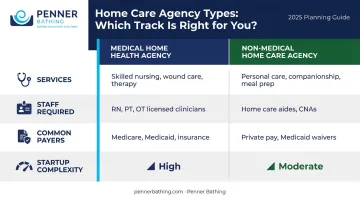
These two tracks carry different licensing paths, staffing credentials, billing systems, and startup costs. Choosing the wrong model for your resources and market is one of the most common early mistakes.
That model choice shapes everything downstream — who you serve, how you staff, and how you get paid. Agencies typically work with:
- Seniors aging in place or transitioning from hospital care
- Adults with disabilities requiring daily assistance
- Post-surgery patients needing short-term skilled support
Payment sources include private pay, Medicare, Medicaid, long-term care insurance, and VA programs. Each combination of client population and payer type demands its own operational setup.
What to Know Before You Start
Most people entering this industry underestimate three things: regulatory complexity, timeline, and the gap between business launch and the first paying client.
Regulatory Reality
- State licensing typically takes 3 to 12 months
- Medicare/Medicaid certification adds additional months on top of that
- Some states have Certificate of Need (CON) requirements or moratoriums that can block entry entirely
Early-Stage Workload
Most agency owners handle scheduling, compliance, hiring, and marketing simultaneously before they can afford dedicated staff. This is not a passive income model in year one.
Clinical vs. Operational Skills
You do not need a clinical background to run a non-medical home care agency. You do need strong organizational discipline, hiring judgment, and a working knowledge of your state's regulatory requirements. The business runs on operational management, not bedside skill.
Building compliance and staffing infrastructure before chasing clients is what separates agencies that stabilize from those that close in year one.
Why Start a Home Healthcare Agency?
This is a market with real, durable demand — not a trend. AARP's 2024 survey found that 75% of adults 50+ want to remain in their current homes as they age. Meanwhile, HHS research estimates that approximately 56% of Americans turning 65 will develop a disability serious enough to require long-term services and supports.
The conditions that make this business viable:
- The senior population will keep growing for decades, making demand structural rather than cyclical
- Startup costs are far lower than opening a residential care facility
- Revenue can come from multiple sources: private pay, Medicare, Medicaid, VA programs, and long-term care insurance
- Clients typically require ongoing services for months or years, creating recurring revenue
- Caregiver quality and reliability are genuine competitive advantages in most local markets
Agencies that fail typically do so by underpaying caregivers, underpricing services, or skipping compliance steps. The 14 steps below are designed to help you avoid those mistakes and build on a foundation that holds.
How to Start a Home Healthcare Agency: 14 Steps
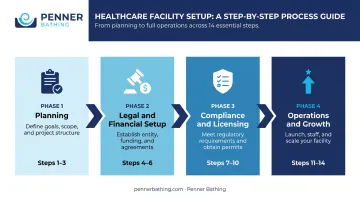
The steps below are grouped across four phases: planning, legal and financial setup, compliance and licensing, and operations and growth. Rushing any phase creates downstream problems.
Phase 1: Planning
Step 1 – Understand the Market and Identify Your Niche
Before writing a business plan, research your local market:
- What is the senior population size in your target area?
- How many agencies already operate there, and what do they offer?
- Are there geographic or demographic gaps — underserved zip codes, specific populations (dementia care, pediatric, post-surgical)?
Your niche will shape pricing, staffing, marketing, and which referral sources matter most. Choosing too broad a scope early spreads resources thin. Choosing a clear niche lets you build expertise and reputation faster.
Step 2 – Choose Your Agency Type (Medical vs. Non-Medical)
This single decision shapes every downstream step:
- Medical home health agency: Requires licensed clinical staff, Medicare/Medicaid certification, and a longer licensing runway, but accesses broader payer types
- Non-medical home care agency: Lower barriers to entry, personal care focus, primarily private pay. Faster to launch, but more dependent on private-pay volume
If you have limited capital and no clinical background, non-medical is the more accessible starting point. If your goal is Medicare billing and skilled services, build in significantly more time and funding.
Step 3 – Write a Business Plan
A solid business plan covers:
- Target client population and services offered
- Pricing model and projected break-even timeline
- Startup cost estimates and funding sources
- Marketing and referral strategy
- Operational structure and key hires
This document is required for loan applications and serves as your decision-making anchor when the business faces trade-offs (and it will).
Phase 2: Legal and Financial Setup
Step 4 – Choose a Legal Business Structure
The four main options:
- Sole proprietorship — simplest, but no liability separation
- Partnership — shared ownership, shared liability
- LLC — most common choice for home care agencies; liability protection, tax flexibility
- Corporation — more complex, better for larger operations or outside investors
Most agencies start as LLCs. Given that your employees will enter clients' homes, liability protection is not optional. Consult a lawyer or CPA before deciding.
Step 5 – Register Your Business and Obtain an EIN
- File formation documents with your state's Secretary of State
- Apply for a Federal EIN through the IRS (free, available online at irs.gov)
- Register for local business licenses as required
- Check whether a DBA filing is needed
Your EIN is required for licensing applications, banking, payroll, and insurance. Complete this early — other steps depend on it.
Step 6 – Secure Startup Funding
Startup costs vary widely by state licensing fees, insurance requirements, staffing, and whether you pursue Medicare/Medicaid certification. No single national figure applies. What is verified:
- Washington state charges $5,000 per service category for an initial 12-month license; Illinois fees start as low as $25 for some HHA categories
- Medicare-certified agencies must submit a surety bond to CMS: at minimum $50,000 in coverage under 42 CFR 489.65 (bond coverage, not a direct cash outlay)
Funding sources:
- Personal savings
- SBA 7(a) loans (up to $5M) or SBA Microloans (up to $50,000)
- Business lines of credit
Note: The SBA does not provide grants for starting a for-profit business. Plan your budget to cover at least 6 to 12 months of operating expenses before revenue stabilizes.
Phase 3: Compliance and Licensing
Step 7 – Obtain State Licensure
Home healthcare is regulated at the state level, and requirements vary widely. Most states require a home care or home health agency license issued by the Department of Health. The typical process includes:
- Application submission with all required documentation
- Criminal background checks on owners and key personnel
- Proof of insurance
- Policies and procedures review
- In some states, an on-site survey
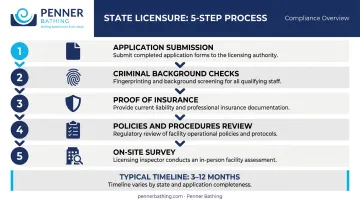
Budget for a 3 to 12 month approval timeline. Some states — including Georgia, Hawaii, Kentucky, Maryland, Mississippi, New Jersey, New York, North Carolina, Tennessee, Vermont, Washington, and D.C. — require a Certificate of Need (CON) for home health agencies. CON requirements can significantly limit or delay entry. Research your specific state's requirements before committing to a timeline.
Step 8 – Pursue Medicare and Medicaid Certification (If Applicable)
Only agencies planning to bill Medicare or Medicaid for skilled services need federal certification. This is separate from state licensure. The process:
- Meet Conditions of Participation under 42 CFR Part 484
- Submit CMS-855A through the PECOS system
- Complete a state survey agency or CMS-approved accreditor survey
- Receive CMS approval and a Medicare billing number
This process adds months to your timeline and significant cost. It is not required for private-pay non-medical agencies.
Step 9 – Secure Insurance and Bonding
Core policies every agency needs:
- General liability — protects against third-party bodily injury or property damage
- Workers' compensation — required in most states upon first hire
- Professional liability (E&O) — covers claims of negligent care or service failure
- Fidelity bond — builds client trust, especially for in-home workers
Most states require proof of insurance before issuing a license. Start the insurance process at least 30 days before applying.
Step 10 – Create a Policies and Procedures Manual
State licensing applications typically require a written P&P manual covering:
- Client intake and care planning
- Caregiver hiring, screening, and training standards
- Emergency protocols
- Client rights and complaint procedures
- HIPAA and privacy practices
- Incident reporting
This manual is reviewed during licensing and during audits. It is not a formality — invest time in building it correctly from the start.
Phase 4: Operations and Growth
Step 11 – Set Up Operations, Technology, and Your Care Environment
Core infrastructure to establish before serving clients:
- Dedicated business phone line (not a personal cell)
- HIPAA-compliant record storage — whether paper or electronic
- Scheduling and care management software
- Electronic visit verification (EVV) — federally required for all Medicaid-funded personal care and home health services under the 21st Century Cures Act
- Payroll processing system
A home office is sufficient early on. As you grow, assess whether a formal office serves your operational or credibility needs.
For agencies that partner with assisted living communities, nursing homes, or rehabilitation centers, the care environment at those facilities directly affects resident outcomes and your reputation by association. Facilities that invest in purpose-built bathing and hygiene equipment — such as the hydrotherapy systems from Penner Bathing — are better positioned to deliver safer, more dignified care. Central City Care in Nebraska has maintained a 20+ year relationship with Penner Bathing, citing product reliability as a consistent strength.
Step 12 – Hire and Train Your Care Team
Recruiting channels that work:
- CNA and HCA training programs
- Community job boards and healthcare-specific job platforms
- Referrals from current staff
- Healthcare job fairs
Before any caregiver works unsupervised, complete:
- Criminal background check (fingerprint-based in many states)
- Verification of required credentials (HCA certification, CNA license, or RN for skilled services — varies by state)
Retention is a financial priority. HCAOA reported median caregiver turnover of 79.2% in 2023 — replacing a caregiver is expensive in time, recruitment cost, and client continuity. The most effective retention levers:
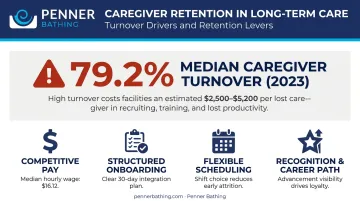
- Competitive pay (BLS reported a $16.12 median hourly wage in 2023 — staying above this matters in competitive markets)
- Structured onboarding
- Flexible scheduling
- Genuine recognition and career path clarity
Step 13 – Build Your Marketing and Referral Strategy
Online presence essentials:
- Professional website with service-specific and geography-specific pages
- Complete and active Google Business Profile
- Listings on Caring.com, A Place for Mom, and your state's Area Agency on Aging directory
- Consistent NAP (name, address, phone) across all platforms
Referral relationships are your highest-volume client channel — prioritize these before and after launch:
- Hospital discharge planners
- Primary care physicians and geriatricians
- Elder law attorneys
- Social workers
- Home health and hospice agencies
Client reviews are decisive for families choosing care providers. A 2024 peer-reviewed study found that CMS quality star ratings meaningfully shifted demand toward higher-rated home health agencies. Build a process for requesting reviews from satisfied clients and families early.
Step 14 – Monitor Performance, Ensure Compliance, and Scale
Track these KPIs from the start:
- Client satisfaction scores
- Caregiver retention rate
- Referral source performance (which sources convert, at what volume)
- Billing accuracy and accounts receivable days
- Gross margin by payer type
Do not scale before you've stabilized. Consistent care delivery, caregiver coverage, billing accuracy, and compliance must all be functioning reliably before you expand to new geographies or service lines. Scaling while understaffed or before pricing is sustainable is the most common reason agencies plateau or close in years two and three.
The Activated Insights 2023 benchmarking data puts the median home-care profit margin at 9.7%. That margin leaves little room for billing errors, scheduling gaps, or premature expansion. Track your numbers weekly, not monthly.
Conclusion
Starting a home healthcare agency is not a shortcut business. The agencies that last do so by getting the regulatory, hiring, and operational fundamentals right before chasing growth — not by finding a faster path around them.
Clarity on your agency type, patience through the licensing process, and early investment in caregiver quality and retention are what separate agencies that stabilize from those that close in year one. The 14-step framework above works as a living checklist — revisit it as your business grows and state regulations shift. The sequence is deliberate. Skipping steps early almost always creates compliance gaps or staffing problems that cost more to fix later than they would have to prevent.
Frequently Asked Questions
How much money do you need to start a private home health care business?
Startup costs vary by state, agency type, and whether you pursue Medicare/Medicaid certification. Non-medical home care agencies require less capital than skilled home health agencies. Budget for 6 to 12 months of operating expenses on top of licensing fees, insurance, and technology costs.
How profitable is a private home health care business?
Profitability depends on client volume, payer mix, caregiver wages, and overhead. The Activated Insights 2023 benchmark puts the median home-care profit margin at 9.7%. Underpaying caregivers and underpricing services are the two most common reasons early-stage agencies fail to reach profitability.
How do I get private-pay clients for a private home health care business?
Hospital discharge planners, physician referrals, senior living communities, and a strong local online presence are the most effective acquisition channels. Google reviews, responsive intake, and professional credentials are what convert inquiries into signed agreements.
What is the 80/20 rule in home care?
In home care, the 80/20 principle typically describes two patterns: roughly 20% of clients generating 80% of revenue, and 20% of caregivers driving the majority of operational issues. Tracking both gives owners a clear starting point for retention decisions and quality improvement.
How long does it take to get a home healthcare agency license?
State licensing timelines range from approximately 3 months to over a year, depending on the state, agency type, and application completeness. States with Certificate of Need (CON) requirements or active moratoriums can extend this timeline further.
Do I need a medical background to start a home healthcare agency?
No medical background is required to start a non-medical home care agency. For skilled home health agencies, state regulations typically require a licensed clinical director or administrator, but the business owner does not need to be a clinician. Focus your energy on compliance systems, hiring, and operational structure — those are the skills that drive agency success.