What does a ratio actually measure? What numbers should you expect? And how do you use this information when touring a facility?
This guide answers all of those questions. You'll learn how ratios are calculated, what the research says about typical staffing patterns, what drives variation across facilities, how staffing affects residents' daily lives, and exactly what to ask during a facility visit.
Key Takeaways
- No national benchmark for assisted living staffing ratios exists—requirements are set state by state, with wide variation in specificity
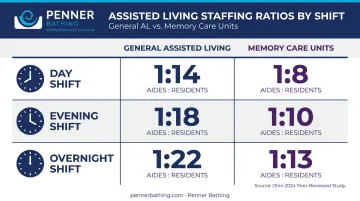
- A 2024 peer-reviewed study of Ohio assisted living communities found approximately 1 aide per 14 residents during the day and 1 per 23 overnight
- Memory care units in the same study averaged 1 aide per 8 residents by day, lower than the 1:5 ratio frequently referenced in industry materials
- Ratios alone don't tell the full story—caregiver training, turnover rates, and overnight licensed coverage matter equally
What Is a Staff-to-Resident Ratio in Assisted Living?
A staff-to-resident ratio expresses how many residents a single caregiver is responsible for during a given shift. A ratio of 1:8 means one caregiver is overseeing eight residents at the same time.
That number tells you surprisingly little on its own without knowing what it actually measures.
Who Counts as "Staff"?
Not every employee on-site contributes to direct resident care. When a facility quotes you a ratio, ask which roles are included:
- Direct care workers: Personal care aides, CNAs, medication aides—the staff physically assisting residents with bathing, dressing, mobility, and other daily tasks
- Licensed nurses: RNs and LPNs, who are counted separately in most research studies
- Support staff: Housekeeping, dietary, maintenance, and administration workers who do not provide hands-on care
A ratio that bundles all employees looks more favorable than one measuring direct caregivers only — so always clarify which staff categories a facility includes before comparing numbers.
Ratios Aren't Fixed
Staffing levels shift across the day. Night shifts typically run leaner because most residents are sleeping. Ratios also fluctuate due to call-outs, bad weather, sudden increases in move-ins, or high staff turnover.
The number a facility advertises reflects a scheduled target, not the staff actually on the floor on a given Tuesday night. Ask for both scheduled and actual staffing figures, and find out how the facility handles coverage gaps when they occur.
Staffing Patterns by Care Type: What the Research Shows
Ranges like "1:6 to 1:8 daytime" and "1:5 to 1:6 for memory care" circulate widely online—but no national authoritative body, not AHCA/NCAL, LeadingAge, nor the Alzheimer's Association, has endorsed these as verified national averages. Families relying on those figures may be working from assumptions rather than data.
The most reliable recent data comes from a 2024 peer-reviewed study of Ohio assisted living communities. While limited to one state, it's the most detailed shift-level staffing analysis currently available.
What Ohio Data Shows
| Shift | Aides per Resident | Licensed Nurses per Resident |
|---|---|---|
| Day | 1:14.1 | 1:24.2 |
| Evening | 1:16.3 | 1:28.9 |
| Overnight | 1:23.4 | 1:42.5 |
Memory care units in those same communities showed notably better aide ratios:
| Shift | Aides per Resident |
|---|---|
| Day | 1:8.0 |
| Evening | 1:8.6 |
| Overnight | 1:11.8 |
Notably, 23% of communities had no licensed nurse on duty overnight—a meaningful concern for residents with nighttime needs, dementia-related confusion, or incontinence.
A Few Important Caveats
- These figures represent Ohio observations, not national benchmarks
- Aides and licensed nurses are measured separately, not combined into a single ratio
- Staffing varies by facility size, resident acuity, and state regulation
For higher-acuity residents with complex medical needs or significant mobility challenges, staffing requirements should follow the individual care plan—no single number applies universally.
Assisted Living vs. Nursing Homes
Nursing homes operate under federal oversight through CMS, which historically set minimum staffing standards. Assisted living has no equivalent federal floor—regulation happens entirely at the state level. That gap explains why ratios vary so widely across facilities, and why the only way to assess actual staffing is to ask each facility for shift-by-shift figures—not just a headline ratio.
What Determines Staffing Ratios in Assisted Living?
The Regulatory Landscape
Unlike nursing homes, assisted living facilities face no federal minimum staffing mandate. Each state licenses and regulates assisted living independently. Some states specify numeric ratios; others use vague language like "sufficient staffing" without defining what that means.
The AHCA/NCAL 2025 Assisted Living State Regulatory Review covers all 50 states plus the District of Columbia and is the most current resource for state-specific requirements. In 2025, 18 jurisdictions reported regulatory changes—including updates to direct-care training in 10 states and staff scheduling rules in 7. Families researching a specific state should consult this resource or contact their state's licensing agency directly.
Resident Care Needs
A facility's resident mix directly shapes how many caregivers are needed. A community where most residents need minimal daily assistance operates differently from one serving residents with dementia, significant mobility limitations, or chronic conditions requiring close monitoring. Those higher-acuity needs demand more staff time per resident—regardless of what the posted ratio says.
This is why two facilities with identical advertised ratios can deliver very different levels of care.
Facility Size and Type
Larger communities may employ more staff in absolute numbers but not necessarily achieve better per-resident ratios. Smaller residential-style homes often maintain lower ratios, allowing for more personalized attention—though they may have fewer specialized resources.
Budget Pressures and Workforce Challenges
Financial constraints are real. A 2023 industry survey of nearly 1,000 assisted living and residential care facilities found CNA turnover at 41.88%—a figure that reflects ongoing workforce instability across the sector. Higher staffing levels generally correlate with higher resident costs, though the exact cost impact varies by facility size, location, and the wage rates in that labor market.
Staff Training and Experience
A smaller, highly experienced team can often outperform a larger team with limited specialized training—particularly for dementia care, fall prevention, or managing complex chronic conditions. When evaluating a facility, ask specifically about staff certifications, dementia-care training, and average tenure—these details reveal more than a raw staffing number ever will.
How Staffing Ratios Affect Resident Care and Daily Life
Safety and Emergency Response
The connection between adequate staffing and resident safety is direct. Fewer caregivers per resident means slower response to falls, longer gaps between wellness checks, and reduced capacity to monitor residents with nighttime confusion or incontinence.
Research supports this association: a study of Medicare beneficiaries with dementia in Ohio assisted living communities found that higher RN hours per resident were associated with fewer injury-related emergency department visits (IRR 0.59, 95% CI 0.36–0.96). The relationship held for RN hours specifically—not for total aide hours—suggesting that the type of staff present matters, not just the count.

Personalized Attention and Emotional Well-Being
When caregivers aren't stretched thin, they can do more than complete tasks on a checklist. They notice that a resident who normally finishes breakfast has left food untouched. They catch a change in gait that might signal a fall risk. They sit down for five minutes.
A small Canadian study found that residents in assisted living identified positive staff relationships as central to their quality of life—a finding that shows up clearly in how residents describe their day-to-day experience.
The Role of Equipment in Supporting Care Quality
Bathing is among the most time-intensive personal care tasks caregivers manage each shift. How efficiently that routine runs has real implications for the residents waiting and for caregiver capacity throughout the day.
Purpose-built bathing systems are designed with caregiver workflow in mind. Penner Bathing, a Nebraska-based manufacturer serving long-term care and assisted living communities since 1980, builds features like fast-fill reservoirs, automatic disinfection cycles, and integrated dispensers directly into their systems. These reduce idle time and manual steps, letting staff move through their bathing schedule without sacrificing resident comfort or dignity.
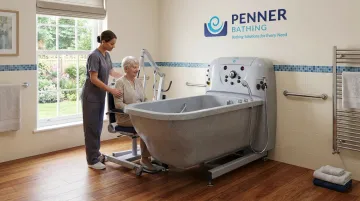
This kind of operational support doesn't replace adequate staffing. But it does help caregivers work more effectively within whatever ratios a facility maintains—which matters most when those ratios are already tight.
Caregiver Burnout and Turnover
Heavy ratios push caregivers toward burnout. A 2025 North Carolina study of staff across 68 assisted living communities found 18.5% reported burnout, and responsibility for more residents was associated with lower job satisfaction.
High turnover disrupts relationships, reduces consistency, and makes it harder for residents to trust familiar faces. A facility may be technically "staffed" while experiencing near-constant churn—and that instability has real consequences for care quality.
How to Evaluate a Facility's Staffing: What to Ask and Watch For
Questions to Ask During a Tour
Go into facility visits with specific questions, not general ones. Broad queries like "Is staffing adequate?" will get you reassuring but useless answers.
Ask instead:
- What is the caregiver-to-resident ratio by day, evening, and overnight shift—and which roles are included in that number?
- Are at least two caregivers on-site at all times?
- Is a licensed nurse present overnight, or is one on call?
- How does the facility handle coverage when a caregiver calls in sick?
- What is your turnover rate by role over the past 12 months?
- Do staff receive specialized training for dementia, Parkinson's, or diabetes management?
- How are individual resident care needs factored into scheduling decisions?
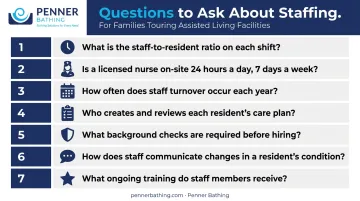
AARP recommends asking specifically about temporary agency staff use—a signal that the facility may be relying on workers unfamiliar with residents to fill gaps.
Red Flags to Watch During Your Visit
Beyond what staff tell you, the environment itself reveals a lot. Watch for:
- Caregivers who appear rushed, visibly stressed, or unable to stop and answer your questions
- Residents waiting in common areas without acknowledgment from nearby staff
- Call lights that go unanswered for extended periods
- Minimal spontaneous interaction between staff and residents
- High turnover disclosed in conversation or reflected in inspection records
- Significant discrepancy between the advertised ratio and the shift-specific numbers you're told
Your observations during a tour are one piece of the picture. To get the full view, contact your state's Long-Term Care Ombudsman, which tracks staffing complaints as one of the most frequent issues in residential care settings, according to the Administration for Community Living. Inspection reports and complaint histories are public records, and reviewing them before committing to a facility gives you an independent check on everything you've been told.
Frequently Asked Questions
What is a good caregiver-to-resident ratio?
No national standard applies. Research from Ohio found roughly 1 aide per 14 residents during daytime shifts in general assisted living and 1 per 8 in memory care. The right ratio depends on your loved one's care needs, state regulations, and the overall resident mix at that facility.
Are there federal staffing requirements for assisted living?
No. Unlike nursing homes, assisted living facilities are not subject to federal minimum staffing mandates. Requirements are set at the state level and vary considerably—some states specify numeric ratios; others only require "sufficient staffing" without defining what that means.
How do staffing ratios differ between day and night shifts?
Daytime ratios are more favorable because residents are active and need more hands-on assistance. The Ohio study found approximately 1 aide per 14 residents during the day and 1 per 23 overnight. That overnight ratio warrants closer scrutiny for residents with nighttime confusion, incontinence, or fall risk.
What ratio is recommended for memory care residents?
The Ohio data found memory care units averaged 1 aide per 8 residents during daytime hours. The Alzheimer's Association does not publish a universal numeric benchmark but recommends asking specifically about dementia training, average staff tenure, and behavioral support capacity.
What are signs that an assisted living facility is understaffed?
Key warning signs include caregivers who appear rushed or stressed, residents waiting without acknowledgment, slow responses to call lights, high staff turnover disclosed during your visit, and minimal spontaneous interaction between staff and residents during your tour.
Does a better staffing ratio mean better care?
Not automatically. A favorable ratio matters, but so does caregiver training, staff consistency, specialized skills, and the overall culture of the facility. Ask about turnover rates and caregiver tenure — those numbers often reveal more than the ratio itself.