This guide is written for nurses, charge nurses, clinical educators, and nursing administrators working in hospitals, long-term care facilities, and assisted living communities. If your facility is working to reduce preventable harm, standardize care delivery, or meet quality benchmarks tied to infection rates or hospital-acquired conditions, understanding how care bundles actually work — and why partial compliance doesn't count — is essential.
Key Takeaways
- Care bundles require 100% completion for every qualifying patient — any missed element means the bundle is recorded as incomplete
- The IHI created the bundle concept in 2001; every element must be grounded in Level 1 evidence (randomized controlled trials)
- Common nursing bundles address central line infections, ventilator-associated pneumonia, sepsis, pressure injuries, and falls
- Compliance is all-or-nothing: partial completion does not count and does not produce the same outcomes
- Adding elements beyond the evidence-based core weakens a bundle rather than improving it
What Are Care Bundles in Nursing?
The Institute for Healthcare Improvement defines a care bundle as "a small, straightforward set of evidence-based practices — generally three to five — that, when performed collectively and reliably, have been proven to improve patient outcomes." Three structural principles make that definition work in practice.
Evidence-Based Means Level 1 Evidence
The IHI's "evidence-based" standard means each element must come from randomized controlled trials — what IHI classifies as Level 1 evidence. Clinical tradition, staff preference, and reasonable-sounding practices don't qualify. There should be no meaningful debate among clinicians about whether each element belongs; if a step is contested, it doesn't meet the threshold.
This is a higher bar than most quality improvement tools require, and it's deliberate.
The All-or-Nothing Principle
A bundle is either completed fully for a patient or it is not. There is no partial credit. If a nurse completes four out of five elements, that encounter is recorded as non-compliant — not as 80% adherent.
This binary measurement is what gives bundles their accountability. Research supports the approach: a study of 984 adult ICUs across 632 U.S. hospitals found that facilities with at least 95% adherence to all five central-line bundle elements had an incidence rate ratio of 0.67 for CLABSI — meaningfully lower than the 0.77 IRR seen in facilities with high adherence to only a single element. Full completion produces substantially better results than near-complete execution.
How Bundles Differ From Checklists
The distinction matters operationally:
| Dimension | Care Bundle | Checklist |
|---|---|---|
| Evidence standard | Level 1 only — no controversy | May include locally preferred or optional steps |
| Ownership | One identified person or team | Often distributed across roles |
| Measurement | All-or-none per patient encounter | Individual items may be credited separately |
| Scope | Defined population, setting, and time window | Can cover broad workflows |
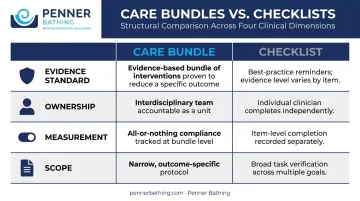
That accountability structure — single owner, binary outcome, Level 1 evidence only — is what separates bundles from general workflow tools and drives their measurable impact on patient outcomes.
Why Care Bundles Are Used in Nursing Settings
The core problem care bundles solve is inconsistency. Evidence-based practices exist across nearly every area of nursing, but in busy clinical environments, they're applied unevenly — across shifts, across staff experience levels, and across patient acuity.
One shift completes every step; the next skips one. A nurse may perform a task correctly without understanding why it's non-negotiable — which means the first gap in routine breaks the chain.
Bundles address this by converting a set of proven interventions into a single, ownable, measurable unit of care.
What the Data Shows
The stakes of inconsistency are measurable. According to the CDC, approximately 1 in 31 hospital patients has at least one healthcare-associated infection on any given day. In nursing home settings, that figure is roughly 1 in 43 residents.
The potential for bundles to close that gap is well-documented. In the widely cited Michigan ICU study published in the New England Journal of Medicine, a five-element central-line intervention across 103 ICUs reduced median catheter-related bloodstream infection rates from 2.7 to 0 per 1,000 catheter-days within three months. Mean rates fell from 7.7 to 1.4 at 16–18 months.
Regulatory and Reimbursement Implications
Bundle-addressable outcomes have real financial consequences for facilities:
- CMS's Hospital-Acquired Condition Reduction Program (HACRP) includes NHSN measures such as CLABSI rates
- Hospitals scoring above the 75th percentile for total HAC score receive a 1% Medicare payment reduction
- Hospital Value-Based Purchasing adjusts inpatient payments based on quality performance
The Joint Commission and IHI both promote bundle use as a quality improvement framework. While no accreditation rule mandates a specific IHI bundle, the outcomes bundles prevent — infections, pressure injuries, falls — feed directly into the CMS quality measures that determine whether a facility gains or loses Medicare reimbursement.
How to Implement a Care Bundle in Nursing
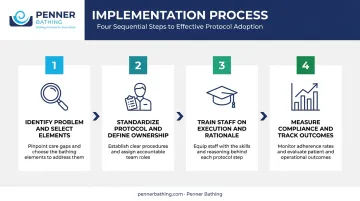
Implementation follows a sequential logic: each phase depends on the one before it. Skipping steps — particularly ownership definition and staff training — is one of the most common reasons bundles fail in practice.
Step 1: Identify the Clinical Problem and Select Bundle Elements
Start with a specific, defined patient risk: catheter-associated infections, pressure injuries, fall risk in post-surgical patients. Then identify only those interventions that meet two criteria:
- Supported by Level 1 evidence
- All necessary — removing any single element should meaningfully reduce the bundle's effectiveness
Keep the bundle to three to five elements. If you can't defend every item against that standard, remove it.
Step 2: Standardize the Protocol and Define Ownership
A bundle without an owner is a suggestion. The protocol must name a specific nurse, team, or role responsible for execution, and establish a defined time window — during morning assessment, during every four-hour repositioning cycle, at admission.
Without this structure, execution becomes discretionary — and discretionary execution produces the inconsistent outcomes bundles are designed to prevent.
Step 3: Train Staff on Execution and Rationale
Training must cover both mechanics and reasoning. Nurses who understand why each element is included are more likely to maintain compliance when time pressure creates shortcuts.
A 2023 multicenter study across 12 hospitals found that a structured education program increased complete Sepsis bundle compliance from 13.7% to 18.7% at one hour and from 46.2% to 57.9% overall. The program combined education with other implementation measures, but the directional finding is clear: informed staff comply more consistently.
Competency verification — not just attendance at a training session — is best practice. Once staff are verified competent, the next step is building the data infrastructure to confirm the bundle is actually working.
Step 4: Measure Compliance and Track Outcomes
Record each patient encounter as either fully completed or not. Don't calculate "percentage of steps done" as a proxy for compliance — that metric masks non-compliance and erodes the all-or-nothing discipline that makes bundles work.
Over time, track two parallel data streams:
- Compliance rates — is the bundle being completed as designed?
- Clinical outcomes — are infection rates, fall incidents, or pressure injury rates changing?
Timely, individual audit feedback outperforms delayed aggregate reporting for improving compliance. Build the feedback loop into your process.
Common Care Bundle Examples in Nursing and Long-Term Care
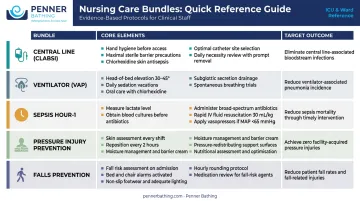
The Five Most Widely Used Bundles
| Bundle | Core Elements | Target Outcome |
|---|---|---|
| Central Line (CLABSI) | Hand hygiene; maximal sterile barriers; chlorhexidine skin antisepsis; avoid femoral site; daily line necessity review | Prevent catheter-related bloodstream infections |
| Ventilator (VAP) | Head-of-bed elevation 30–45°; daily sedation interruption + extubation readiness; peptic-ulcer prophylaxis; DVT prophylaxis; daily chlorhexidine oral care | Prevent ventilator-associated pneumonia |
| Sepsis (Hour-1) | Measure lactate; blood cultures before antibiotics; broad-spectrum antibiotics; 30 mL/kg crystalloid for hypotension or lactate ≥4 mmol/L; vasopressors if hypotension persists | Early sepsis recognition and treatment |
| Pressure Injury Prevention | Support surface; skin inspection; repositioning; incontinence and moisture management; nutrition and hydration | Reduce skin breakdown and pressure injury development |
| Falls Prevention | Risk screening; patient/family education; environment modification; medication review; individualized intervention plan | Reduce fall incidents |
One important caveat on falls: no falls intervention has been verified as meeting full IHI criteria — including Level 1 elements and all-or-none measurement — by AHRQ or the Joint Commission. Programs like Fall TIPS are explicitly toolkits. Facilities should implement them rigorously without labeling them IHI-style bundles.
Application in Long-Term Care and Nursing Home Settings
Long-term care presents distinct compliance challenges. Residents are older, more vulnerable to skin breakdown and infection, and served by rotating staff across multiple shifts. A single missed repositioning, skipped skin assessment, or inconsistent moisture management step carries real consequences for residents already at elevated risk.
Pressure injury prevention is where this risk concentrates most. The hygiene elements of the bundle — skin inspection, incontinence management, and structured bathing — are where execution breaks down most frequently. Consistent bathing schedules across all shifts require both staff discipline and equipment that operationally supports it.
Purpose-built bathing systems can support the hygiene consistency these bundles require. Penner Bathing's healthcare systems (including the Cascade and Premier lines) are designed for institutional, multi-patient use. Standard automatic disinfection between uses, fast-fill reservoirs that cut turnaround time between sessions, and built-in BioCote® antimicrobial surface protection all help maintain the structured, repeatable hygiene routines that pressure injury and infection prevention protocols depend on.
BioCote® is a supplementary surface-level protection, not a standalone infection control measure. Penner is clear that it doesn't replace proper cleaning and disinfection practices — it functions as one layer within a broader hygiene infrastructure.
Most bundles originated in ICU settings. Their core principles transfer to skilled nursing facilities and assisted living communities, but specific elements and trigger criteria should be reviewed for the relevant patient population before adoption.
Key Factors That Affect Care Bundle Success and Common Misconceptions
What Determines Whether a Bundle Works
- Staffing and workload — high nurse-to-patient ratios directly strain the consistency of execution; bundles require time to complete properly
- Completeness of training — staff who can only recite steps, not explain them, are more likely to skip under pressure
- Clarity of ownership — shared ownership is functionally the same as no ownership
- Frequency of auditing — infrequent or delayed feedback allows non-compliance to persist
- Organizational culture — facilities that treat incomplete bundles as a no-blame learning opportunity get better compliance data than those where non-compliance goes unreported
Three Misconceptions Worth Correcting Directly
"A care bundle is just a fancy checklist." Checklists can include optional, locally preferred, or weakly evidenced steps, and allow partial credit. A care bundle is defined by Level 1 evidence, single ownership, and all-or-nothing measurement — structural differences that produce meaningfully different accountability.
"Adding more steps makes a bundle stronger." IHI's design limit is three to five elements for a reason. Overloading a bundle dilutes focus, increases cognitive load, and reduces compliance rates. It also invalidates the all-or-none denominator when elements can't apply to every patient.
"Partial completion is better than nothing." The evidence disagrees. Facilities with written bundle policies but low adherence show no meaningful association with lower infection rates. Incomplete bundles should be treated as non-compliance — not partial progress.
When Care Bundles Aren't the Right Tool
Bundles lose effectiveness or become inappropriate when:
- The clinical problem lacks sufficient Level 1 evidence for specific interventions
- Patient complexity makes standardized protocol execution impossible for some elements
- A bundle is adopted because it exists elsewhere, not because it matches the specific patient risk in your setting
- Contraindications prevent one or more elements from applying to the full target population
In these cases, individualized care planning or a broader quality improvement framework may be more appropriate than forcing a bundle structure.
Conclusion
Care bundles work because they make the right thing the default — not the exception. By packaging three to five evidence-based practices into a single, ownable, all-or-nothing unit, they eliminate the variability that turns individual best practices into inconsistent habits.
The implementation steps are sequential and interdependent: a well-designed bundle without defined ownership fails. Ownership without training produces inconsistent execution. Training without measurement produces no accountability. Each layer depends on the one before it.
For nurses and nursing administrators, the operational message is straightforward: the value of a care bundle lies not in the protocol document but in the discipline of complete, consistent, accountable execution — across every patient and every shift. The facilities that internalize this — and build systems that enforce it — are the ones that convert best practices from policy language into measurable patient outcomes.
Frequently Asked Questions
What is a nursing care bundle?
A nursing care bundle is a set of three to five evidence-based practices delivered together for a specific patient risk — such as central line infections or pressure injuries. The bundle only produces its intended outcomes when all elements are completed consistently for every qualifying patient; partial completion is recorded as non-compliance.
What are the 4 bundles of care?
Four widely recognized nursing care bundles include:
- Central Line Bundle — prevents CLABSI
- Ventilator Bundle — prevents VAP
- Sepsis Hour-1 Bundle — supports early recognition and treatment
- Pressure Injury Prevention Bundle — reduces skin breakdown risk
The bundle used in any given setting depends on the clinical context and patient population.
How is a care bundle different from a checklist?
The core differences come down to evidence standards, ownership, and measurement:
- Care bundles: Level 1 evidence required for every element; single identified owner; all-or-nothing compliance within a defined time window
- Checklists: May include non-evidence-based items; ownership can be distributed; partial completion is typically allowed
These structural differences produce meaningfully different accountability outcomes.
Who is responsible for implementing a care bundle?
A care bundle must have one clearly assigned owner — a specific nurse, team, or role — with a defined time window for execution. Shared or ambiguous ownership is one of the most common reasons compliance fails — diffused responsibility means no one is accountable for full execution.
How is care bundle compliance measured?
Compliance is recorded as fully completed or not completed for each patient encounter. Partial completion — even completing four of five elements — does not count. Over time, facilities should track both overall compliance rates and downstream clinical outcomes to evaluate whether the bundle is working as intended.
Can care bundles be used in long-term care and nursing home settings?
Yes. Care bundles are effective in long-term care, particularly for pressure injury prevention, infection control, and fall reduction. Many bundles were developed in ICU settings, but their core principles adapt well to nursing homes and assisted living — with adjustments to specific elements and trigger criteria where needed.