According to the CDC, an estimated 234,094 nonfatal bathroom injuries occurred among people aged 15 and older in 2008, with roughly 80% resulting from falls — and 68% of those occurring in or around a tub or shower. Choosing the wrong bathing setup isn't just inconvenient. It has consequences.
This guide breaks down the main types of shower systems, their core functions and features, and how to match the right system to your specific setting — whether that's a residential bathroom remodel, an aging-in-place home, or a long-term care facility.
Key Takeaways
- A shower system combines a valve, controls, showerhead(s), and optional outlets, each governed by separate safety standards
- The right type depends entirely on the user: their mobility, care needs, and setting
- For elderly or mobility-limited users, anti-scald thermostatic controls and barrier-free entry are requirements, not upgrades
- In long-term care, infection control and caregiver efficiency are just as important as resident comfort
- Start with user needs, not aesthetics — the right system follows from there
What Is a Shower System?
A shower system is the complete assembly of components that controls water delivery during bathing. That includes the mixing valve, temperature and flow controls, the showerhead or heads, and any additional outlets like handheld wands or body jets.
The distinction from a single fixture matters. A showerhead is one component; a shower system coordinates multiple elements — valve, controls, supply fitting, and outlets — each governed by its own standard. The Department of Energy defines a showerhead as a component attached to a single supply fitting, while ASSE 1016 separately governs the compensating valves that regulate temperature.
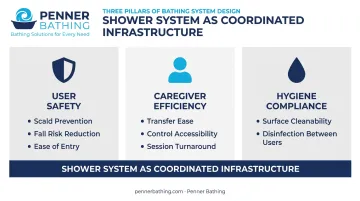
In residential bathrooms, the distinction is mostly academic. In healthcare and accessibility settings, it matters considerably. The system's design directly affects:
- User safety — scald prevention, fall risk, ease of entry
- Caregiver efficiency — transfer ease, control accessibility, session turnaround
- Hygiene compliance — surface cleanability, disinfection between users
Treating a shower system as coordinated infrastructure — rather than a collection of separate fixtures — shapes every decision that follows, from valve selection to outlet placement.
Types of Shower Systems
Shower systems vary by water delivery method, level of control, and physical setup. The right type starts with understanding who will use it and how.
Standard Wall-Mounted Shower Systems
The most common configuration: a fixed showerhead mounted to a wall arm, connected to a single valve controlling both temperature and flow.
Most wall-mounted systems use a pressure-balancing valve, which automatically compensates when water pressure fluctuates elsewhere — like when a toilet flushes. This prevents sudden temperature spikes, which is a meaningful safety baseline in shared-use facilities and multi-unit buildings.
IPC 2024 Section 412.3 requires these valves to conform to ASSE 1016 and include a means to limit the maximum setting to 120°F — though enforcement depends on local code adoption.
Best suited for:
- Standard residential and guest bathrooms
- Basic retrofit situations where budget and installation complexity need to stay low
- Settings where a single user controls their own temperature and flow
Rainfall and Overhead Shower Systems
Rainfall systems mount at the ceiling or high on a wall arm and disperse water in a wide, gentle downward flow — covering the full body without requiring movement.
The experience differs from a standard angled spray in ways that matter practically. Water falls from above rather than from the side, which some users find more natural. However, the tradeoff is that performance depends on adequate water pressure and ceiling height.
EPA WaterSense Version 1.1 limits labeled rain showers to 2.0 gpm, with testing conducted at 20, 45, and 80 psi. High-efficiency rain showers must deliver at least 1.4 oz of spray force at 20 psi to qualify. Before installation, confirm your home's water pressure and supply capacity actually support the product you're considering.
Best suited for:
- Spa-inspired residential master bathrooms
- Installations where ceiling height and water supply capacity meet product requirements
Body Spray and Multi-Jet Shower Systems
Body spray systems install multiple water outlets directly into the shower walls at varying heights, delivering targeted water to different areas simultaneously.
These systems require:
- A thermostatic valve
- Separate volume controls per outlet
- Dedicated plumbing runs
That makes them a renovation-stage investment — not something you add onto an existing setup.
From a therapeutic standpoint, available research on targeted water delivery addresses aquatic immersion and exercise — not residential shower jets specifically. The comfort benefit is real, but specific clinical claims for body spray systems aren't supported by direct clinical evidence. What is well-documented is that targeted warm water can be soothing for users managing muscle tension or joint stiffness.
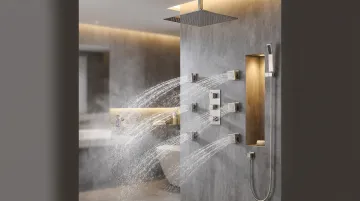
Best suited for: Luxury residential master baths; users wanting a spa-style experience and willing to invest in proper installation.
Walk-In and Accessible Bathing Systems
This category is built around a fundamentally different design priority: safe, dignified bathing for users who cannot safely manage a standard shower.
Key design features that define accessible systems:
- Low or no-threshold entry
- Built-in seating
- Handheld wand fixtures
- Grab bar compatibility
- Anti-scald thermostatic controls
ADA Section 608 specifies dimensional requirements for covered facilities — transfer shower compartments at exactly 36 x 36 inches, grab bars at 33–36 inches above the floor, seat height at 17–19 inches, and a minimum 59-inch hose on spray units. These standards apply to state and local government facilities, public accommodations, and commercial facilities — not private homes generally — but they represent the most rigorously tested accessible geometry available, and they're a sensible benchmark for any accessibility-focused installation.
In long-term care settings, accessible bathing systems go further. The practical requirements extend beyond resident safety to caregiver workflow and infection control. Purpose-built therapeutic bathing systems for institutional use typically include: In long-term care settings, accessible bathing systems carry additional demands. Requirements extend beyond resident safety to caregiver workflow and infection control. Purpose-built therapeutic bathing systems for institutional use typically include:
- Automatic disinfection cycles
- Antimicrobial surfaces with built-in protection
- Fast-fill reservoirs to reduce staff time per bathing session
- Height-adjustable transfer mechanisms for varied mobility needs
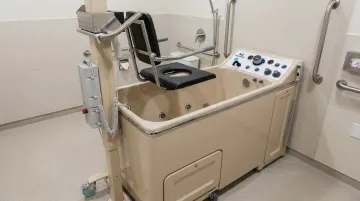
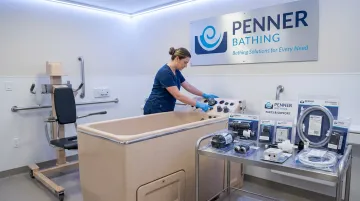
Penner Bathing's healthcare bathing systems — the Cascade, Premier, Contour, and Pacific lines — are built for these environments. All include automatic disinfection as standard, with dedicated disinfect jets controlled from the unit's panel. The Contour's offset design adds caregiver workspace; the Premier includes a flat-screen TV cabinet for resident comfort during extended sessions. Left, right, and end-opening configurations across all models accommodate varied mobility patterns and transfer equipment.
For residential aging-in-place use, Penner's Dream Spa Walk-In Bath offers a swing-out door design — where the user sits down first, then swings their legs in — along with a heated seat, Aqua-Aire jet system, PennAire Microbubble Technology, and a handheld shower wand operable from a seated position. It's engineered to fit standard tub spaces without major renovation.
Who benefits most:
- Seniors aging in place at home
- Residents of assisted living facilities and nursing homes
- Individuals with post-operative mobility restrictions
- Facility staff who need reliable, easy-to-operate equipment
Steam Shower Systems
Steam showers enclose the shower space and add a generator that produces steam — turning the enclosure into a personal steam room with a humid, heat-based environment rather than a spray-based one. Many users find steam relaxing and report benefits for breathing and muscle comfort. However, it's honest to note that a 2017 Cochrane review found no demonstrated benefit — or harm — from heated humidified air for the common cold, and no direct steam-shower clinical trials for circulation or muscle claims have been published.
Installation requirements are specific:
- An airtight enclosure
- Waterproofing and vapor control (TCNA methods require a membrane with permeance of 0.5 perms or less for continuous-use steam rooms)
- A dedicated steam generator meeting UL 499 safety standards
- Proper ventilation
Best suited for: Luxury residential bathrooms or specialized wellness settings where the higher installation investment is justified by user preference.
Key Functions and Features to Look For
Regardless of system type, these features determine whether a shower system is actually safe and practical for its intended users.
Temperature Control
Thermostatic valves maintain a preset water temperature independently of pressure changes elsewhere in the system. They also allow separate flow control — you can turn the water off and back on at the same temperature without readjusting.
Pressure-balancing valves react to pressure fluctuations but require manual temperature adjustment if conditions change. They combine temperature and volume in a single handle, which is simpler but less consistent.
For elderly users, post-surgical patients, or anyone on medications that reduce heat sensitivity, thermostatic control is the safer choice. For these populations, it's a risk management decision, not a preference one.
Anti-Scald Protection
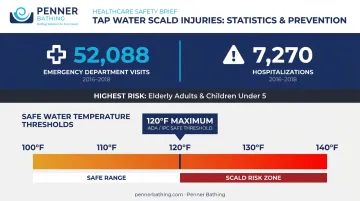
120°F is the standard benchmark. Both ADA Section 608.6 and IPC 2024 Section 412.3 specify this maximum for their covered applications. CPSC identifies older adults and children under five as the primary victims of tap-water scald injuries.
A 2023 analysis estimated 52,088 emergency department visits and 7,270 hospitalizations from tap-water scalds during 2016–2018. Thermostatic systems with correctly set limit stops are the primary technical defense against this risk.
Diverter Valves and Volume Controls
In multi-outlet systems, two controls work together to give each user a consistent, comfortable experience:
- Diverter valves direct water between outlets — switching from a fixed head to a handheld wand, for example
- Volume controls regulate flow independently per outlet, so one outlet can run at partial flow while another stays off
Both allow bathing to be customized per user without requiring repositioning or repeated adjustments.
Hygiene and Surface Maintenance
In long-term care environments, smooth non-porous surfaces that resist limescale are a baseline requirement. Automatic disinfection between users and antimicrobial material protection address infection risks that standard residential systems aren't designed for.
CDPH directs long-term care staff to disinfect bathing equipment between residents — a requirement that purpose-built systems like Penner's handle automatically, reducing both the labor burden and the risk of inconsistency.
How to Choose the Right Shower System for Your Needs
The right shower system depends entirely on who will use it — and under what conditions. Getting that answer right before selecting a product saves money, reduces risk, and avoids costly retrofits later.
Define the primary user first:
- A healthy adult remodeling their master bath has very different needs from a senior aging in place, a post-surgical patient, or a long-term care resident
- Current mobility doesn't predict future needs — design for where the user is headed, not just where they are today
Assess accessibility requirements honestly:
- If seating, grab bars, handheld spray, or barrier-free entry may ever be needed, treat those as minimum specifications now
- Retrofitting a standard shower for accessibility after the fact typically costs two to three times more than building it in from the start — and requires shutting down the space during construction
Match system complexity to the setting:
- A digital thermostatic multi-jet system may work in a luxury master bath but becomes a liability in a care facility where multiple staff members operate it across different residents
- Simplicity, reliability, and ease of use matter as much as features in institutional settings
Factor in long-term cost of ownership:
- Durability, parts availability, manufacturer support, and maintenance requirements determine the true cost over time — not the purchase price alone
- For example, Penner Bathing has supplied long-term care facilities since 1980 and ships replacement parts same-day on orders placed before 2:00 PM CST — a meaningful operational detail when a bathing system goes down in a care setting
Verify safety before aesthetics:
- A system that looks attractive but lacks anti-scald protection, proper drainage, or accessible controls puts residents at risk of scald burns, slip-and-fall injuries, and regulatory citations
- Confirm the system meets relevant plumbing codes and, for covered facilities, ADA Section 608/610 requirements
Conclusion
Shower systems span a wide range — from a single wall valve and showerhead to sophisticated multi-outlet therapeutic systems with thermostatic controls, automatic disinfection, and height-adjustable transfer mechanisms. The right choice depends entirely on the user's needs, the physical setting, and the specific functions that matter most in that context.
For seniors, individuals with mobility challenges, and long-term care environments, the stakes extend well beyond aesthetics. The right bathing system protects user safety, supports caregiver workflows, and preserves the dignity that every person deserves in daily care. Penner Bathing has spent over 40 years helping facilities and families work through exactly that decision — and the right fit is always specific to the person being cared for.
Frequently Asked Questions
What are the three types of showers?
Showers are commonly categorized three ways: by structure (walk-in stall, tub-shower combo, enclosed stall), by water delivery (overhead/rainfall, wall-mounted, body spray), or by control type (pressure-balanced, thermostatic, digital). Most practical discussions draw from all three frameworks depending on the installation context.
What is the best shower system to buy?
For most residential use, a thermostatic wall-mounted system with a handheld attachment covers the bases well. For seniors or users with mobility limitations, a walk-in accessible system with anti-scald controls, barrier-free entry, and built-in seating is the more appropriate choice.
What types of shower upgrades benefit elderly or care facility users?
The most impactful upgrades for elderly users and care settings include converting a standard tub to a walk-in or barrier-free shower, adding thermostatic anti-scald controls, integrating a handheld wand and built-in seating, and — for facility use — incorporating automatic disinfection systems. Each upgrade varies in cost and complexity.
What is the difference between a thermostatic and pressure-balancing shower system?
Thermostatic valves hold a preset temperature independently of pressure fluctuations and allow separate flow control. Pressure-balancing valves adjust the hot/cold mix reactively and combine temperature and volume in a single handle. Thermostatic systems offer greater consistency and safety — especially important for elderly users who may not detect temperature changes quickly.
What shower systems are best for elderly or limited mobility users?
Walk-in accessible systems with barrier-free entry, handheld wands, built-in seating, and anti-scald thermostatic controls are the standard recommendation. Care facilities should also prioritize automatic disinfection and ease of staff operation. ADA Section 608 specifications for compartment dimensions, seat height, and grab bar placement serve as a reliable installation benchmark.