Introduction
Picture this: a patient in their late 70s, recovering from heart failure, gets discharged from the hospital on a Friday afternoon. They're handed a folder of paperwork, a medication list that doesn't quite match what they were taking before admission, and a follow-up appointment scheduled three weeks out. By Monday, they're back in the emergency room.
This scenario plays out thousands of times each week across the United States. The moment between care settings — hospital to home, hospital to skilled nursing facility, ICU to general ward — is one of the most dangerous in all of healthcare. According to AHRQ, nearly 20% of patients experience an adverse event within three weeks of discharge, with approximately 75% of those events considered preventable or largely avoidable.
Failed care transitions drive preventable readmissions, medication errors, and avoidable harm. The burden falls hardest on older adults with chronic conditions and those with limited social support. This post covers what care transitions are, why they remain a persistent safety problem, and which evidence-based models actually reduce harm.
Key Takeaways
- Nearly 1 in 5 patients suffers an adverse event within three weeks of discharge — most preventable
- Medication errors affect more than half of all patients transitioning between care settings
- Only 43.6% of Medicare patients with high-risk diagnoses receive outpatient follow-up within seven days of discharge
- Three evidence-based models (BOOST, CTI, and TCM) each show measurable reductions in 30-day readmissions
- Safe transitions depend on shared accountability across every care setting involved in a patient's journey
What Is a Patient Care Transition?
A patient care transition is the movement of a patient between healthcare practitioners, settings, or levels of care — hospital to home, hospital to skilled nursing facility, ICU to general ward, primary care to specialist. Every one of these handoffs involves real risk.
Who Is Most Vulnerable
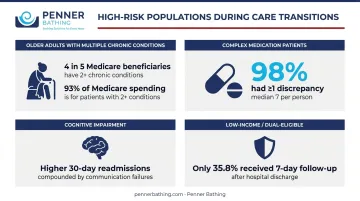
Not all patients face equal danger during transitions. The populations at highest risk include:
- Older adults with multiple chronic conditions — AHRQ reports that four in five Medicare beneficiaries have multiple chronic conditions, accounting for 93% of Medicare spending and nearly all Medicare readmissions
- Patients on complex medication regimens — a 2024 study found that 98% of adults age 50 or older moving from post-acute care to home had at least one medication discrepancy within seven days, with a median of seven discrepancies per person
- Those with cognitive impairment — older adults with dementia face higher 30-day readmission rates, compounded by inadequate discharge planning and communication failures during hospital-to-SNF transfers
- Low-income and dual-eligible patients — only 35.8% of dually eligible Medicare beneficiaries with high-risk diagnoses received follow-up within seven days of discharge, compared to 43.6% overall
A care transition spans healthcare systems, providers, patients, and families — each with distinct responsibilities and information needs. When any part of that chain breaks down, patients pay the price.
Why Care Transitions Are a Patient Safety Priority
The consequences of poorly managed transitions are well-documented, financial, and in many cases, entirely preventable.
Medication Errors and Adverse Events
Drug-related problems are the most common form of transition harm. A 2020 systematic review found median post-discharge rates of 53% for medication errors and 50% for unintentional medication discrepancies. Among Medicare beneficiaries age 65 or older, 18.7% experienced an adverse drug event within 45 days of discharge — and 35% of those events were preventable.
Discharge summaries compound the problem. One foundational study found summaries were available for only 12.2% of first post-discharge outpatient visits. A separate study found that discharge summaries documented only 16% of individual pending test results — meaning patients routinely leave the hospital with unresolved clinical questions that no one is tracking.
Financial and Regulatory Pressure on Hospitals
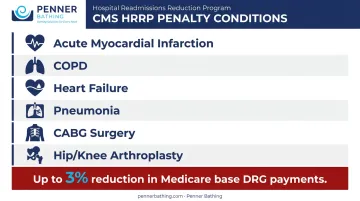
The Centers for Medicare & Medicaid Services (CMS) Hospital Readmissions Reduction Program (HRRP) penalizes hospitals with excessive 30-day readmission rates. The penalty applies to six specific conditions:
- Acute myocardial infarction
- COPD
- Heart failure
- Pneumonia
- CABG surgery
- Elective hip or knee arthroplasty
Hospitals with excessive readmission rates in these categories face a reduction of up to 3% in Medicare base operating DRG payments — a meaningful hit for high-volume facilities.
MedPAC's March 2026 report puts the current risk-adjusted 30-day readmission rate for fee-for-service Medicare beneficiaries at 15.4%, up 0.3 percentage points from 2023.
Shared Accountability Across Settings
Hospitals often bear the most regulatory scrutiny, but skilled nursing facilities, assisted living communities, and home health agencies share equal responsibility for what happens on their end of the handoff. Safe transitions require both the sending and receiving organizations to act — and to communicate.
The Seven Essential Elements of Safe Care Transitions
Four Essential Elements of Safe Care Transitions
The National Transitions of Care Coalition (NTOCC) identifies seven categories essential for safe and seamless care transitions. The four below represent the most clinically impactful — and the most frequently neglected.
Medication Management
Medication reconciliation — reviewing and aligning a patient's full medication list at every transition point — is the single most impactful intervention available. Proper medication management means:
- Reconciling all medications at discharge against pre-admission and in-hospital regimens
- Educating patients and caregivers on purpose, dosage, and potential side effects
- Identifying discrepancies before they cause harm, not after
Transition Planning and Communication
Planning begins before discharge — not at the moment of it. A clear, written plan shared among the patient, family, discharging provider, and receiving provider is the baseline. When that plan is delayed or absent, readmissions follow. A 2021 meta-analysis found broader discharge-communication interventions were associated with readmission rates of 9.1% versus 13.5% in usual care groups.
Patient and Family Education and Engagement
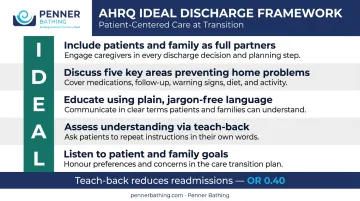
Patients and families are active partners in transitions — not passive recipients of instructions. The AHRQ IDEAL framework offers a practical structure for this engagement:
- Include the patient and family as full partners
- Discuss five key areas that prevent problems at home
- Educate in plain language, avoiding medical jargon
- Assess understanding using teach-back
- Listen to patient and family goals, concerns, and preferences
Teach-back — asking patients to explain information in their own words — is particularly powerful. A 2023 meta-analysis found discharge education using teach-back reduced readmissions with an odds ratio of 0.40 (95% CI 0.17–0.94).
Follow-Up Care and Shared Accountability
Timely post-discharge follow-up is a proven readmission reducer. Current rates fall well short of that standard:
- 43.6% of Medicare patients with HRRP priority conditions received follow-up within seven days
- Rates drop to 34.1% among Black beneficiaries and 35.8% among dual-eligible patients
Both the sending and receiving provider share accountability for closing this gap. The follow-up appointment should be scheduled before the patient leaves — not left to chance after discharge.
Evidence-Based Models That Improve Care Transitions
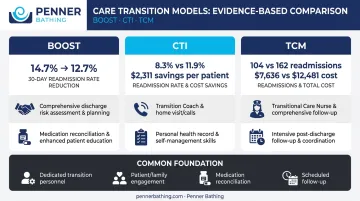
The Agency for Healthcare Research and Quality reviewed three widely studied, multi-element care transition models that reduce readmissions among high-risk older adults. Each offers principles that any care setting can apply.
BOOST: Better Outcomes for Older Adults through Safe Transitions
BOOST is a Society of Hospital Medicine quality improvement program that standardizes the discharge process through structured tools and staff engagement. Key components include:
- The 8Ps risk assessment tool (Problems with medications, Psychological, Principal diagnosis, Physical limitations, Poor health literacy, Poor social support, Prior hospitalization, Palliative care)
- Standardized discharge checklists
- A 72-hour post-discharge follow-up phone call
In an 11-hospital evaluation, BOOST units saw 30-day readmissions decline from 14.7% to 12.7% over 12 months, while control units remained flat (14.0% to 14.1%).
CTI: Care Transitions Intervention
CTI is a 30-day, patient-centered self-management program built on four pillars:
- Medication self-management
- A dynamic personal health record
- Timely primary and specialist follow-up
- Recognition of red flags that signal deterioration
A Transitions Coach — typically a nurse or social worker — meets the patient in the hospital, conducts a home visit within 72 hours of discharge, and follows up with three calls over 30 days. In a randomized controlled trial of 750 adults age 65 or older, 30-day readmissions were 8.3% with CTI versus 11.9% with usual care. One implementation tracked by CHCS reported $2,311 in annual savings per beneficiary against a $999 program cost — a 131% return on investment.
TCM: Transitional Care Model
Developed at the University of Pennsylvania, TCM is a nurse-led model designed for chronically ill older adults at high readmission risk. Advanced Practice Nurses serve as a direct liaison between patients and their full care team, conducting home visits, providing telephone support, and managing medication reconciliation for up to two months post-discharge.
In a randomized trial of 239 older adults hospitalized with heart failure, the TCM intervention produced 104 readmissions versus 162 over 52 weeks, with mean per-patient costs of $7,636 versus $12,481.
The Shared Lesson
All three models share the same structural foundation — and that's what makes them work:
- Dedicated transition personnel assigned to each patient
- Active patient and family engagement throughout the process
- Thorough medication reconciliation at discharge
- Clear, scheduled follow-up protocols post-discharge
A discharge checklist is one tool. These models are end-to-end systems built around accountability at every handoff.
How Long-Term Care Facilities Can Create a Safer Transition Environment
Clinical protocols matter. But the physical and relational environment into which a patient arrives matters too — and it's often overlooked.
Staff Readiness on the Receiving End
When a patient transfers into a skilled nursing facility or assisted living community, the receiving team should already know:
- The patient's current medication list
- Their functional status and mobility limitations
- Their care plan and pending follow-up items
- Red flags that would indicate deterioration
Too often, this information arrives after the patient does. Facilities that designate a transition coordinator or champion — someone who owns the incoming handoff process — close that gap systematically.
The Role of Comfort and Safe Personal Care
Beyond clinical readiness, newly arrived residents are often anxious, physically depleted, and disoriented. A welcoming environment with familiar routines and responsive staff reduces that distress and supports recovery.
Safe, dignified bathing is a meaningful part of that picture. For facilities receiving patients directly from hospital or rehabilitation settings, bathing equipment designed for medically fragile and cognitively impaired residents makes a measurable difference in early-stage comfort and recovery.
Penner Bathing's healthcare bathing systems are built for this population. Key features include:
- Height-adjustable transfer mechanisms for safe, low-effort patient entry
- Multiple door configurations to accommodate varying mobility levels
- Non-slip surfaces and cognitively accessible controls
- Automatic disinfection standard on every model
- PennAire Microbubble Technology, which infuses bath water with oxygen-rich microbubbles that support skin hydration and deep cleansing

For facilities managing the heightened demands of newly admitted patients, Penner's fast-fill reservoir reduces staff time per bathing session, keeping workflow manageable even during high-admission periods.
Frequently Asked Questions
What is a patient care transition?
A patient care transition is the movement of a patient between healthcare settings, providers, or levels of care — such as hospital to home or ICU to general ward. These moments require coordinated communication, medication reconciliation, and follow-up care to prevent avoidable harm.
How long will Medicare pay for transitional care?
Medicare covers Transitional Care Management (TCM) services for 30 days following discharge from an inpatient facility. CPT code 99495 covers moderate-complexity decisions with a face-to-face visit within 14 calendar days. CPT code 99496 covers high-complexity decisions with a visit within 7 days. Interactive contact must occur within two business days of discharge.
What's the difference between an ICU and a TCU?
An ICU (Intensive Care Unit) provides acute, intensive monitoring for critically ill patients at risk of life-threatening organ dysfunction. A TCU (Transitional Care Unit) is a short-term, post-acute setting for patients who are medically stable but not yet ready for home — supporting discharge to the community or long-term care through restorative services.
What are the most common risks during care transitions?
The top risks include:
- Medication errors from poor reconciliation
- Missed follow-up appointments
- Communication gaps between discharging and receiving providers
- Patients or caregivers who don't understand the discharge plan
Each of these can lead to preventable readmissions or adverse events.
What role do family caregivers play in care transitions?
Family caregivers are essential partners — they manage medications, recognize warning signs, attend follow-up appointments, and communicate with providers. Engaging and educating caregivers during discharge directly improves transition outcomes and reduces readmission risk.
What is IDEAL discharge planning?
IDEAL is an AHRQ framework for engaging patients and families during hospital discharge:
- Include patients as active partners in their care plan
- Discuss key home-care areas before discharge
- Educate using plain, jargon-free language
- Assess understanding through teach-back
- Listen to patient and family goals and concerns