
Introduction
Few decisions carry more emotional weight than choosing how a loved one receives care as they age or face serious health challenges. The stakes are real: daily routines, personal independence, safety, finances, and long-term quality of life all hang in the balance — and there's rarely an easy answer.
According to the 2024 AARP Home and Community Preferences Survey, 75% of Americans age 50+ want to remain in their current home for as long as possible. Yet wanting to age in place and being able to do so safely are two different things.
What follows is a practical breakdown of both paths — so you can make a confident, informed choice for your family.
Key Takeaways
- Institutional care (nursing homes, assisted living) provides 24/7 supervision, making it the stronger fit for complex or high-level medical needs
- Home care preserves independence and familiar surroundings — well-suited for those needing daily assistance, not constant clinical oversight
- Part-time home care costs far less than a nursing home; full-time live-in arrangements can approach similar price territory
- The right choice depends on medical complexity, safety risks, financial resources, and available family support
- Many families combine home care with home modifications to delay or avoid institutional placement
Institutional Care vs. Home Care: Quick Comparison
Costs and coverage vary by location, condition, and care level — treat these figures as a starting point, not a firm quote.
| Category | Institutional Care | Home Care |
|---|---|---|
| Definition | Professional care in a dedicated facility | Care delivered in the individual's own home |
| Typical Services | Skilled nursing + personal care | Personal assistance + optional skilled services |
| Who Provides Care | Licensed medical staff | Trained aides or licensed professionals |
| Cost Range (monthly) | ~$9,277 (nursing home, semi-private) | ~$34/hour; ~$6,483/month at 44 hrs/week |
| Insurance Coverage | Medicaid (most common); Medicare (short-term only) | Private pay or long-term care insurance; some Medicaid HCBS |
| Level of Independence | Structured; limited personal autonomy | High — individual controls daily routine |
| Best Suited For | Complex medical needs or significant safety risks | Daily help without round-the-clock supervision |
| Social Environment | Built-in group activities and peer dining | Dependent on caregiver visits and family network |
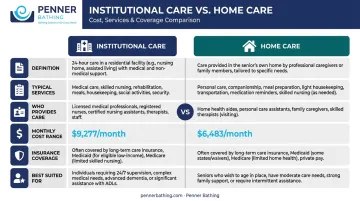
Source: CareScout 2024 Cost of Care Survey
What Is Institutional Care?
Institutional care is an umbrella term for professional care delivered inside a dedicated facility. It's not a single thing — there are meaningful differences in what each setting provides.
Types of Institutional Care
| Type | Level of Care |
|---|---|
| Nursing home | Highest medical oversight; 24-hour skilled nursing |
| Assisted living | Help with daily activities; some medical monitoring |
| Memory care | Specialized for dementia and Alzheimer's |
| Rehabilitation/SNF | Short-term recovery after surgery or hospitalization |
Benefits of Institutional Care
Institutional settings offer structural advantages that are difficult to replicate at home:
- 24/7 supervision: Continuous clinical presence for individuals with advanced dementia, post-stroke recovery, or frequent fall risk — around the clock, at a cost home care can't match
- On-site specialized services: Physical therapy, occupational therapy, wound care, and physician oversight under one roof — coordinating all of this at home is impractical for people with multiple complex conditions
- Built-in social engagement: Structured group activities, communal dining, and peer interaction reduce isolation for people who would otherwise spend most of the day alone
Limitations of Institutional Care
Loss of autonomy. Residents follow facility schedules, share spaces, and have limited control over daily decisions. Research links restricted autonomy in residential care to depressive feelings and apathy — while greater perceived control consistently correlates with higher life satisfaction.
Cost and financial burden. The national median for a semi-private nursing home room is $9,277 per month, or roughly $111,325 per year. Medicare's SNF coverage is conditional and capped at 100 days per benefit period — with cost-sharing of $217/day kicking in after day 20 in 2026. Most long-term nursing home stays are funded by Medicaid (63% of residents as of July 2024) or paid out of pocket.
What Is Home Care?
Home care is professional or semi-professional support provided in the individual's own residence. The term covers several distinct categories that are often confused:
- Non-medical personal care — help with bathing, grooming, dressing, meal preparation, and companionship
- Skilled home health care — licensed clinical services like wound care, IV therapy, or physical therapy, ordered by a physician
- Companion/respite care — social support and temporary relief for family caregivers
Benefits of Home Care
Comfort and emotional continuity. Staying in one's own home preserves identity, routine, and psychological security. An Austrian comparative study found nursing-home residents scored notably lower on autonomy measures than frail adults living at home — though the two groups also differed in health status, so direct causal claims should be made carefully.
One-on-one attention. In nursing facilities, nursing time is distributed across all residents — CMS data from July 2025 shows residents averaged 3.85 nursing hours per resident day from all staff combined. A hired home aide, by contrast, is present exclusively for their client during scheduled hours.
Cost advantage for moderate needs. At $34/hour (the 2024 national median), part-time home care is substantially cheaper than a nursing home for families who need 20–30 hours of coverage per week. The key caveat: this advantage disappears if 24/7 care is required, at which point home care can match or exceed institutional costs.
Supporting independence with home modifications. Many families pair home care with targeted safety upgrades to make aging in place sustainable. The bathroom is one of the highest-risk areas: more than 14 million adults age 65+ fall each year, and step-over tub entries are a leading cause. Walk-in bath solutions like Penner Bathing's Dream Spa Walk-In Bath (starting at $5,950) eliminate that step-over motion and fit standard tub spaces without a full renovation, making the upgrade practical for most households.

Limitations of Home Care
Home care has real limits and isn't suited for every situation:
- Rapidly progressing dementia with wandering or unsafe behaviors
- Severe mobility impairment requiring mechanical transfers
- Complex wound care or IV therapy beyond what a visiting nurse can cover
- Situations where supervision gaps between caregiver visits pose genuine safety risks
The Alzheimer's Association notes that residential care becomes appropriate when a person is unsafe at home, needs more care than can be provided there, or the arrangement threatens the health of either the individual or the caregiver.
Which Care Setting Is Right for You?
The right choice depends on matching the level of care to the individual's actual needs — medical, financial, and social.
Key Factors to Evaluate
Medical complexity is often the deciding factor. If someone requires continuous monitoring, has unpredictable emergencies, or needs supervision that no home caregiver can reliably provide, institutional care is the safer choice. If the primary needs are help with daily activities and companionship, home care is generally appropriate.
Cost and financial resources. Look beyond sticker prices:
- Medicaid covers nursing facility care as a mandatory benefit for eligible individuals
- Medicaid home and community-based services (HCBS) vary by state and may have waiting lists
- Asset limits for Medicaid eligibility are typically around $2,000 per person
- Home care is often private pay — requiring advance planning
Family support and caregiver availability shape what's actually sustainable. Home care works best with an engaged family network and reliable coordination. For geographically distant families, or those managing their own burnout, institutional care can reduce risk for everyone involved.
Situational Recommendations
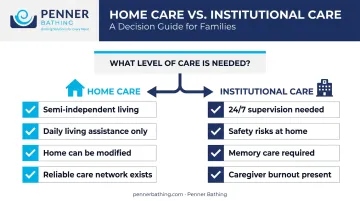
Choose institutional care if:
- The individual needs 24/7 medical supervision
- Safety needs cannot be addressed at home
- Memory care is required
- Family caregivers are approaching burnout
Choose home care if:
- The individual is semi-independent and values their autonomy
- Primary needs involve daily living activities, not continuous clinical monitoring
- The home can be modified to address safety risks
- A reliable care network exists
Consider a 79-year-old woman living alone after a hip fracture, with mild cognitive decline and poor balance. Her family lives two hours away. After repeated falls and one hospitalization, they evaluated 40+ hours per week of home care but couldn't reliably fill overnight gaps.
They ultimately selected assisted living, where she had no further falls and joined regular social activities. Repeated safety events, unaffordable round-the-clock coverage, and family distance together form the exact scenario institutional care is designed for.
Many families start with part-time home care and increase services or transition to a facility as needs evolve. The decision doesn't have to be permanent — starting early gives you more options and time to plan.
Conclusion
Institutional care excels at managing medical complexity, continuous supervision, and structured daily support. Home care excels at preserving independence, personal comfort, and one-on-one attention for those who don't need constant clinical oversight. The right choice comes down to the individual's current condition, available support, and realistic financial options — not a universal ranking of one setting over the other.
Practical next steps:
- Consult a physician or care coordinator to assess current and anticipated medical needs
- Evaluate financial options — Medicaid eligibility, long-term care insurance, and out-of-pocket costs
- If choosing home care, assess what modifications are needed to make the home safe — including accessibility upgrades like walk-in bathing equipment that reduce fall risk and support independent bathing
- Revisit the decision as needs change — what works now may not work in 12 months
Frequently Asked Questions
What is considered institutional care?
Institutional care refers to professional support delivered inside a dedicated facility such as nursing homes, assisted living communities, memory care units, and rehabilitation centers. Residents receive ongoing medical and personal support from licensed staff on-site, rather than in their own home.
What is the primary advantage of home care over institutional care?
Home care allows individuals to remain in familiar surroundings, maintain greater control over daily routines, and receive personalized one-on-one attention during caregiver hours. For those who don't require continuous medical supervision, this typically translates to better emotional well-being and quality of life.
What are three types of home care?
The three main types of home care are:
- Non-medical personal care: help with bathing, dressing, and meal preparation
- Skilled home health care: licensed clinical services like wound care or physical therapy, ordered by a physician
- Companion or respite care: social support and temporary relief for family caregivers
How long will Medicare pay for home health care?
Medicare covers home health care with no fixed time limit, provided the individual remains homebound, has a physician's order, and requires skilled care. It does not cover non-medical personal or custodial care when that's the only service needed. Coverage is reviewed in 30-day periods.
Is home care more affordable than nursing home care?
For part-time care needs, yes — often substantially so. At a national median of $34/hour, 20 hours per week runs roughly $2,720/month, compared to $9,277/month for a nursing home semi-private room. When full-time live-in coverage is needed, that gap narrows considerably.