Introduction
Picture a nurse in a long-term care facility midway through the evening shift. A resident's condition has changed — pain levels are up, mobility has dropped, the family is asking questions. The nurse needs to assess the situation, adjust the care plan, coordinate with the attending physician, document everything accurately, and do it all before the next resident needs attention.
What guides those decisions? Not intuition, and not facility habit alone. Nursing standards of practice do.
These are authoritative statements published by the American Nurses Association (ANA) that define the minimum level of competent, ethical, and accountable care expected from every registered nurse. They apply regardless of role, specialty, or care setting — equally to an ICU nurse in a major hospital and an RN managing a caseload in a small assisted living community.
This guide covers what those standards are, how they're structured, who enforces them, how they differ between RNs and LPNs, and what they look like in practice, particularly in long-term care environments.
Key Takeaways
- Nursing standards operate across four layers: the ANA, state Nurse Practice Acts, employer policies, and federal requirements
- The six Standards of Practice mirror the nursing process — assessment through evaluation — forming the clinical backbone of nursing care
- The 12 Standards of Professional Performance define professional conduct beyond clinical tasks
- RNs lead the nursing process; LPNs assist under supervision — a distinction critical for delegation
- Failing to meet standards can trigger license suspension, disciplinary action, or civil liability
What Are Nursing Standards of Practice?
The ANA defines the Standards of Professional Nursing Practice as authoritative statements of the actions and behaviors all RNs are expected to perform competently, regardless of role, population, specialty, or setting. The defining publication is Nursing: Scope and Standards of Practice, currently in its 4th edition (2021).
Two Categories, Both Mandatory
The standards split into two distinct but equally binding categories:
- Standards of Practice — what nurses do clinically, structured around the nursing process
- Standards of Professional Performance — how nurses conduct themselves professionally, covering ethics, communication, leadership, and accountability
Both apply to all RNs. Neither is optional based on setting or seniority.
Why Standards Matter Beyond the Bedside
These standards serve three practical functions:
- They establish consistent expectations for patient care across every care environment
- They give nurses, employers, and regulators an objective benchmark for evaluating conduct
- The ANA notes its scope and standards "may serve as evidence of the standard of care" in legal and regulatory proceedings
These standards evolve with the profession. The 4th edition added Advocacy as a standalone standard and revised several titles from the 3rd edition, so nurses are responsible for staying current with each revision.
Specialty organizations extend this base for specific practice areas. The American Psychiatric Nurses Association (APNA), for example, publishes its own Psychiatric-Mental Health Nursing: Scope and Standards of Practice (3rd edition, 2022) for nurses in that specialty.
The ANA Standards of Practice: The Nursing Process in Action
The six Standards of Practice are built around the nursing process — a systematic, critical-thinking framework for clinical decision-making. Together, they describe how RNs deliver care from first contact to outcome evaluation.
The Six Standards, Defined
| Standard | What It Requires |
|---|---|
| 1. Assessment | Collect pertinent data about the patient's health or situation — subjective and objective — including integrating data gathered by LPNs and other team members |
| 2. Diagnosis | Analyze assessment data to identify actual or potential diagnoses, problems, and issues using nursing scientific principles |
| 3. Outcomes Identification | Identify expected, measurable outcomes individualized to the patient — setting the target the care plan works toward |
| 4. Planning | Develop a collaborative plan with strategies to attain those outcomes, incorporating input from the broader care team |
| 5. Implementation | Implement the identified plan, including coordination of care (5A) and health teaching and health promotion (5B) |
| 6. Evaluation | Evaluate progress toward goals and modify the care plan based on the patient's response |
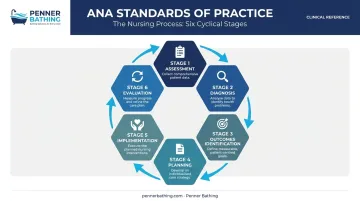
The Process Is Cyclical, Not Linear
In practice, evaluation frequently loops back into reassessment and updated planning — especially in complex care environments. The process isn't a checklist nurses complete once; it's a continuous feedback loop.
A resident in a long-term care facility with dementia and fluctuating pain levels might require reassessment daily, with care plan modifications triggered by changes in behavior, appetite, or mobility. The nursing process doesn't have a finish line; it adapts continuously to the patient's current status.
That adaptability is the point — the standards are designed to match care to the patient, not the other way around.
Standards of Professional Performance: Beyond Clinical Care
The 12 Standards of Professional Performance define how nurses are expected to conduct themselves professionally — not just what they do at the bedside. These are behavioral and ethical expectations that apply across every role, shift, and care setting.
The 12 Standards, Grouped by Theme
Professional Identity and Ethics
- Ethics — integrating ethical principles in all aspects of practice
- Advocacy — demonstrating advocacy across all roles and settings (added as a standalone standard in the 4th edition)
- Respectful and Equitable Practice — practicing with cultural humility and inclusiveness
Interpersonal and Team Standards
- Communication — communicating effectively throughout professional practice
- Collaboration — partnering with healthcare consumers and key stakeholders
Growth and Leadership
- Leadership — leading within the profession and practice setting
- Education — seeking knowledge that reflects current and future nursing practice needs
- Scholarly Inquiry — integrating scholarship, evidence, and research into practice
Accountability and Environment
- Quality of Practice — contributing to quality nursing outcomes
- Professional Practice Evaluation — evaluating one's own and others' nursing practice
- Resource Stewardship — using resources safely, effectively, and responsibly
- Environmental Health — advancing environmental safety in practice settings
Scaled Expectations
Engagement with these standards scales with a nurse's education, experience, and position. A staff RN and a nurse manager are both accountable for demonstrating leadership — but the scope looks different. A charge nurse's responsibilities extend to the unit; a CNO's extend to the organization.
That distinction carries real weight in performance evaluations, promotion decisions, and accountability reviews.
Who Sets and Enforces Nursing Standards?
Nurses operate under multiple overlapping authorities at once. A license suspension, a facility citation, and a termination can all stem from the same incident — each triggered by a different layer of accountability.
The Four Layers
| Source | Role | Enforcement Mechanism |
|---|---|---|
| ANA | Publishes authoritative professional standards | Does not issue or revoke licenses |
| State Legislature / Board of Nursing | Enacts the Nurse Practice Act; defines legal scope of practice | Investigates violations; can reprimand, restrict, suspend, or revoke licenses |
| Employer | Sets facility-specific policies and protocols | Disciplinary action, termination |
| CMS | Sets Conditions of Participation for Medicare/Medicaid-funded facilities | Affects facility's eligibility to receive federal funding |
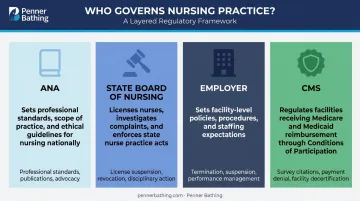
The Joint Commission (TJC) is an independent accreditor — not a federal regulator. Where CMS recognizes TJC accreditation, facilities can achieve "deemed status," meaning accreditation establishes compliance with applicable Medicare requirements.
What Boards of Nursing Can Actually Do
State Boards of Nursing are where professional standards become legally enforceable. A BON can:
- Issue formal reprimands
- Impose fines
- Restrict practice (for example, prohibiting a nurse from working unsupervised)
- Suspend or revoke a nursing license
Nursing students aren't exempt. They are legally accountable for the quality of clinical care they provide and must recognize and report limits in their own competence. That foundational standard applies equally to licensed nurses.
Standards by Role: RN vs. LPN
Both RNs and LPNs follow standards rooted in the nursing process, but their responsibilities differ significantly in scope. Conflating them creates real problems, both clinically and legally.
Core Distinctions
RNs:
- Initiate and lead the nursing process from assessment through evaluation
- Perform full assessment and develop nursing diagnoses
- Create and modify care plans
- Are accountable for overall patient outcomes
- Supervise delegatees and evaluate outcomes of delegated care
LPNs:
- Assist in implementing the nursing process under RN or provider supervision
- Gather and report data; carry out planned care approaches
- May delegate selected tasks to competent individuals in specific situations
- Report outcomes to the supervising RN or provider
Delegation: The RN's Responsibility
Delegation is a standards-based obligation, not an informal judgment call. RNs are responsible for:
- Selecting delegated functions based on the delegatee's education, credentials, and demonstrated competence
- Ensuring the delegatee can perform the task safely before assigning it
- Retaining accountability if a delegated task is carried out unsafely
Delegating to someone who lacks the necessary skills is a standards violation on the RN — not just the person who carried it out.
State regulations add specificity here. Washington's WAC 246-840-700, for example, details exactly what RNs and LPNs may delegate in community-based long-term care and in-home settings — including what personal-care tasks LPNs may assign to qualified caregivers in those environments. Nurses must know the rules specific to their state, not just the general framework.
Applying Nursing Standards in Long-Term Care Settings
Long-term care is one of the most demanding environments for nursing standards compliance. The CDC reports 14,700 nursing homes with approximately 1.2 million residents in the US as of 2022 — many with complex, chronic conditions requiring ongoing assessment and care plan management.
Where Standards Show Up in Daily Practice
In nursing homes and assisted living communities, standards aren't abstract policy. They appear in:
- Assessment frequency — residents with changing conditions require ongoing evaluation, not just intake assessments
- Care plan updates — evaluation findings must loop back into revised planning
- Documentation — accurate, timely records are both a professional performance standard and a legal requirement
- Delegation decisions — which tasks RNs assign to LPNs and CNAs, and how outcomes are monitored
The Standard of Environmental Health is particularly relevant in long-term care. CMS Appendix PP addresses privacy during personal care, hygiene-related activities of daily living, and requirements for clean bed and bath linens in Medicare/Medicaid-certified skilled nursing facilities.
How Equipment Supports Standards Compliance
Meeting standards for dignity, safety, and infection control requires more than policy — it requires equipment designed for that purpose. Purpose-built bathing systems give nursing staff consistent footing for meeting these standards — particularly around infection control and resident dignity.
Penner Bathing's healthcare bathing systems, used in long-term care facilities for over four decades, address infection control through two complementary layers:
- Automatic disinfection via dedicated Disinfect Jets runs between patient uses, standardizing sanitation protocols and eliminating the human error that can occur with manual cleaning routines
- BioCote® antimicrobial protection is built into the spa's surfaces during manufacturing, providing continuous passive bacterial suppression 24 hours a day without requiring staff activation or reapplication
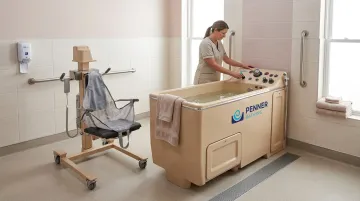
The first handles active between-patient cleaning; the second maintains ongoing surface protection regardless of cleaning schedules. For facilities serving Medicare and Medicaid residents, CMS participation compliance ties directly to infection control practices — making standardized hygiene equipment a documented compliance factor, not just an operational preference.
Penner's systems also address the dignity-related aspects of professional performance standards through ergonomic design. Height-adjustable configurations, forward-facing rail-free frames, and integrated transfer seating all minimize unnecessary exposure time and support resident comfort throughout the bathing process.
Frequently Asked Questions
What are the standards of nursing practice?
Nursing standards of practice are authoritative guidelines published by the ANA that define the minimum competent level of care expected from all registered nurses. They are structured around six steps of the nursing process, from assessment through evaluation, and apply to every RN regardless of setting.
What is the difference between standards of practice and standards of professional performance?
Standards of practice define what nurses do clinically, using the nursing process as their framework. The 12 standards of professional performance define how nurses conduct themselves professionally — covering ethics, communication, leadership, advocacy, and accountability.
What happens if a nurse fails to meet standards of practice?
Failure to meet standards can constitute unprofessional conduct, gross negligence, or incompetence. State Boards of Nursing may impose sanctions ranging from formal reprimand to license suspension or revocation, and civil liability for nursing malpractice is also possible when negligence causes patient harm.
How does the Nurse Practice Act relate to nursing standards?
The Nurse Practice Act is state-specific legislation that defines the legal scope of nursing practice and is enforced by each state's Board of Nursing. It operates alongside the ANA's professional standards simultaneously, and neither supersedes the other.
Who is responsible for enforcing nursing standards of practice?
Enforcement comes from multiple sources. State Boards of Nursing handle legal enforcement, courts address malpractice claims, CMS ties compliance to federal funding eligibility, and employers enforce facility-specific policies. TJC evaluates organizational compliance independently as an accreditor.
Do nursing standards apply in assisted living facilities the same way they do in nursing homes?
Not automatically. CMS Appendix PP applies to Medicare/Medicaid-certified skilled nursing facilities and nursing homes, not necessarily to every assisted living setting. Nurses in assisted living should verify which federal and state regulations apply based on their facility type and funding sources.