
For nurses, this diagnosis carries real daily weight. Patients with limited mobility face compounding risks: pressure injuries, deep vein thrombosis, contractures, pneumonia, and loss of independence that can be difficult to reverse once established.
This article covers the NANDA-I definition, nursing assessment, evidence-based interventions, three sample care plans, and expected outcomes — organized as a practical reference nurses can apply at the bedside.
Key Takeaways
- Impaired physical mobility (NANDA-I #00085) is defined as a limitation in independent, purposeful movement of the body or one or more extremities
- A complete care plan covers the diagnosis statement, assessment findings, interventions, measurable outcomes, and evaluation
- Effective interventions target mobility restoration, fall prevention, complication reduction, and PT/OT collaboration
- Educating patients and caregivers sustains mobility gains after discharge
What Is Impaired Physical Mobility?
The NANDA-I approved definition is straightforward: a limitation in independent, purposeful movement of the body or of one or more extremities. Functional mobility spans three distinct domains:
| Domain | What It Covers |
|---|---|
| Bed mobility | Moving within bed, including lying-to-sitting and repositioning |
| Transferring | Moving between surfaces — bed to chair, chair to toilet |
| Ambulation | Walking, with or without an assistive device |
Impairment in any one domain affects daily independence, even when the others remain intact.
Weight-Bearing Classifications
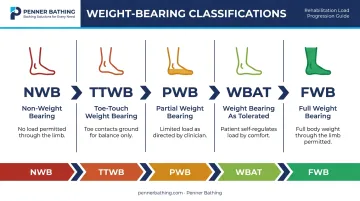
The patient's prescribed weight-bearing status directly shapes both nursing interventions and realistic expected outcomes. Five classifications are used:
- NWB (Non-Weight Bearing): No weight through the affected limb
- TTWB (Toe-Touch Weight Bearing): Toes may contact the floor for balance only
- PWB (Partial Weight Bearing): A specified portion of body weight only — the order should include an operational limit, since TTWB and PWB are frequently interpreted inconsistently
- WBAT (Weight Bearing As Tolerated): Weight may increase to what the patient can tolerate
- FWB (Full Weight Bearing): Full body weight through the limb
Common Causes
Causes are often multifactorial, particularly in older adults. Major categories include:
- Neurological: Stroke (more than 795,000 US cases annually per CDC), Parkinson's disease (~1.1M Americans living with it), multiple sclerosis, spinal cord injury
- Musculoskeletal: Arthritis (CDC estimates 58.5M US adults affected), fractures (~300,000 older adults hospitalized annually for fall-related hip fractures)
- Post-surgical recovery and acute pain
- Deconditioning: ICU-acquired weakness affects approximately 30% of ICU patients
- Psychological: Fear of falling, depression, low motivation
- Age-related decline: About 35% of adults over 70 have mobility limitations, rising sharply after age 85
- Cognitive impairment, obesity, malnutrition, and developmental delays
Signs and Symptoms
NANDA-I does not formally divide defining characteristics into subjective and objective subsets, but nurses gather both patient-reported information and observed findings.
Patient-reported:
- Pain or discomfort with movement
- Fear of falling or reluctance to move
- Stiffness, weakness, or fatigue with activity
Nurse-assessed:
- Limited range of motion (ROM)
- Decreased muscle strength or tone
- Altered or unsteady gait, postural instability
- Inability to reposition or transfer independently
- Slow or uncoordinated movement
- Inability to complete ADLs without assistance
NANDA-I Nursing Diagnosis for Impaired Physical Mobility
A nursing diagnosis is a standardized clinical judgment about how a patient responds to a health condition. Unlike a medical diagnosis, it guides nursing-specific interventions rather than physician-directed treatment.
NANDA-I recognizes four diagnosis types:
| Type | Description |
|---|---|
| Problem-focused | Current undesirable response; supported by related factors and defining characteristics |
| Risk | Vulnerability to an undesirable response; supported by risk factors, not current symptoms |
| Health promotion | Motivation to improve well-being or health potential |
| Syndrome | Cluster of diagnoses that occur and are addressed together |
Impaired physical mobility (code 00085, Domain 4 Activity/Rest, Class 2 Activity/Exercise) is typically a problem-focused diagnosis.
The PES Format
Problem-focused nursing diagnoses are written using the three-part PES format:
- P (Problem): The NANDA-I label
- E (Etiology): "Related to" — the underlying cause
- S (Signs/Symptoms): "As evidenced by" — the defining characteristics observed
Each component must be specific and patient-centered. PES format applies to problem-focused diagnoses only. Risk diagnoses omit the "as evidenced by" component because symptoms are not yet present.
The examples below show how this plays out across different clinical scenarios.
Example Diagnosis Statements
Example 1 — Post-Surgical Recovery: Impaired Physical Mobility R/T post-surgical pain and weakness AEB limited ROM, guarded movement, and inability to ambulate independently
Example 2 — Neurological Condition: Impaired Physical Mobility R/T neuromuscular deficit secondary to stroke AEB unilateral weakness and inability to ambulate without maximum assistance
Example 3 — Deconditioning: Impaired Physical Mobility R/T prolonged deconditioning AEB decreased muscle strength and inability to transfer from bed to chair independently
Distinguishing Related Diagnoses
These three labels are frequently confused but should not be substituted for each other:
- Impaired Physical Mobility: Limitation of independent, purposeful body or extremity movement
- Activity Intolerance: Insufficient physiologic endurance to complete required activity; the key indicator is cardiopulmonary response, not movement limitation itself
- Self-Care Deficit: Inability to complete a specific ADL (bathing, dressing, feeding, toileting); the focus is on task completion rather than the mechanism of movement
All three may coexist in the same patient.
Nursing Assessment for Impaired Physical Mobility
Functional Mobility Assessment
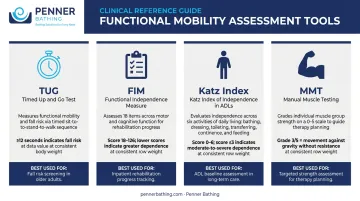
Select assessment tools based on the specific clinical question being answered — each measures something distinct:
| Tool | What It Measures | Key Benchmark |
|---|---|---|
| Timed Up and Go (TUG) | Time to stand, walk 3 meters, turn, return, sit | ≥12 seconds flags fall risk (CDC) |
| Functional Independence Measure (FIM) | 18 items (13 motor, 5 cognitive); 1–7 per item; total 18–126 | Higher scores = more independence |
| Katz Index of ADLs | Independence in 6 basic ADLs; scored 0–6 | Useful in older adults; less sensitive to small changes |
| Manual Muscle Test (MMT) | Voluntary muscle performance, 0–5 ordinal scale | Examiner-dependent; document muscle tested and position |
MMT grades for reference:
- 0 — No contraction
- 1 — Trace contraction, no movement
- 2 — Full ROM with gravity eliminated
- 3 — Full ROM against gravity
- 4 — Movement against gravity plus resistance
- 5 — Normal against maximal resistance
Beyond formal scoring, document weight-bearing status, active and passive ROM in affected joints, gait pattern, and ability to reposition independently.
Secondary Assessments
- Pain: Numeric scale before and after movement
- Cardiopulmonary response: Monitor heart rate, respiratory rate, O₂ saturation, and blood pressure both before and during activity progression
- Skin integrity: Inspect bony prominences; use Braden Scale for pressure injury risk screening
- Nutritional status: Malnutrition and low protein impair muscle recovery; ESPEN recommends routine malnutrition screening in older adults
- Assistive devices: Evaluate appropriateness of current equipment
Psychosocial and Environmental Assessment
Psychological barriers must be identified before realistic mobility goals can be set. Assess:
- Fear of falling and confidence with movement
- Depression or low motivation to participate in therapy
- Caregiver availability and competence
- Home or facility environment: clutter, flooring, lighting, grab bars
- Patient's own goals and self-reported priorities — these anchor the care plan in what matters to the individual
Nursing Interventions for Impaired Physical Mobility
ROM Exercises and Progressive Mobility
Begin passive ROM as soon as the patient's condition allows — research shows irreversible articular changes become more prominent after four or more weeks of immobilization, so earlier movement preserves more function.
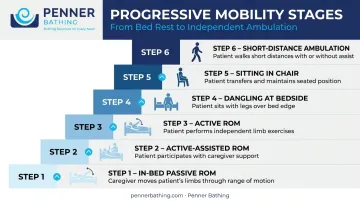
Progress through stages based on readiness and tolerance:
- In-bed movement: Passive ROM performed by nursing staff
- Active-assisted ROM: Patient participates with nurse support
- Active ROM: Patient performs independently
- Dangling at bedside: Legs over the side of the bed
- Sitting in chair: At bedside or in a chair with support
- Short-distance ambulation: Progressing distance as tolerated
Nurse-led early mobility protocols are associated with shorter ICU and hospital stays, though intervention content and evidence certainty vary. The key principle is individualized progression, not a rigid schedule.
Safe Patient Handling and Repositioning
Safe patient handling protects both patient and nurse. Core practices include:
- Use gait belts, body mechanics, and assistive lift equipment for all transfers
- Document the specific assistance level required (maximum, moderate, minimal, standby)
- Individualize repositioning frequency based on skin risk, mobility level, tolerance, support surface, and clinical condition (Cochrane evidence does not support a single universal two-hour interval as optimal for all patients)
- Positioning types serve distinct purposes: lateral positioning offloads sacral pressure; semi-Fowler reduces aspiration risk; prone positioning (when appropriate) relieves posterior pressure
- Maintain proper body alignment in all positions to prevent contractures
Fall Prevention and Environmental Safety
Use the Morse Fall Scale or a validated equivalent to stratify risk. At a cutoff of 50, one 2022 acute-care study found 85.7% sensitivity — performance varies by setting, so understand your tool's limitations before relying on a single threshold.
Implement a multifactorial plan:
- Non-slip footwear during all mobility attempts
- Bed in the lowest position; ensure call system is within reach
- Clear pathways and adequate lighting
- Scheduled toileting assistance to reduce unsupervised attempts
- Note: bed rails are not a universal solution and can introduce entrapment or climb-over hazards
For discharge planning, educate patients and caregivers on home modifications: removing loose rugs, adding grab bars, raising toilet seat height, and improving bathroom lighting.
Preventing Immobility Complications
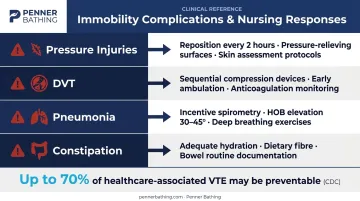
Key risks and nursing responses:
- Pressure injuries: Inspect bony prominences regularly; use pressure-relieving mattresses and individualized repositioning schedules
- DVT: CDC estimates up to 70% of healthcare-associated VTE may be preventable. Apply anti-embolism stockings or sequential compression devices, encourage active leg exercises, and confirm ordered prophylaxis is administered on schedule
- Pneumonia: Encourage coughing and deep breathing exercises; elevate the head of the bed; encourage early mobilization
- Constipation: Monitor bowel function; encourage fluid intake and dietary fiber; ambulate as tolerated
For long-term care residents, therapeutic bathing also supports the mobility care plan. Warm water hydrotherapy can ease the muscle and joint discomfort that makes movement painful, while bathing systems designed with safe transfer features reduce fall risk during the bathing process itself. Penner Bathing manufactures therapeutic bathing systems specifically for nursing homes and assisted living facilities, with automatic disinfection standard across all models — a relevant detail for residents with compromised skin integrity.
Interdisciplinary Collaboration and Patient/Caregiver Education
- Physical therapy: Gait training, strength building, transfer training, and progression of the mobility program
- Occupational therapy: Adaptive techniques for ADLs and appropriate equipment selection
- Case management: Coordinate home health or rehabilitation follow-up prior to discharge
Patient education should cover progressive exercise adherence and pain management strategies that support movement rather than avoidance. Caregiver education must include safe transfer techniques, correct equipment use, and specific signs of worsening mobility to report to the care team.
Sample Impaired Physical Mobility Care Plans
The following care plans cover three common clinical presentations. Each follows NANDA-I format and should be individualized to the patient's baseline, care setting, and goals.
Care Plan 1 — Post-Surgical Recovery
Diagnosis: Impaired Physical Mobility R/T post-surgical pain and weakness AEB limited ROM, guarded movement, and inability to ambulate independently
Nursing Interventions:
- Administer ordered analgesics 30–45 minutes before planned mobility attempts
- Implement progressive ambulation: dangling → bedside sitting → hallway walking with increasing distance
- Collaborate with PT for gait training and strength exercises
- Perform active and passive ROM exercises to affected extremities each shift
Expected Outcomes:
- Patient ambulates a patient-specific distance (established from baseline) with stated assistance level within 48 hours of surgery
- Patient demonstrates correct use of prescribed assistive device before discharge
- Patient reports pain at a manageable level (≤4/10) during mobility sessions
Care Plan 2 — Neurological Condition (Stroke or Parkinson's Disease)
Diagnosis: Impaired Physical Mobility R/T neuromuscular impairment AEB unilateral weakness, coordination deficits, and inability to ambulate without maximum assistance
Nursing Interventions:
- Implement progressive mobility program in coordination with PT, advancing from passive ROM to supported ambulation as tolerated
- Perform passive and active-assisted ROM to affected extremities at least twice per shift
- Assess and document fall risk at each shift using validated tool; maintain fall precautions
- Educate caregiver on safe transfer techniques and correct use of mobility aids before discharge
Expected Outcomes:
- Patient demonstrates improved muscle strength and coordination, advancing at least one assistance level (e.g., maximum to moderate) within a timeframe defined at baseline
- Patient performs ADLs with the assistance level specified in the individualized care plan
- Patient uses prescribed assistive devices correctly and safely during ambulation
Care Plan 3 — Deconditioning in a Long-Term Care Setting
Diagnosis: Impaired Physical Mobility R/T prolonged deconditioning AEB decreased muscle strength and inability to transfer from bed to chair independently
Nursing Interventions:
- Incorporate resistance exercises with light weights or resistance bands into daily routine, progressing load as tolerated
- Schedule ambulation sessions at consistent times daily; document distance and assistance level
- Nursing staff perform passive ROM between scheduled therapy sessions to maintain joint mobility
- Consult dietitian for protein and caloric support to promote muscle recovery; monitor hydration
Expected Outcomes:
- Patient demonstrates measurable strength improvement (e.g., ability to lift extremities against gravity or increased grip strength) within two weeks
- Patient performs bed-to-chair transfers with one reduced assistance level within a defined timeframe
- Patient maintains skin integrity and remains free of pressure injuries throughout care period
Frequently Asked Questions
What is the impaired physical mobility care plan?
A care plan for impaired physical mobility is a structured nursing document covering the NANDA-I diagnosis statement, assessment findings, nursing interventions, and measurable outcomes. It guides care systematically and is updated as the patient's mobility status changes.
What is a NANDA nursing diagnosis for impaired mobility?
The NANDA-I approved label is "Impaired Physical Mobility" (code 00085), defined as a limitation in independent, purposeful physical movement of the body or one or more extremities. It is documented as a three-part PES statement linking the problem, its cause, and observed defining characteristics.
What are the nursing interventions for someone with impaired mobility?
Core interventions include ROM exercises, progressive ambulation, safe repositioning, fall prevention, assistive device training, PT/OT referrals, and patient education. Interventions must account for the underlying cause, weight-bearing status, and severity of impairment.
What are the signs and symptoms of impaired physical mobility?
Patient-reported signs include pain with movement, fear of falling, and reluctance to move. Nurse-assessed findings include limited ROM, decreased muscle strength, altered gait, postural instability, inability to reposition or transfer independently, and dependence on assistive devices for ADLs.
How do you prevent complications from impaired physical mobility?
Individualize repositioning frequency based on skin risk and clinical condition to prevent pressure injuries. Perform ROM exercises to prevent contractures. Use compression devices and encourage leg exercises to reduce DVT risk — CDC notes up to 70% of healthcare-associated VTE is preventable. Promote deep breathing and coughing exercises to reduce pneumonia risk.
What are the expected outcomes for impaired physical mobility nursing care plans?
Short-term goals include improved ROM, reduced pain with movement, and safe assistive device use. Long-term goals target optimal ambulation, complication prevention, and adherence to PT exercises. All outcomes must be specific to the patient's baseline and reassessed regularly.