Introduction
Picture a nurse in a long-term care facility who notices something troubling: a resident who once asked questions about her medications has gone quiet. She nods when nurses explain her care plan but never pushes back, never asks why, never offers her own preferences. She's receiving care — but she's not part of it.
Patient partnership is designed to close that gap.
Patient partnership in nursing is a collaborative, trust-based approach where patients are treated as active participants rather than passive recipients of care. Their values, preferences, and voice shape clinical decisions — not just satisfaction scores.
Professional bodies including the American Nurses Association (ANA), IPEC, and AACN have embedded partnership competencies directly into nursing standards and accreditation frameworks, reflecting a broad consensus that it's foundational to quality practice.
This guide covers:
- What patient partnership actually means — and how it differs from patient-centered care
- Its core principles and evidence-based benefits
- Practical strategies nurses can use to build it
- Specific applications in long-term care and nursing home settings
Key Takeaways
- Patient partnership makes patients co-decision-makers — not just recipients of tailored care
- Shared decision-making requires genuine dialogue about values — presenting a care plan isn't enough
- Three daily practices drive the most impact: active listening, dignity-preserving routines, and family inclusion
- Long-term care settings demand adapted strategies, particularly for residents with dementia or communication barriers
- Time pressure is a real barrier, but brief intentional check-ins still move the needle
What Is Patient Partnership in Nursing?
More Than Patient-Centered Care
Patient-centered care and patient partnership are often used interchangeably, but they represent different levels of patient involvement. Patient-centered care tailors treatment to individual needs and preferences. Patient partnership goes further — placing the patient as an active decision-maker, not just the recipient of well-intentioned choices.
The AACN's Domain 2 defines the person as a "full partner and the source of control" in team-based care. IPEC's version 3 competency framework builds interprofessional collaborative practice around four pillars — Values and Ethics, Roles and Responsibilities, Communication, and Teams and Teamwork — each organized around the patient.
In practice, the gap matters. A 2017 BMJ Open qualitative study found that care often remains professionally led even when patient-centered language is used. Partnership sits at the high-involvement end of that continuum, where patients have genuine say in what happens to them.
Who Is Involved?
Patient partnership extends well beyond the nurse-patient dyad. It includes:
- Families and caregivers, particularly when patients have limited capacity to advocate for themselves
- Interdisciplinary team members — physicians, therapists, social workers — coordinating care around shared patient goals
- The patient as the central voice, not a passive subject of coordination
In long-term care settings, this dynamic carries particular weight — relationships with nursing staff develop over months and years, and trust builds through consistency rather than single-episode interactions.
The Core Principles of Patient Partnership in Nursing
Treating Patients as Equals and Keeping Them Informed
Genuine partnership starts with how nurses listen. A patient's perspective must be given real weight in clinical conversations — not acknowledged and then set aside. In practice, this might look as simple as pausing a care plan discussion to ask, "Does this match what's important to you?" before moving forward.
Being fully informed is what makes genuine participation possible. Nurses have a responsibility to communicate diagnoses, treatment options, and care plans in plain language. A patient who understands their options can contribute meaningfully to decisions about their own care.
Shared Decision-Making
NICE defines shared decision-making as a joint process that combines clinical evidence with the patient's own preferences, beliefs, and circumstances. As NICE guidance NG197 makes clear: supplying information or explaining a completed plan, while necessary, does not constitute a shared decision.
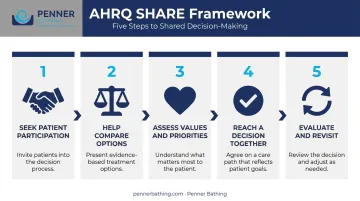
The AHRQ SHARE framework provides a practical five-step structure:
- Seek the patient's participation
- Help them compare options with clear pros and cons
- Assess their values and what matters most to them
- Reach a decision together
- Evaluate the decision over time and revisit it
Recognizing Inequalities and Actively Seeking Input
The SHARE framework only works when every patient can meaningfully engage with it. That means accounting for real differences in literacy, language, cognitive ability, and cultural background. NICE requires communication support, visual aids, and accessible information before concluding that a patient cannot participate in a decision. Capacity is presumed. What changes is the method of participation, not whether participation happens at all.
And partnership isn't a one-time conversation. It requires nurses to routinely solicit patient feedback, treat it as clinically meaningful, and visibly act on it — following up with patients to show how their input shaped care decisions.
Why Patient Partnership Matters: Benefits for Patients and Nurses
Better Outcomes and Patient Safety
The evidence is promising, though context matters. A 2024 systematic review in JAMA Network Open found improved knowledge in 13 of 20 shared decision-making studies and improved satisfaction in 6 of 14 — meaningful gains, even if not universal.
For older adults specifically, a 2024 study of 1,610 participants found higher intended adherence to treatment under a shared decision-making communication style compared to an authoritarian one (69.1% vs. 62.2% for treatment adherence intentions). That gap matters in long-term care, where chronic condition management depends on cooperation over time.
Better cooperation also connects directly to safety. A 2016 NIHR study found that patients reported 68 safety incidents that neither case notes nor staff reports captured. Patients notice things institutional systems miss — nurses who make space for that input add a meaningful layer to safety monitoring.
Nurse Wellbeing
The ANA links emotionally fulfilling nurse-patient relationships with reduced fatigue and burnout. A 2025 cross-sectional survey of 1,013 nurses associated relationally meaningful work with greater subjective wellbeing and lower turnover intention. These are correlational findings, not causal proof — but they reflect a consistent pattern: nurses who engage patients as partners report the work feeling more sustainable.
How to Build Effective Patient Partnerships in Nursing: Practical Strategies
Practicing Active Listening
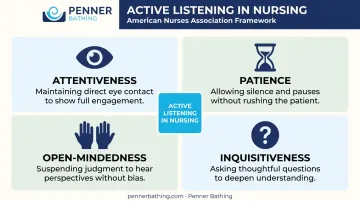
The ANA identifies four components of active listening in nursing:
- Attentiveness — verbal acknowledgment and nonverbal cues like eye contact and open posture
- Patience — allowing patients to finish without interruption
- Open-mindedness — genuinely respecting beliefs and choices that differ from clinical preference
- Inquisitiveness — asking questions about needs, feelings, and wellbeing, not just symptoms
High-pressure nursing environments create predictable failures: charting during conversations, giving scripted responses, mentally composing the next task while a patient is still speaking. A 2022 integrative review found that EHR use at the bedside can reduce eye contact and promote task-focused exchanges. A practical fix: finish the note after the conversation, not during it. Even brief, undivided attention signals that the patient's words matter.
Building Trust Through Consistent, Dignified Care
Trust is built through repetition. Specific actions that communicate respect:
- Asking permission before starting procedures
- Explaining what is happening and why, in plain language
- Honoring stated preferences, even small ones
- Following through on commitments — if you say you'll check back, check back
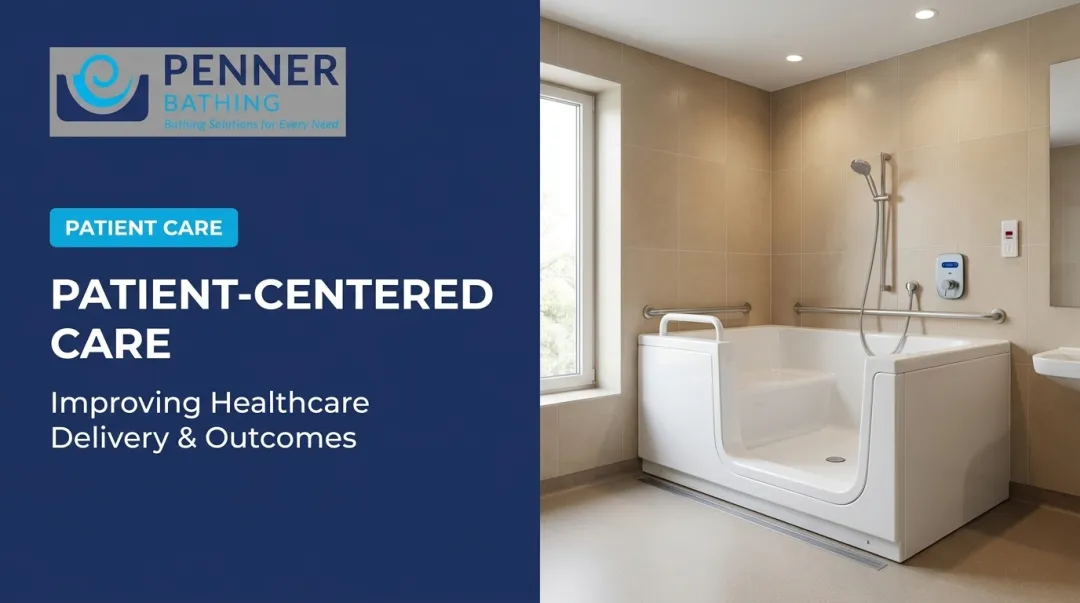
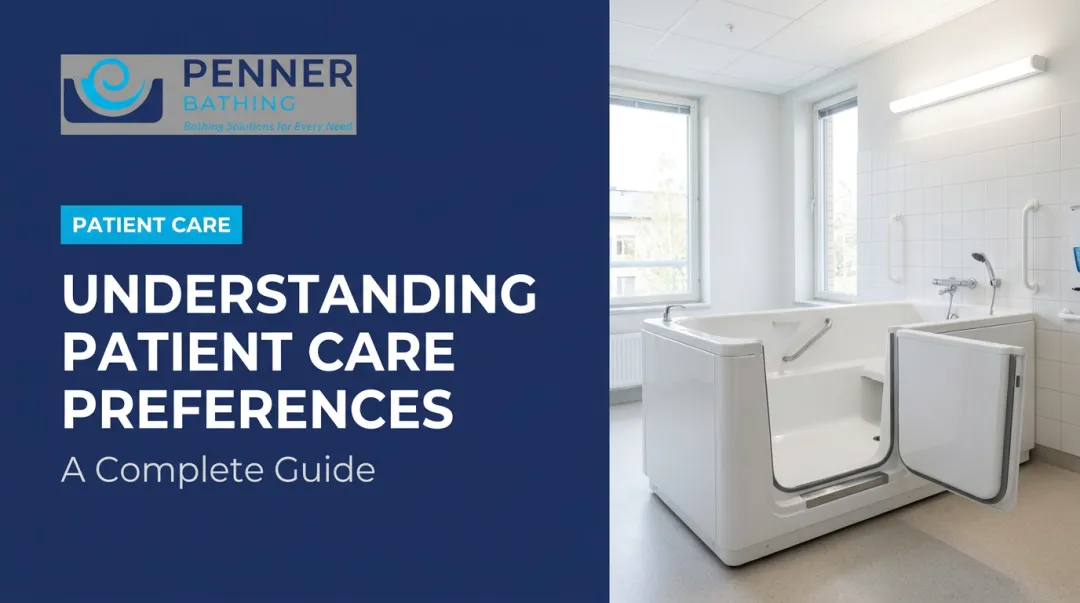
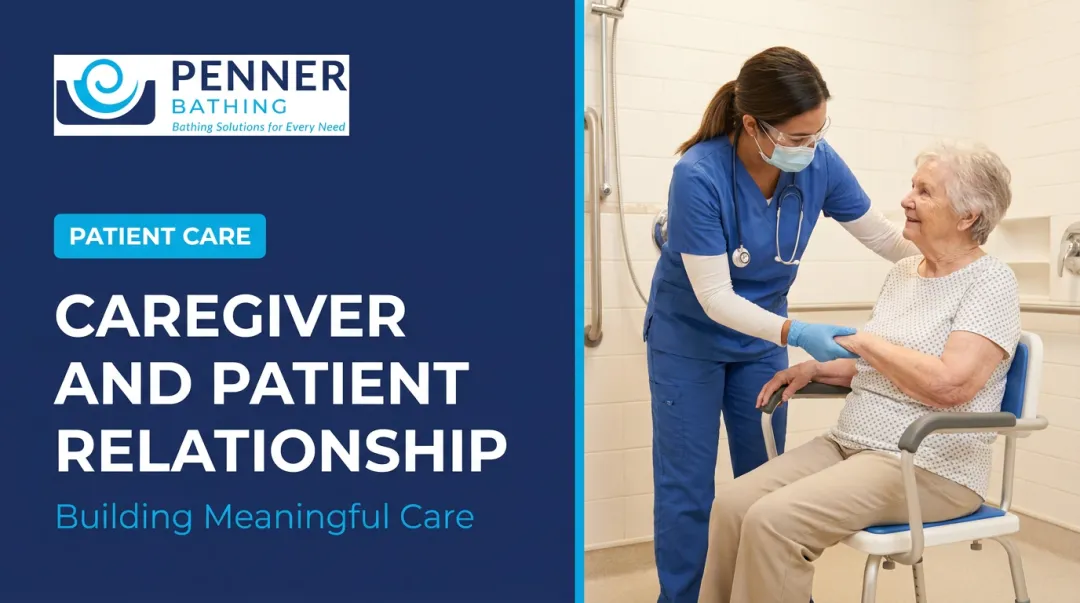
These behaviors matter in every care setting, but the physical environment shapes how consistently they're possible. In long-term care, bathing is one of the most intimate and frequent touchpoints between nurses and residents — and how that routine is handled signals whether dignity is a genuine value or just a policy checkbox. Facilities that invest in purpose-designed bathing systems, such as Penner Bathing's therapeutic tubs with forward-facing transfer designs and integrated entertainment options, create conditions where unhurried, resident-centered care is easier to deliver. When residents feel physically comfortable and safe, the interaction becomes an opportunity for connection rather than a task to get through.
Involving Families and Caregivers
Family members are resources, not intrusions — when boundaries are respected. Practical approach:
- Identify early which individuals the patient wants involved in care discussions
- Respect privacy by not sharing information beyond what the patient has authorized
- Treat family input as meaningful context, not noise to manage
In long-term care, families often become the patient's voice when verbal communication is limited. Building genuine relationships with families — not just informing them — is part of patient partnership.
Shared Decision-Making in Practice
A practical framework for a shared decision-making conversation:
- Present the options, including the option of no change, in plain, jargon-free language
- Explain trade-offs: what each option involves, what the risks are, and what the benefits are
- Invite the patient's perspective by asking what matters most to them, not just which option they prefer
- Collaborate on a plan — arrive at a decision together, not a prescription with the patient's signature on it
- Follow up and revisit the decision as circumstances change
Patient Partnership in Long-Term Care and Nursing Home Settings
Long-term care presents both the strongest case for patient partnership and some of its most complex challenges. Residents may have dementia, multiple chronic conditions, or significant communication barriers. Unlike hospital care, the relationship with nursing staff isn't episodic — it's ongoing, sometimes for years. That continuity makes trust the precondition for nearly every care interaction, not just a communication goal.
Adapted Strategies for Long-Term Care
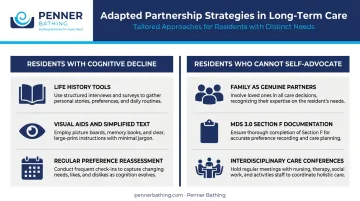
For residents with cognitive decline:
- Use life history tools and care preference assessments to understand values even when verbal communication is limited
- NICE recommends visual aids, simplified text, and structured tools for capturing likes, dislikes, routines, and personal history
- Revisit advance care preferences regularly — they can and do change
For residents who cannot self-advocate:
- Involve families as genuine partners, not just information recipients
- Document preferences in CMS's MDS 3.0 Section F (preferences for customary routines and activities), as required under federal regulations at 42 CFR 483.21
- Use interdisciplinary care planning conferences plus informal daily exchanges — a 2017 participatory study found both were necessary for effective person-directed planning
The Role of the Physical Environment
Facilities that invest in resident comfort during daily routines create conditions where partnership becomes possible. The bathing environment is one concrete example: residents who are left undressed and waiting, or who associate bath time with institutional discomfort, are harder to engage as partners in their own care.
Penner Bathing's healthcare systems address this directly. Spa-like aesthetics reduce the anxiety that sterile settings often trigger. Fast-fill reservoirs cut wait times while residents are vulnerable and exposed. Automatic disinfection removes manual cleaning delays between residents, keeping the process moving without sacrificing hygiene. When the environment itself signals respect for dignity, nurses have more space to focus on the relationship — not the logistics.
Common Barriers to Patient Partnership and How to Overcome Them
Structural and System-Level Barriers
These are real constraints, not excuses:
- Time pressure and high patient-to-nurse ratios — MedPAC reports a 2024 national median of 0.5 acuity-adjusted RN hours per resident-day in skilled nursing facilities
- Task-centered routines that leave little room for dialogue
- Hierarchical communication norms that push nurses into authority roles rather than collaborative ones
- Limited training in patient engagement and shared decision-making
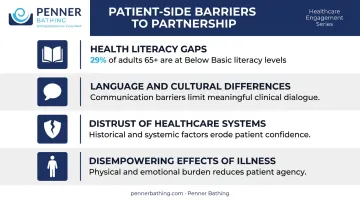
Patient-Side Barriers
Nurses must also meet patients where they are:
- Health literacy gaps are common — CDC data found that 29% of adults 65 or older scored at Below Basic health literacy levels in the national literacy assessment
- Language and cultural differences require adapted communication, not just simplified words
- Distrust of healthcare systems runs deep, particularly among historically marginalized populations
- The disempowering effects of illness — someone who feels frightened, confused, or unwell often defaults to passivity
Practical Nurse-Level Responses
These strategies work within real-world time and staffing constraints:
- Use brief, intentional check-ins rather than waiting for scheduled care plan meetings
- Apply the AHRQ SHARE model in short interactions — simply asking "What matters most to you about this?" opens the door
- Leverage interdisciplinary team meetings to reinforce partnership goals across the care team
- Advocate for policies that build patient engagement into workflow rather than layering it on top
Frequently Asked Questions
What is meant by patient partnership in nursing?
Patient partnership is a collaborative approach where nurses involve patients as active participants in their own care. Unlike standard care, patient values and preferences genuinely shape clinical decisions rather than simply informing the care environment.
Why is trust so important in the nurse-patient relationship?
Trust is the foundation of honest communication. Patients who trust their nurses are more likely to share symptoms, raise concerns early, and engage meaningfully with their treatment plan — all of which directly affect care quality and safety outcomes.
How does patient partnership improve health outcomes?
Active patient involvement leads to stronger treatment adherence, earlier problem identification, and care plans that reflect patients' actual needs. SDM research consistently shows improvements in patient knowledge and reduced decisional conflict — gains that are especially pronounced in chronic condition management.
What is the difference between patient-centered care and patient partnership?
Patient-centered care tailors treatment to the individual. Patient partnership goes further: the patient becomes a co-decision-maker with genuine agency over their care plan, rather than a passive recipient whose preferences are noted but not acted on equally.
What are common barriers to patient partnership in nursing?
Time constraints, high workloads, health literacy differences, cultural and language barriers, and limited training in patient engagement are the primary obstacles. Targeted communication training and intentional habits — even brief check-ins — can help nurses work within these constraints.
How can nurses practice shared decision-making in daily care?
By presenting options clearly, actively inviting patient input, incorporating patient values into care plans, and following up to adjust plans as preferences evolve. The AHRQ SHARE model provides a structured approach that holds up even in time-limited clinical interactions.