Introduction
Nearly 4 in 10 patients transferred from hospitals to nursing homes experience an adverse event — and a 2019 JAMA Internal Medicine study found that 70.4% of those events were preventable or ameliorable. That's not a quality problem on the margins. That's a preventable failure — one that facility leaders are positioned to address.
Healthcare safety is both a moral obligation and an operational reality — one that shapes the daily experience of residents, patients, and the caregivers responsible for their wellbeing. Facilities that treat safety as a compliance checkbox miss the deeper point: it's the foundation everything else is built on.
This article covers the principles and practices that matter most for facility leaders: building a culture where safety is non-negotiable, protecting both patients and staff, designing physical environments that reduce harm, and identifying the specific interventions that produce measurable results.
Key Takeaways
- Most healthcare errors stem from broken systems, not individual negligence — fix the system, not just the person
- Healthcare workers face injury rates nearly 3x the private-industry average in skilled nursing facilities
- A just culture builds transparent reporting without fear — the foundation of any lasting safety improvement
- Physical environment — including bathing systems, lighting, and flooring — is a measurable safety variable in long-term care
- Sustainable safety improvement requires ongoing measurement tied to leadership accountability
Why Healthcare Safety Is a Non-Negotiable Priority
Healthcare safety failures don't stay contained to one part of the organization. When staff get hurt, patient care suffers. When patients are harmed, the facility bears regulatory, legal, and reputational consequences. These risks are interconnected — and leadership that treats them as separate problems misreads the system.
The Numbers on Worker Injury Are Hard to Ignore
BLS 2024 data tells a stark story about who bears the physical cost of healthcare work:
- 2.3 per 100 workers — private industry average for nonfatal occupational injuries
- 3.4 per 100 — health care and social assistance overall
- 5.5 per 100 — nursing and residential care facilities
- 6.3 per 100 — skilled nursing facilities specifically
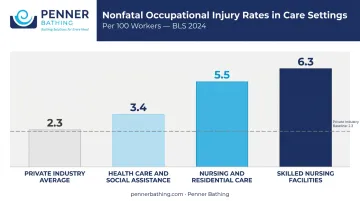
That's nearly triple the private-industry rate. When caregivers are injured, facilities face workers' compensation costs, reduced staffing capacity, and rushed care routines that put residents at greater risk. Staff safety and patient safety are not separate issues.
Systems, Not Scapegoats
The most consistent insight from patient safety research is that most errors reflect system failures — not moral failures by individual clinicians. Understaffing, unclear protocols, equipment that isn't designed for its actual use case, and inadequate training all create conditions where errors become likely.
Organizations that respond to errors by blaming individuals leave the underlying system intact — which means the same conditions remain in place for the next error to occur.
The Regulatory and Reputational Stakes
Safety failures carry real institutional consequences:
- OSHA enforcement — facilities can face serious violations and substantial penalties for inadequate hazard controls
- Accreditation risk — The Joint Commission and CMS certification both hinge on demonstrable safety practices
- Litigation exposure — adverse events create medical negligence claims that cost far more than prevention
- Community trust — a facility's reputation in its local market depends heavily on safety outcomes that families can see and feel
The Foundational Principles of Patient Safety
The Ethical Backbone: Four Principles of Biomedical Ethics
Tom Beauchamp and James Childress established the ethical framework that still governs patient safety thinking in their Principles of Biomedical Ethics (8th ed., Oxford University Press, 2019). The four principles carry direct operational implications for care delivery:
| Principle | What It Means in Practice |
|---|---|
| Autonomy | Patients have the right to make informed decisions about their own care |
| Beneficence | Every care decision should actively serve the patient's best interest |
| Nonmaleficence | Minimize unnecessary harm through evidence-based protocols and proper equipment |
| Justice | Equitable care isn't just ethical — gaps in quality create measurable safety disparities |
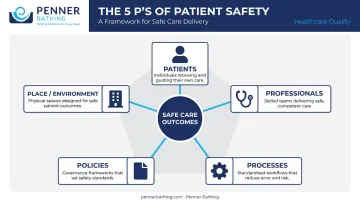
The 5 P's of Patient Safety
Safe care outcomes depend on all five elements functioning together. A gap in any single area creates systemic vulnerability:
- Patients — engaged, informed participants in their own care
- Professionals — trained, supported, and empowered to speak up
- Processes — standardized, evidence-based protocols for high-risk routines
- Policies — organizational rules that reinforce safe behavior
- Place/Environment — physical spaces and equipment designed to reduce harm
Nonmaleficence in Practice
"Do no harm" doesn't mean avoiding all risk. Eliminating risk entirely would make care impossible. It means minimizing unnecessary harm through informed choices:
- Selecting equipment appropriate for the patient population
- Following protocols validated by clinical evidence
- Designing workflows that reduce avoidable adverse events
Justice as a Safety Issue
Equity belongs in any serious safety discussion. A 2023 JAMA Network Open study covering 13,179 U.S. nursing homes found that major-injury falls and stage 3-4 pressure ulcers were significantly underreported in facilities serving predominantly non-White residents. When measurement itself is unequal, safety disparities go uncorrected.
Building a Just Culture of Safety in Healthcare
What Just Culture Actually Means
A just culture is a system-level approach where errors trigger transparency and root-cause analysis — not automatic blame. It distinguishes between three categories of behavior:
- Human error — mistakes despite best efforts (manage the system)
- At-risk behavior — choices that increase risk without awareness (coach and redirect)
- Reckless behavior — conscious disregard for known risks (hold accountable)
This framework matters because it allows organizations to learn from the first two categories without either ignoring accountability or creating fear that silences reporting.
Why Criminalization Backfires
In 2022, nurse RaDonda Vaught was convicted of criminally negligent homicide after administering the wrong medication, sparking national debate about where individual accountability ends and systemic responsibility begins. She received three years of supervised probation. Her case exposed a difficult truth: when clinicians fear criminal prosecution for errors, the instinct is to conceal rather than report, and the underlying system conditions that enabled the error go unaddressed.
The Leadership Imperative
ACHE's Blueprint for Safety identifies six leadership domains that drive genuine safety culture. These are worth treating as an audit framework:
- Establish a compelling safety vision
- Select, develop, and engage the board
- Build trust, respect, and inclusion
- Prioritize safety in leadership selection and development
- Lead and reward a just culture
- Establish clear organizational behavior expectations
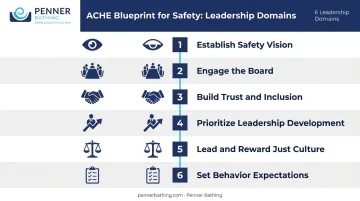
Leadership accountability, not front-line compliance, is the most critical driver of lasting improvement.
Disclosure and Its Effect on Litigation
Counterintuitively, transparent disclosure of errors to patients and families reduces litigation exposure. A 2024 evaluation of Michigan Medicine's communication-and-resolution program covering 2013–2022 found that 92% of claims were closed or settled internally, with stable or decreased resolution times. Honesty and relationship-preservation are also effective risk-management strategies.
Creating Safe Patient Environments in Long-Term Care
The Physical Environment Is a Safety Variable
Room layout, flooring, lighting, and equipment design shape the frequency of falls, infections, and patient injuries — especially for elderly or mobility-impaired residents. According to the 2022 National Academies nursing home report, approximately 50% of nursing home residents fall annually, and nearly 2 million infections occur in nursing homes each year. These aren't statistics about individual carelessness. They're the measurable output of environments not designed to prevent them.
Design interventions that reduce harm include:
- Smaller-scale layouts that reduce disorienting corridors
- Private rooms that limit infection transmission
- Access to natural light, which supports circadian rhythm and orientation
- Equipment and bathing areas designed to accommodate safe transfers
Bathing as a High-Risk Routine
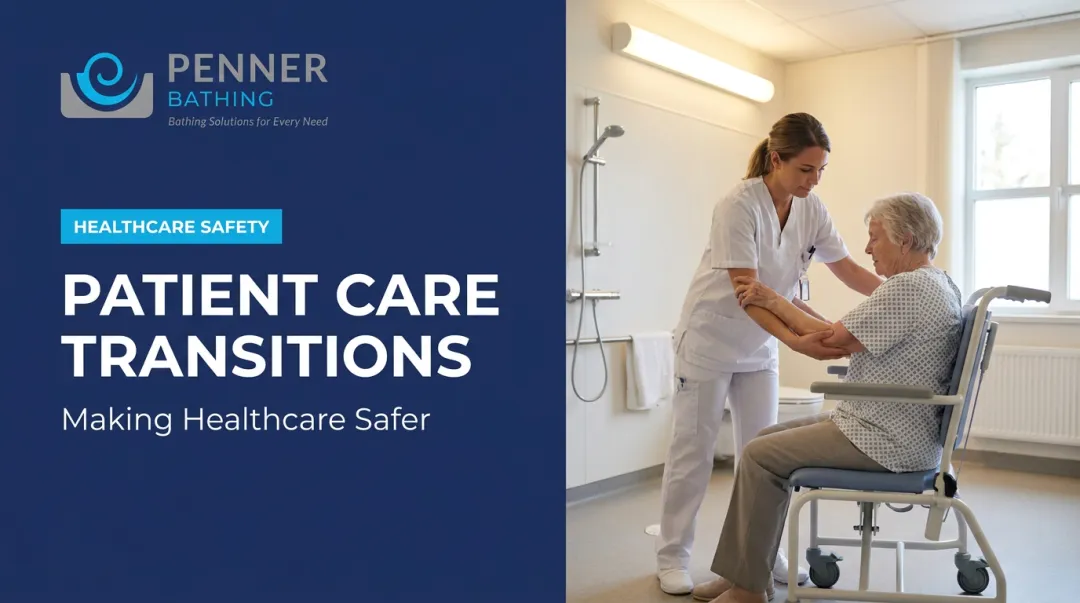
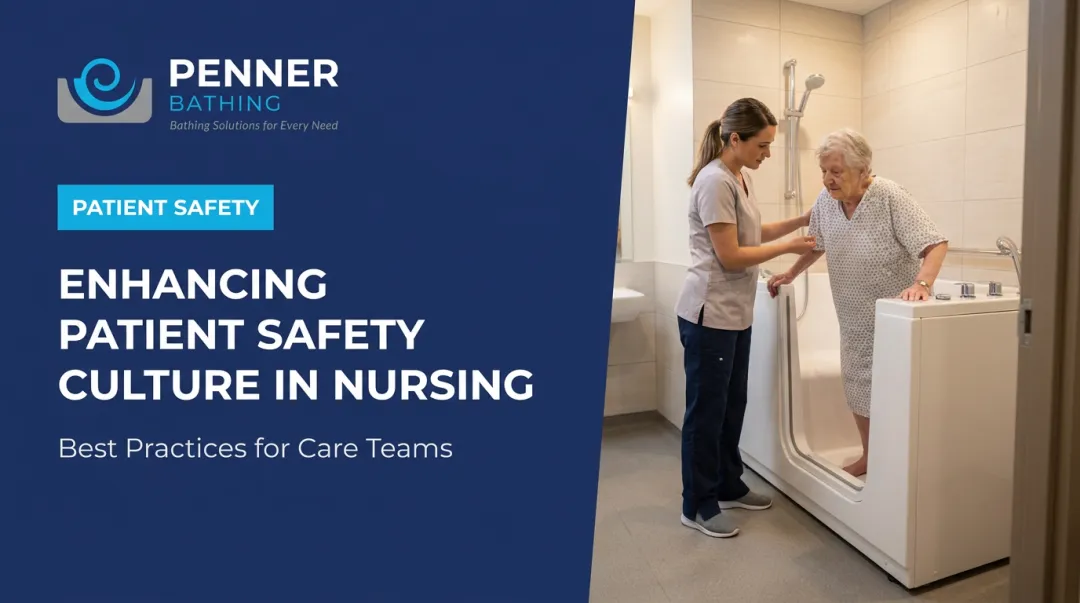
Bathing is among the most physically demanding and high-risk care routines in long-term care — for both residents and caregivers. Transfers in and out of bathing equipment are a significant source of falls and skin integrity issues, and the wet environment amplifies risk.
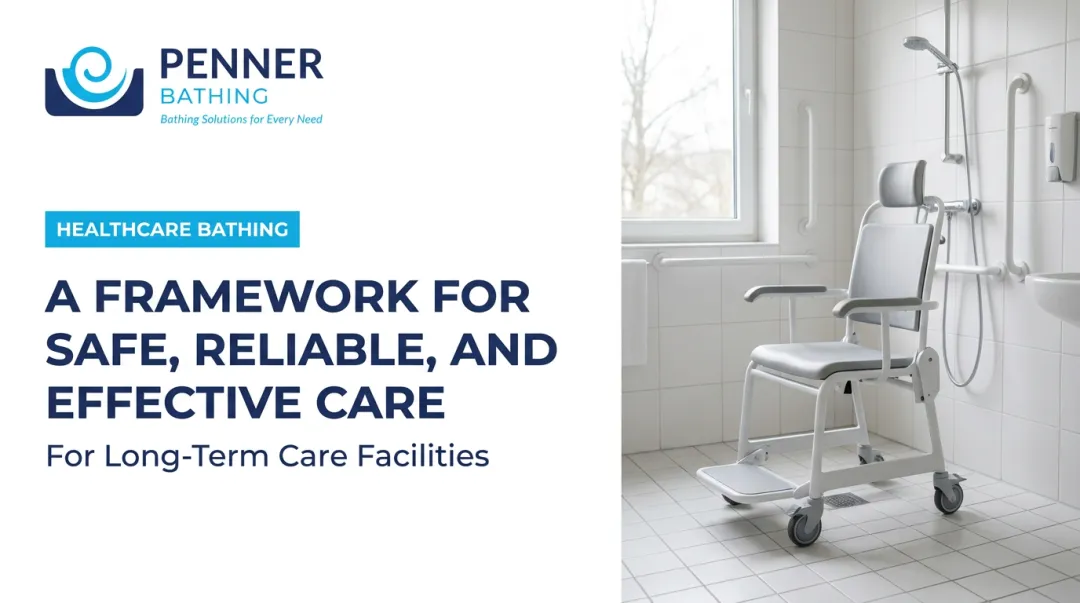
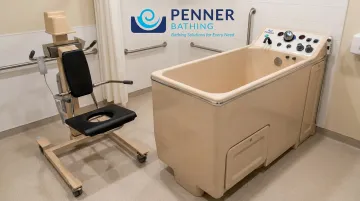
Purpose-built healthcare bathing systems address this directly. Penner Bathing, which has designed and manufactured bathing systems for long-term care facilities since 1980, engineers its equipment around this specific context:
- End-opening transfer configurations that reduce caregiver physical strain
- Rail-free designs that eliminate transfer obstacles
- Mobile transfer options that minimize repositioning steps
Infection control is the other half of the equation. Penner's automatic disinfection system, standard across all product lines, removes the inconsistency that manual protocols introduce — when disinfection is built into the care routine, human error is no longer a variable. Their systems also incorporate BioCote® antimicrobial protection into the spa materials themselves, providing continuous surface-level activity 24/7. That matters in high-turnover environments where multiple residents share the same equipment each day.
Staff Ergonomics and Patient Outcomes
Caregiver injury and patient safety aren't separate problems. When staff are physically strained by poorly designed equipment, care quality suffers — and rushed or understaffed bathing routines create exactly the conditions where falls and skin injuries occur.
NIOSH recommends safe patient handling and mobility programs specifically because manual lifting and repositioning cause musculoskeletal disorders that sideline healthcare workers. Equipment designed with caregiver ergonomics in mind — including features like Penner's fast-fill reservoir that reduces total bathing time — protects staff alongside residents.
Dignity as a Safety Factor
Resident comfort and psychological safety aren't soft concerns. The National Academies report found that residents in Green House model homes — designed to feel residential rather than institutional — were 45% less likely to require catheters and 38% less likely to develop pressure ulcers than residents in traditional settings.
When residents feel comfortable and calm, they cooperate with care routines rather than resisting them. That cooperation reduces the physical risk to both resident and caregiver during transfers and bathing.
Practical Steps Healthcare Administrators Can Take Today
Start with an Honest Assessment
Federal regulations under 42 CFR 483.71 require a documented facility-wide assessment at least annually — covering resident population, staffing competencies, equipment, services, and an all-hazards risk analysis. Many facilities treat this as a compliance checkbox. The administrators who use it as a genuine diagnostic tool find it far more valuable.
Start by:
- Reviewing incident reporting data for patterns across time and care areas
- Identifying one high-risk routine — bathing, transfers, or medication administration — for an immediate protocol and equipment audit
- Comparing current practices against the QAPI framework required under 42 CFR 483.75
Invest in Staff Education and Competency Tracking
Regulations under 42 CFR 483.95 require at least 12 hours of in-service education annually for nurse aides, along with documented competency evaluations. High-performing facilities routinely exceed that threshold.
Effective training programs include:
- Simulation exercises and mock drills for high-risk scenarios (including de-escalation)
- Skills check-offs for equipment-specific operations like transfer systems and bathing equipment
- Documentation that captures both completion and demonstrated competency
Measure, Share, and Hold Leadership Accountable
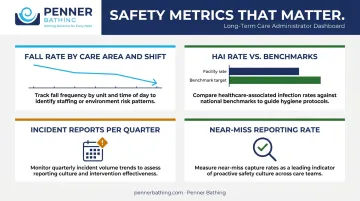
Safety improvement that isn't measured doesn't sustain. Establish specific metrics and share results transparently with staff:
- Fall rates by care area and shift
- HAI rates tracked against facility and national benchmarks
- Incident reports filed per quarter
- Near-miss reporting rates (a leading indicator of culture)
Tie leadership performance to safety outcomes, not clinical productivity alone. When administrators treat fall rates and HAI numbers with the same urgency as occupancy rates, that priority becomes visible — and staff respond to it.
Frequently Asked Questions
What are the 4 C's of health and safety?
The 4 C's are Competence, Communication, Control, and Cooperation. In healthcare, this means ensuring staff are properly trained, information flows clearly across the care team, hazards are identified and managed, and everyone from leadership to front-line staff works toward shared safety goals.
What are the 5 P's of patient safety?
The 5 P's are Patients, Professionals, Processes, Policies, and Place/Environment. Safe care requires all five to work in alignment — a breakdown in any one area, such as a poorly designed environment or undertrained staff, can lead to preventable harm.
What is JCAHO now called?
JCAHO — the Joint Commission on Accreditation of Healthcare Organizations — shortened its name to The Joint Commission in 2007. It continues to set and enforce healthcare safety standards in the U.S., including a Nursing Care Center Accreditation Program specifically for long-term care organizations.
What are the 4 major components of a healthcare worker safety program?
A comprehensive program covers hazard identification, prevention and control measures, education and training, and incident reporting and evaluation systems. OSHA requires management commitment and worker participation as foundational to all four components.
What are the most common safety risks for elderly patients in long-term care settings?
Falls, healthcare-associated infections, medication errors, and pressure injuries (including skin breakdown during routine care) are the leading risks. Many occur during high-contact activities like bathing and transfers — making equipment design and caregiver training especially critical interventions.