Here's the short answer: Original Medicare does not cover standard shower chairs. They're classified as personal convenience items, not medically necessary durable medical equipment (DME). That said, there are meaningful exceptions — commode chairs, specific clinical situations, and alternative programs like Medicare Advantage and Medicaid — that are worth understanding before paying out of pocket.
This guide breaks down exactly why standard shower chairs don't qualify, what does qualify, and where to turn if Medicare won't help.
Key Takeaways
- Original Medicare Part B excludes standard shower chairs : Medicare classifies them as personal convenience items, not durable medical equipment (DME)
- Commode chairs (HCPCS E0163/E0165) may qualify for Medicare coverage under specific medical criteria
- Medicare Advantage, Medicaid, and VA programs sometimes provide coverage where Original Medicare doesn't
- Basic shower chairs typically cost $34–$74 out of pocket at major retailers
- A physician's prescription is necessary but not sufficient — meeting Medicare's full DME criteria is also required
Why Original Medicare Doesn't Cover Shower Chairs
Medicare Part B covers durable medical equipment when all four of these conditions are met:
- The item withstands repeated use
- It's primarily and customarily used for a medical purpose
- It's not generally useful to someone without illness or injury
- It's appropriate for home use
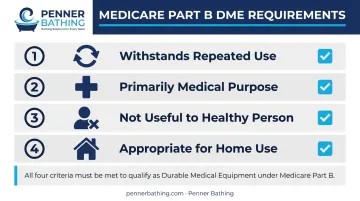
Shower chairs fail on criterion three. Medicare's position is that a healthy person might also benefit from a shower chair — meaning it doesn't meet the threshold of being "primarily useful to someone who is ill or injured."
What Qualifies as Durable Medical Equipment
To understand where shower chairs fall short, it helps to see what Medicare does cover under DME. According to Medicare.gov, covered categories include:
- Walkers and wheelchairs
- Hospital beds
- Oxygen equipment and accessories
- Commode chairs
- Power-operated scooters
These items share a common thread: they serve a function that a healthy person fundamentally doesn't need. A walker isn't a convenience — it's a mobility necessity for someone who can't walk safely without one.
How Shower Chairs Are Classified
CMS's National Coverage Determination (NCD 280.1) specifically excludes "bathtub seats" as comfort or convenience items that are "not primarily medical in nature." A Michigan Medicaid provider letter from November 2023 confirms this directly, stating that bath/shower chairs under HCPCS code E0240 are "statutorily excluded from Medicare" DME coverage.
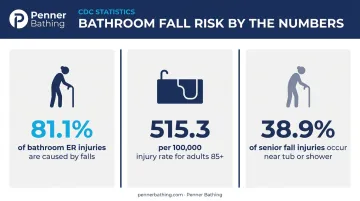
The exclusion exists despite significant fall risk data. CDC emergency department data found that 81.1% of bathroom injuries treated in emergency departments were caused by falls — with injury rates climbing to 515.3 per 100,000 among adults aged 85 and older. For that age group, 38.9% of injuries occurred in or around the tub or shower.
That leaves seniors and caregivers to find coverage through other channels — Medicare Advantage plans, Medicaid waivers, or out-of-pocket purchase.
Exceptions: When Medicare May Cover Shower Chair-Related Equipment
Standard shower chairs are out. That said, a few legitimate pathways exist worth understanding.
Commode Chairs as a Covered Alternative
Medicare covers commode chairs under HCPCS codes E0163 (fixed arms) and E0165 (detachable arms) when a beneficiary physically cannot use regular toilet facilities and meets at least one of these conditions:
- Confined to a single room
- Confined to one level of the home where no toilet exists
- Confined to a home without toilet facilities
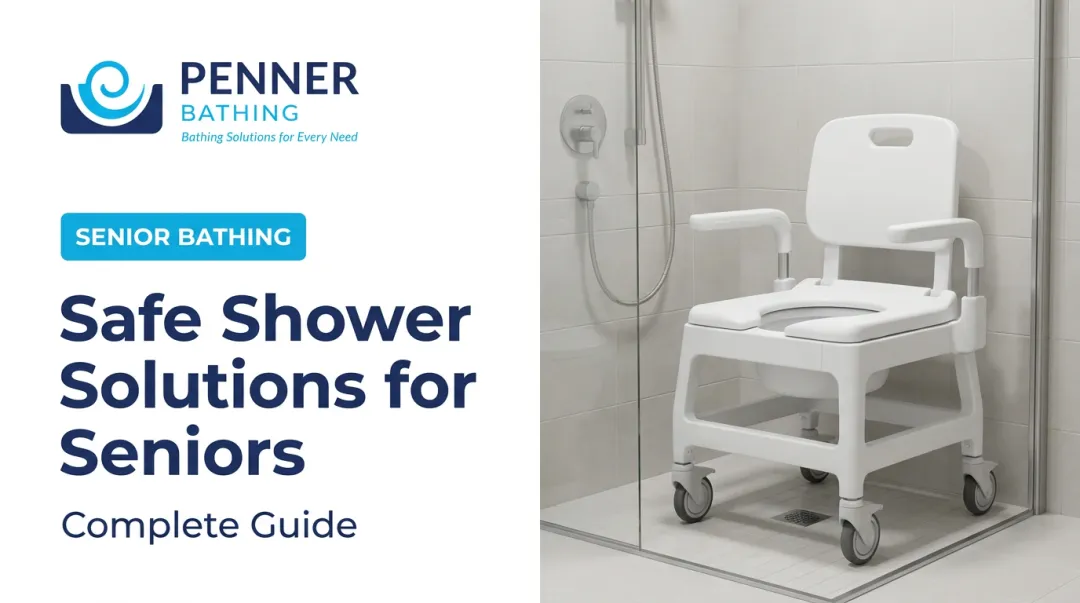
This matters for shower use because many commode chairs are waterproof and sturdy enough to function safely in a shower. For someone who qualifies for a Medicare-covered commode chair, that same chair may serve double duty as a shower seat.
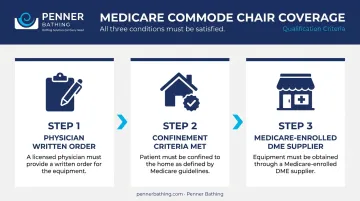
To qualify, all three conditions must be met:
- Physician writes a written order documenting medical necessity
- Patient's condition satisfies one of the confinement criteria above
- Chair is purchased through a Medicare-enrolled DME supplier
Specialized Rehab Shower Chairs and Bathing Systems
Some private insurers — Aetna's traditional plans, for example — cover specialized bathing systems or rehab shower chair/commode combinations under their own clinical criteria. Aetna's policy (CPB 0429) covers these for members with conditions such as ALS, cerebral palsy, multiple sclerosis, muscular dystrophy, spinal cord injury, or lower-extremity amputation who require complex positioning support during bathing.
Important clarification: No CMS LCD or national Medicare policy creates this same exception for Original Medicare — these are private insurer criteria only.
For those private plans that do cover specialized bathing systems, documentation requirements are substantial:
- Face-to-face physician examination within six months of the order
- Specialty evaluation by an occupational or physical therapist
- Home accessibility assessment by an assistive technology professional
- Documented trial showing a lower-cost option won't work
Medicare Part A During Facility Stays
If someone is admitted to a hospital or skilled nursing facility (SNF) under a Part A-covered stay, the facility provides all medically necessary equipment — including shower chairs used during that stay. Medicare pays the facility; no separate DME claim is submitted.
This coverage ends at discharge. Any equipment needed at home afterward must qualify separately under Part B's DME rules.
Alternative Programs That May Cover a Shower Chair
When Original Medicare says no, these programs are worth checking.
Medicare Advantage (Part C) Plans
According to KFF's 2026 Medicare Advantage analysis, 68% of individual Medicare Advantage enrollees are in plans offering an over-the-counter (OTC) benefit, and home/bathroom safety devices are available to 21% of individual-plan enrollees (and 60% of Special Needs Plan enrollees).
Benefit availability isn't the same as guaranteed coverage for a specific item, though. Call the plan directly, ask about the OTC allowance, and confirm whether shower chairs appear on the eligible-item list.
Medicaid
Medicaid policies vary significantly by state. Michigan Medicaid, for instance, covers standard E0240 bath/shower chairs (effective January 1, 2024, without prior authorization) for beneficiaries who cannot sit or stand independently in a bathtub or shower. Washington state has its own prior authorization process.
Contact your state Medicaid office or ask a social worker to verify what's covered locally. Most states require a physician's prescription documenting medical necessity.
Veterans Affairs (VA) Benefits
The VA's Home Improvement and Structural Alteration (HISA) grant covers permanent structural alterations — not removable equipment like a standard shower chair. HISA lifetime limits are $6,800 for qualifying service-connected cases and $2,000 for other eligible non-service-connected cases.
For medically necessary removable equipment, veterans should contact their local VA Prosthetic and Sensory Aids Service (PSAS) separately — shower chairs fall under that program, not HISA.
How to Access a Shower Chair Without Coverage
For most people, buying a shower chair out of pocket is the fastest and simplest path. Prices at major retailers are reasonable:
- Basic models at Walgreens: $34–$50
- Heavy-duty models: around $74
- CVS standard chair: adjustable height (14.5–19.5 inches), 300-pound capacity
When choosing a chair, look for:
- Non-slip rubber feet or locking casters
- Appropriate weight capacity for the user
- Armrests and a backrest for stability
- Dimensions that fit the specific shower or tub
Free and low-cost resources are also available if upfront cost is a barrier:
- Area Agencies on Aging (AAA) — local offices often connect seniors with equipment assistance
- Easterseals Iowa — lends adaptive bathroom devices
- Crawford County, Wisconsin ADRC — maintains a loan closet that includes shower chairs at no cost
- Facebook Marketplace and Goodwill offer secondhand options at significantly reduced cost
If you've already paid out of pocket, it's worth checking whether the purchase is tax-deductible. A shower chair bought for a medically documented condition may qualify as a medical expense under IRS Publication 502. Only unreimbursed costs exceeding 7.5% of adjusted gross income are deductible, and shower chairs aren't named explicitly in the publication — a tax professional can confirm whether your situation qualifies.
Choosing the Right Bathing Safety Solution for the Long Term
A shower chair is often a practical first step, but it isn't always the safest long-term solution for seniors with significant mobility challenges.
When evaluating bathing safety equipment, consider:
- Seat height adjustability — essential for safe entry and exit
- Weight capacity — verify it exceeds the user's weight with comfortable margin
- Armrests and backrest — critical for stability and trunk support
- Stability mechanism — non-slip feet for stationary chairs; locking casters for mobile chairs
- Tub/shower compatibility — tub transfer benches work differently than freestanding shower chairs
For seniors with more significant mobility limitations, a walk-in bath addresses risks that a shower chair simply can't. Penner Bathing's Dream Spa Walk-In Bath is designed for seniors and individuals with disabilities: its swing-out door lets users sit before entering the water, eliminating the step-over movement behind many bathroom falls.
The Dream Spa pairs that entry design with a handheld shower wand, heated seat and backrest, low threshold, and an optional automatic door close — delivering a complete bathing environment rather than a single safety accessory. It's also engineered to fit standard tub spaces without major remodeling.
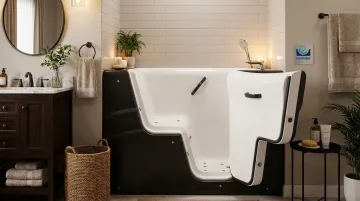
Penner Bathing has manufactured bathing systems from Aurora, Nebraska since 1980, with aging-in-place as a core design priority across its product line.
Whatever direction you're considering, involve a physician or occupational therapist in the decision — especially if an underlying condition might qualify for specialized equipment coverage. A professional recommendation also creates documentation that supports any future insurance claim.
Frequently Asked Questions
Can I get a shower chair from Medicare?
Standard shower chairs are not covered by Original Medicare — they're classified as personal convenience items, not medically necessary DME. Commode chairs and, in some private plans, specialized rehab shower chairs may qualify under specific medical criteria.
Does Medicare Advantage cover shower chairs?
Some Medicare Advantage plans include OTC or home safety allowances that list shower chairs as eligible items, but coverage varies widely by plan. Contact your plan directly to confirm what's included and whether a physician's order is required.
Are shower chairs covered by Medicaid?
Medicaid may cover shower chairs in some states when a physician prescribes them as medically necessary. Michigan covers them without prior authorization for qualifying beneficiaries; rules vary significantly elsewhere. Check with your state Medicaid office for the specifics that apply to you.
What is the difference between a shower chair and a commode chair for Medicare purposes?
Commode chairs are primarily for toileting and qualify as Medicare-covered DME when specific confinement criteria are met. Shower chairs are classified as convenience items with no recognized medical purpose under Medicare.
Can a doctor's prescription make a shower chair eligible for Medicare coverage?
A prescription alone isn't sufficient. Medicare requires the item to meet all four DME criteria. A physician's order can support coverage for a commode chair or specialized bathing system, but not for a standard shower chair regardless of diagnosis.
What bathroom safety equipment does Medicare actually cover?
Medicare covers commode chairs, walkers, wheelchairs, and hospital beds when medical necessity criteria are met. Grab bars, standard shower chairs, and raised toilet seats are excluded as personal convenience items; bath mats and similar products fall under a separate hygienic items exclusion.