Introduction
Health disparities don't disappear at the nursing home door. According to a 2022 HHS/ASPE analysis, nursing homes with the highest proportions of minority residents averaged 3.6–3.7 nursing hours per resident-day, compared to 3.9–4.0 hours in facilities with the lowest minority populations — a gap that compounds daily across an already vulnerable population.
Equality means giving every resident the same care. Equity means giving each resident the care they need. For a mobility-impaired resident, that might mean different equipment, a different communication approach, and different risk considerations than for an ambulatory one.
Long-term care and assisted living facilities sit at the intersection of these challenges, serving populations who depend on them for nearly every aspect of daily life.
This article covers what equitable patient-centered care means in LTC settings, the most persistent barriers facilities face, proven practices to address them, and how to build equity into facility-wide systems rather than isolated programs.
Key Takeaways
- Equity means tailoring care to each resident's barriers — not treating everyone identically
- Nursing homes with higher minority populations show measurably lower staffing levels, with real consequences for care quality
- Five core obstacles block equitable care: communication barriers, implicit bias, social determinants of health, accessibility gaps, and missing data
- Professional interpreters, social determinants screening, and accessible environments all have strong evidence behind them
- Lasting change requires embedding equity into quality improvement systems, not isolated projects
What Does Equitable Patient-Centered Care Mean?
The CDC defines health equity as "a fair and just opportunity to attain the highest level of health." That definition has practical weight in care settings: achieving it means removing the specific barriers that prevent certain residents from reaching the same health outcomes as everyone else.
That distinction matters in practice. Consider two residents side by side. One is ambulatory and can transfer independently. The other uses a wheelchair and requires lift assistance. Giving both the same bathing setup isn't equal — it's inadequate for one. Equitable care provides each with what they actually need to participate safely and with dignity.
Who Experiences the Greatest Disparities?
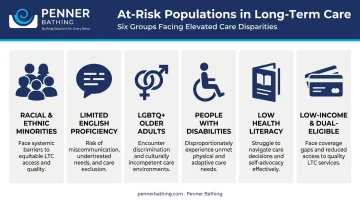
Research identifies several populations at elevated risk of receiving lower-quality care in LTC and institutional settings:
- Racial and ethnic minorities — overrepresented in lower-staffed facilities and among residents with repeated hospital transfers
- Patients with limited English proficiency (LEP) — face communication gaps that affect informed decision-making and safety reporting
- LGBTQ+ older adults — a 2024 review documents fears of harassment, identity concealment, and loss of control in residential care settings
- People with disabilities — encounter physical access barriers in equipment, bathing infrastructure, and clinical spaces
- Older adults with low health literacy — struggle with written materials, forms, and numerical health information
- Residents with low income or dual Medicare-Medicaid eligibility — research shows socioeconomic factors drive outcome differences in assisted living, often independently of race
The Two Dimensions That Matter
Equitable patient-centered care rests on two connected ideas:
- Patient-centeredness — The IOM describes this as care "respectful of and responsive to individual preferences, needs, and values, with patient values guiding clinical decisions." In practice, it means every care decision accounts for what matters to that specific person.
- Equity — removing the structural barriers that prevent those preferences from being honored in practice. Without it, a facility can use person-centered language in its policies while delivering care that still disadvantages the same residents, consistently, by design.
Why Health Equity Matters in Long-Term Care Settings
LTC facilities are not peripheral to the health equity conversation — they're central to it. Residents depend on these settings for daily care, often indefinitely — meaning equity gaps don't surface episodically but compound over time.
The staffing disparity cited above is one indicator. Another: a study of long-stay nursing home residents found that Black residents made up 34% of those experiencing repeated hospital transfers, versus 20% of residents without repeated transfers. Advanced practice nurses judged 53% of transfers among the highest-frequency group as potentially avoidable. These are observational findings — they don't establish cause — but they point to real patterns worth investigating.
What Inequitable Care Actually Costs
The consequences extend across multiple dimensions:
- Clinical outcomes — disparities in staffing, assessment quality, and pain management translate into measurable outcome differences
- Patient trust — residents who feel misunderstood or underserved disengage from their own care
- Regulatory exposure — CMS quality measures and accreditation standards increasingly require facilities to account for equity in their performance data
- Staff burnout — caregivers navigating unaddressed language, accessibility, and communication barriers face higher workloads and more difficult care interactions
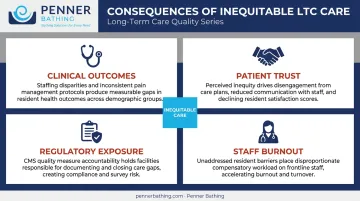
Facilities that address these gaps systematically tend to score better on CMS quality measures, reduce avoidable transfers, and report higher resident satisfaction — outcomes that reinforce each other over time.
Identifying the Key Barriers to Equitable Patient Care
Communication Barriers
Language, literacy, and cognitive factors are among the most documented sources of care inequity. Patients with limited English proficiency are less likely to fully understand their care plans, and research from AHRQ indicates that language-related safety events are frequently absorbed into generic "communication" categories rather than tracked as LEP-specific incidents.
Health literacy is a parallel issue. CDC data from national assessments found that 71% of adults over 60 had difficulty with print materials, 80% with forms or charts. In LTC, where residents are navigating medication regimens, discharge planning, and advance directives, that gap carries serious consequences.
That's what makes it a systemic issue, not a personal one — and why structured, recurring training matters more than one-time awareness sessions.
Implicit Bias
A 2022 JAMA Network Open review linked racial bias and false biological beliefs to differences in how pain is recognized and managed in clinical settings. Implicit bias doesn't require malicious intent — it operates through the shortcuts and assumptions that form under time pressure. That's what makes it a systemic issue, not a personal one — and why structured, recurring training matters more than one-time awareness sessions.
Those same pressures shape how other barriers play out at the facility level, including the social conditions residents carry with them long before admission.
Social Determinants of Health
Social conditions shape health long before a resident arrives — and continue affecting outcomes throughout their stay. Key SDOH factors in LTC include:
- Housing instability and inadequate living conditions prior to admission
- Food insecurity affecting nutritional status and recovery
- Social isolation, which compounds existing health risks
- Income limitations that restrict access to medications and follow-up care
The loneliness data reinforces the urgency. In 2024, 29.2% of surveyed US adults ages 50–80 reported loneliness — a figure with direct clinical implications given its documented links to cognitive decline, depression, and poor health outcomes.
Physical and Environmental Accessibility
The DOJ's 2024 rule on medical diagnostic equipment identifies several concrete access barriers for patients with disabilities:
- Adjustable exam tables unavailable or not in use
- Scales inaccessible to wheelchair users
- Insufficient transfer space around equipment
- Diagnostic equipment designed only for standing patients
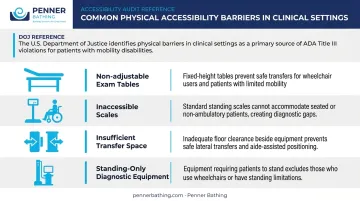
In bathing and hygiene specifically, inadequate infrastructure puts residents with mobility limitations at higher risk of injury and undermines dignity during one of the most personal aspects of daily care.
Data and Documentation Gaps
Without systematically collecting race, ethnicity, language preference, disability status, and SDOH information, facilities cannot identify which populations are receiving lower-quality care or measure whether interventions are working. As CMS states, standardized demographic data collection is foundational to identifying quality disparities and targeting improvement.
Best Practices for Advancing Equitable Patient Care
Cultivate Self-Awareness and Address Implicit Bias
The AMA's 2023 educational module on implicit bias provides a structured framework for helping clinical and care staff recognize how assumptions shape decisions — particularly under time pressure. The key is treating bias training as ongoing professional development, not a compliance checkbox.
Practical structural tools matter as much as training:
- Standardized care protocols applied consistently regardless of patient demographics
- Reflective practice exercises that prompt staff to examine their own decision patterns
- Peer review processes that examine whether care decisions — pain management, assessment frequency, follow-up — vary across patient subgroups
One important note: AHRQ's 2024 rapid review of bias training found the evidence base is still developing. Training alone cannot be expected to resolve disparities. It works best as one component of a broader structural approach.
Improve Communication Across Language and Ability Barriers
A 2023 systematic review found that professional interpreters consistently outperformed ad hoc alternatives — family members, untrained bilingual staff — on quality, communication accuracy, and patient satisfaction. HHS's 2024 Section 1557 guidance formalizes this: covered entities must take reasonable steps to provide qualified interpreters for LEP patients and cannot routinely rely on minors or accompanying adults.
For health literacy, AHRQ classifies the teach-back method as an evidence-based intervention. In practice, this means:
- Plain language in all written materials
- Visual aids and culturally appropriate resources
- Asking patients to explain care instructions back in their own words — not as a test, but as confirmation that the communication worked
Screen for and Address Social Determinants of Health
Routine SDOH screening during intake and at regular intervals gives facilities the information they need to connect residents with relevant community resources. Validated tools like the CMS AHC HRSN screener and PRAPARE questionnaire provide structured formats that integrate into EHR workflows.
The Yale New Haven Health System offers a useful model: through standardized EHR-based HRSN screening across five acute-care hospitals from January 2022 to February 2023, the system increased inpatient screening rates from near zero to 66%, representing 45,875 screenings. The project succeeded because screening was embedded into standard workflows, not treated as an add-on task.
Ensure Physical Accessibility and Dignified Accommodations
Accessible equipment is a precondition for equitable care, not an enhancement. Bathing and hygiene infrastructure in particular presents real risks when it isn't designed for residents with mobility limitations.
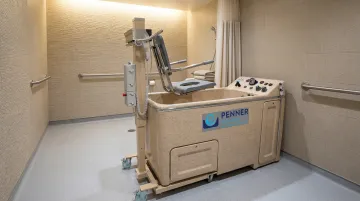
For long-term care, assisted living, and hospital settings, purpose-built bathing systems like those from Penner Bathing are one practical approach. Their healthcare systems include:
- Motorized lifting mechanisms for safe patient transfer
- Height-adjustable transfer components and end-opening or side-entry configurations
- Integrated scales for clinical monitoring
- Automatic disinfection standard across the Premier Transfer line, ensuring consistent infection control between resident uses
Penner also provides on-site evaluation services to match equipment to each facility's space and resident population, followed by staff training to ensure safe, consistent operation.
Beyond equipment, facilities should:
- Screen for disability status and accommodation needs before clinical encounters using standardized tools
- Document individual accommodation needs in a clearly visible location in each resident's record
- Review physical spaces — bathrooms, bathing areas, clinical rooms — for barriers that exclude residents with mobility, sensory, or cognitive differences
Build a Diverse and Culturally Competent Workforce
A workforce that reflects the demographics of the population served builds trust and improves communication quality. Practical steps include:
- Inclusive hiring practices that actively expand candidate pools
- Ongoing cultural competency training — not a one-time orientation
- Mentorship pipelines for underrepresented staff groups
- Formal assessment of clinician language proficiency before allowing direct patient communication without an interpreter
Building a Systems Approach to Health Equity
Addressing one disparity at a time produces incremental, fragile progress. A resident who benefits from a new interpreter policy still faces gaps if SDOH screening doesn't happen or if bathing equipment creates accessibility barriers. Equity work has to be embedded into how a facility operates, not layered on top of it.
Frameworks That Provide Structure
Several frameworks help translate intent into operational change:
| Framework | Scope | What It Provides |
|---|---|---|
| Joint Commission LD.04.03.08 | Hospitals and select settings (effective Jan. 1, 2023) | Leader accountability, HRSN assessment, stratified data, written action plans |
| AHA Health Equity Roadmap | Hospital systems | Voluntary transformation guide with assessment tools |
| CMS Nursing Home Quality Measures | Skilled nursing and LTC | MDS 3.0 measurement infrastructure — requires local stratification to reveal disparities |
| CMS Demographic Data Guidance | Health systems broadly | Rationale and standards for race, ethnicity, language, and disability data collection |
Note: The Joint Commission's R3 Report requirements apply to hospitals and specific programs — not necessarily nursing care centers. Facilities should verify which standards apply to their specific accreditation status.
Stratify Your Data
Aggregate performance data hides disparities. A facility might show acceptable fall rates overall while Black residents or LEP residents experience those falls at twice the rate. Disaggregating outcome data by race, ethnicity, language preference, and disability status reveals these patterns — and creates the factual foundation for targeted action.
Collecting the data is only the first step. What matters is what happens after the review: targeted interventions, follow-up measurement, and honest assessment of whether gaps are closing.
Embed Equity Into Quality Improvement
Every QI project carries equity implications, even when equity isn't the explicit focus. An initiative to reduce hospital readmissions might improve outcomes for English-speaking residents while leaving LEP residents behind if communication barriers aren't addressed in the intervention design.
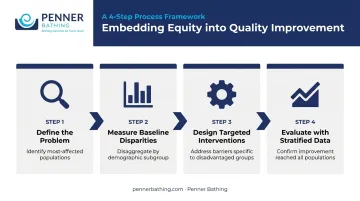
Building equity in from the start means:
- Define the problem with attention to which populations are most affected
- Measure baseline disparities across demographic subgroups, not just aggregate rates
- Design interventions that address the specific barriers disadvantaged groups face
- Evaluate outcomes with stratified data to confirm improvement reached everyone
Leadership Accountability and Community Engagement
QI design alone won't sustain equity progress without leadership driving it. Organizational leaders need to set measurable targets, review stratified data regularly, and make equity performance visible to staff, boards, and the communities they serve.
Community engagement matters as much as internal accountability. Gathering feedback directly from residents and families, particularly from populations experiencing disparities, ensures that equity efforts address the real barriers those populations face — not just the ones that are easiest to measure.
Frequently Asked Questions
What does equitable patient-centered care mean?
Equitable patient-centered care means tailoring care to remove the individual and systemic barriers that prevent specific patients from achieving optimal health outcomes. It goes beyond equal treatment to ensure fair treatment based on each person's actual needs and circumstances — recognizing that the same intervention can produce very different results for different populations.
How can health equity be achieved?
Achieving health equity requires a systems-level approach: collecting disaggregated patient data, training staff to recognize implicit bias, addressing social determinants of health, and embedding equity into all quality improvement decisions. The key is treating health equity as an integrated priority, not a series of separate disparity projects.
What are the main barriers to equitable patient care?
The five core barriers are communication gaps (language, health literacy, cognitive limitations), implicit bias in care delivery, social determinants of health, physical accessibility gaps in equipment and environments, and the absence of systematic data collection on patient demographics and needs.
What role does implicit bias play in health disparities?
Implicit bias, meaning unconscious assumptions about patients based on race, gender, age, or disability, can affect which patients receive thorough assessments, appropriate pain management, and timely follow-up. Research links these patterns to measurable differences in care quality, particularly in pain recognition and clinical decision-making.
How can long-term care facilities improve equitable care for residents with disabilities?
Start with routine disability status screening and document individual accommodation needs prominently in each resident's record. Ensure physical environments and equipment — including bathing and hygiene infrastructure — are accessible, and train staff to tailor care to each resident's specific requirements. Equipment designed for LTC settings, like specialized transfer and bathing systems, addresses both safety and dignity.
What are social determinants of health and why do they matter in patient care?
Social determinants of health are non-medical factors, such as housing stability, income, food security, and social support, that directly shape a person's health status and ability to engage with care. Residents arrive at LTC facilities with histories shaped by these factors, so routine screening and resource connection are essential to closing outcome gaps.