Introduction
Nursing is among the most physically and emotionally demanding professions in healthcare. In long-term care, assisted living, and hospital settings, the challenges are compounded — patient needs are complex, acuity is high, and the margin for error is razor-thin.
Nurse managers sit at the intersection of frontline care and institutional leadership — close enough to the floor to see problems forming, senior enough to act on them. When managers address systemic issues before they surface as turnover or adverse events, the entire unit benefits.
This article covers six issues that consistently affect nursing teams across care settings, with practical strategies nurse managers can act on today.
Key Takeaways:
- Staffing shortages require data-backed advocacy, not just scheduling patches
- Burnout prevention starts with culture, not just benefits packages
- Physical safety risks during bathing and transfers are largely preventable with the right equipment
- Career visibility and ethical support are among the most underutilized retention tools available to nurse managers
Issue #1: Staffing Shortages and Workload Imbalance
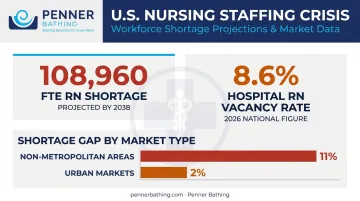
Staffing is the most persistent problem in nursing today. HRSA projects a shortage of 108,960 FTE registered nurses by 2038 — an 11% gap in non-metropolitan areas compared to 2% in urban markets. Meanwhile, NSI's 2026 report places the hospital RN vacancy rate at 8.6%, with one-third of participating hospitals running vacancy rates at 10% or higher.
The downstream effects are predictable and serious: heavier patient loads, less time for individualized care, increased overtime, and a higher likelihood of medical errors. Nurse managers can't fix a systemic shortage alone, but they have more leverage than most realize.
How Nurse Managers Can Help
Conduct regular workload audits. Track nurse-to-patient ratios by unit and shift. When ratios become unsafe, document it — that data is your strongest argument when advocating to administration for additional hires or per diem support.
Extend onboarding beyond orientation. A 2025 meta-analysis found that first-year turnover among newly licensed acute-care RNs ranges from 12% to 25%, with 36% of new nurses reporting intention to leave within that period. Structured mentorship programs extending well into the first year improve belonging and loyalty before those departure decisions get made.
Advocate for competitive compensation and scheduling. Flexible shift options and market-rate wages matter — both for recruitment and for retaining experienced nurses.
Reduce per-session workload with better equipment. In long-term care settings, routine tasks like bathing consume significant staff time. Bathing systems with fast-fill reservoirs reduce preparation time between residents without requiring additional staff. Penner Bathing's healthcare bathing systems, for example, are designed specifically with this efficiency in mind — so nurses spend less time on equipment logistics and more time on direct patient care.
Issue #2: Nurse Burnout and Mental Health Concerns
Burnout in nursing is a clinical syndrome — not just fatigue — marked by emotional depletion, depersonalization, and a diminished sense of accomplishment. Nurses in high-acuity and chronically understaffed settings are disproportionately affected.
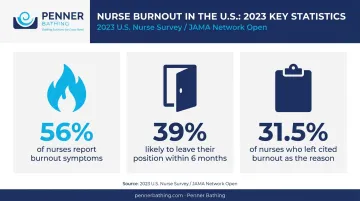
A 2023 survey of 7,419 U.S. nurses found that 56% reported burnout symptoms, and 39% said they were likely to leave their current position within six months. A separate JAMA Network Open analysis found that 31.5% of nurses who left a job cited burnout as the reason, with inadequate staffing the most common contributing factor.
How Nurse Managers Can Help
Normalize mental health conversations. Create a unit culture where nurses can express burnout or compassion fatigue without fear of being seen as weak or unreliable. That shift starts with how managers respond the first time someone speaks up.
Schedule structured debriefs after difficult events. Deaths, codes, and high-stress incidents leave emotional residue. A brief, structured team debrief — not a mandatory hour-long meeting, but a purposeful 10-15 minutes — gives nurses a collective space to process rather than absorb silently.
Connect staff to existing resources. The American Nurses Foundation's Nurse Well-Being Program provides free Stress First Aid-based courses, self-assessments, and leader training. Many nurses don't know these resources exist. Make it a standing agenda item, not a one-time email.
Model self-care from the top. When managers visibly respect their own limits, take breaks, and use available support, it gives staff permission to do the same. Nurses take cues from their managers — if leadership runs on empty, staff will too.
Reduce repetitive physical load where possible. Identifying tasks that can be standardized, streamlined, or shared across shifts lowers the cumulative physical and cognitive strain that accelerates burnout — especially on understaffed units.
Issue #3: Workplace Safety and Physical Hazards
Nursing is physically dangerous work. BLS data from 2016 shows RNs experienced 104.2 injury and illness cases per 10,000 FTEs — compared to 91.7 for all occupations. Musculoskeletal disorders were nearly double the all-occupation average: 46.0 versus 29.4.
In long-term care and assisted living specifically, manual patient handling during bathing and transfers is one of the leading causes of back injuries among nursing staff. NIOSH identifies repositioning and lifting patients as a primary driver of work-related musculoskeletal disorders and recommends safe patient handling programs as the primary countermeasure.
These injury rates are preventable. Here's where nurse managers can make the most difference.
How Nurse Managers Can Help
- Conduct regular safety audits. Walk the unit with fresh eyes — are transfer belts accessible? Have staff drifted into shortcuts with body mechanics? Document what you find and act on it.
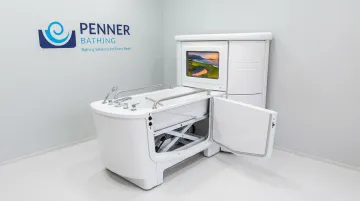
- Invest in ergonomic bathing equipment. Therapeutic bathing systems designed for healthcare settings reduce the manual strain that traditional tub bathing creates. Penner Bathing's Cascade and Premier systems, for example, offer height-adjustable designs and multi-directional patient access that cut down on awkward positioning during assisted bathing. For transfers, the Vancare lift systems Penner distributes support residents up to 450 lbs without requiring staff to manually lift.
- Establish clear incident reporting protocols. Near-misses and minor injuries need to be documented and reviewed — not dismissed. Patterns in your data will show where the next serious injury is likely to happen.
- Keep safety education ongoing. Body mechanics and safe handling techniques should be revisited in regular team meetings, not buried in onboarding paperwork.
Issue #4: Limited Career Advancement Opportunities
Nurses who can't see a growth path within their organization start looking outside it. Feeling valued and having visible advancement opportunities consistently rank among the top drivers of retention — while their absence correlates with turnover intention.
How Nurse Managers Can Help
- Build internal mentoring programs that connect newer nurses with experienced staff through structured relationships with clear goals and check-ins
- Support certifications and advanced degrees — even small investments in continuing education signal that the organization sees long-term value in the nurse as a professional
- Implement cross-training opportunities so nurses can develop skills across units, reducing stagnation and the over-reliance on any single staff member
- Use annual reviews as succession planning tools — communicate clearly what competencies lead to advancement and help nurses map a path toward those benchmarks
Nurses shouldn't have to guess whether growth is possible. When advancement is visible and actively supported, managers give staff a concrete reason to stay.
Issue #5: Workplace Violence and Incivility
Workplace violence is not a rare event in nursing — it's a documented occupational hazard. Joint Commission data indicates that over a 12-month period, 21% of U.S. nurses and nursing students experienced physical assault and more than 50% experienced verbal abuse. NIOSH identifies persistent underreporting driven by the belief that violence is simply part of the job and a lack of clear reporting channels.
The problem doesn't stop at patient-to-nurse aggression. Peer incivility — lateral bullying, dismissive behavior, public humiliation — erodes team trust and discourages staff from speaking up about anything, including safety concerns.
How Nurse Managers Can Help
Nurse managers have direct influence over how violence and incivility are handled on the unit. Three areas matter most:
- Enforce a zero-tolerance policy — Address incivility immediately, whether it comes from a patient, a family member, or a colleague. Managers who let incidents slide signal that the behavior is acceptable.
- Provide de-escalation training — Target the highest-risk scenarios: post-anesthesia recovery, psychiatric episodes, cognitive decline crises. Staff need both response skills and clear reporting pathways when de-escalation fails.
- Acknowledge every report — Nurses who feel dismissed when they flag a threatening incident stop reporting. Follow through on investigations and communicate outcomes back to staff.
Joint Commission standards effective in 2022 require accredited hospitals to maintain violence prevention policies, conduct annual worksite analysis, and train staff — making this both an ethical priority and a regulatory obligation for most facilities.
Issue #6: Ethical Challenges in Nursing Practice
Moral distress occurs when a nurse knows the ethically correct action but feels prevented from taking it due to institutional constraints, resource limitations, or authority structures. OJIN defines it clearly as distinct from general stress, and the consequences are serious: one hospital study found nurses with above-average moral distress scores had 9.1 times the odds of intending to leave.
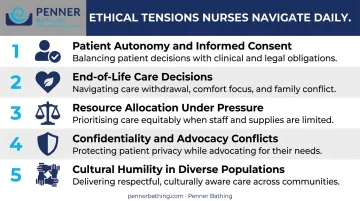
Nurses commonly face ethical tensions across several fronts, often simultaneously:
- Patient autonomy and informed consent
- End-of-life care decisions
- Resource allocation under pressure
- Confidentiality and advocacy conflicts
- Cultural humility in diverse patient populations
How Nurse Managers Can Help
Ensure access to ethics consultation. Nurses need a structured avenue to raise and resolve moral conflicts. Ethics committees or formal consultation processes exist in the majority of U.S. hospitals, but access in long-term care and assisted living settings remains less developed.
Make ethics education a routine part of professional development, not a compliance checkbox. Nurses who regularly discuss ethical frameworks are better equipped to navigate gray areas without becoming paralyzed or resentful.
Foster psychological safety around patient advocacy. Nurses who fear retribution for raising ethical concerns will stop raising them, and that silence puts patients at risk. Make it explicit that advocacy is valued, not threatening.
Frequently Asked Questions
What are the seven major ethical issues in nursing practice?
A common grouping includes: patient autonomy, informed consent, privacy and confidentiality, end-of-life care, fair resource allocation, advocacy, and cultural humility. Note that this isn't an official ANA list — the ANA's 2025 Code of Ethics covers 10 provisions — but these areas come up most often in day-to-day practice. Nurse managers can help by creating safe forums for staff to raise concerns.
What are the most common issues nurses face in long-term care facilities?
Staffing shortages and high patient ratios top the list, followed by caregiver burnout, physical safety risks during transfers and bathing, and the emotional demands of caring for aging or cognitively impaired residents. AHCA's 2024 provider survey found 99% of nursing homes actively trying to hire more staff.
How can nurse managers reduce burnout among their staff?
Start by normalizing mental health conversations and scheduling brief debriefs after difficult patient events. Connect staff to EAP resources and the American Nurses Foundation's Well-Being Program. Reducing physical and logistical burdens through better equipment, clearer delegation, and workflow improvements is one of the most underused prevention strategies available.
What is the role of a nurse manager in addressing workplace violence?
Nurse managers are responsible for enforcing zero-tolerance policies, providing de-escalation training, and building a reporting culture where nurses feel safe coming forward. Joint Commission standards require accredited hospitals to maintain prevention policies and analyze incident data — nurse managers are the frontline of implementation.
How does understaffing affect patient care in nursing homes?
Higher nurse-to-patient ratios mean less time for individualized care, increased risk of missed assessments or medication errors, and greater nurse fatigue. CMS now displays turnover measures on Care Compare specifically because higher turnover correlates with lower nursing home quality scores.
What strategies help nurse managers improve nurse retention?
The most effective combination includes competitive compensation, structured mentorship during onboarding, flexible scheduling, and clear advancement pathways. Equipment and workflow improvements that reduce daily physical burden round out the strategy — nurses stay where the work is manageable long-term.