![Patient Care Assistant Duties & Responsibilities [2026]](https://file-host.link/website/pennerbathing-uj4awa/assets/blog-images/5c287aad-642d-4e45-a141-820e109015bd/1784185585478548_c4bfbe2b16c843369cd487bf4bb383d6/360.webp)
The U.S. Bureau of Labor Statistics counted 1,448,910 nursing assistants in May 2025, with 211,800 annual job openings projected — driven largely by replacement needs in an aging population that requires more long-term care than any previous generation.
This guide covers everything you need to know about the PCA role in 2026: what the job actually involves day-to-day, how it compares to similar titles, what skills employers want, where PCAs work, and how to enter the profession.
Key Takeaways
- PCAs assist with bathing, dressing, feeding, mobility, and vital sign monitoring under licensed nursing supervision
- 35% of nursing assistant jobs are in skilled nursing facilities — the single largest employer of this workforce
- CNA certification is state-regulated; PCA certification (CPCT/A through NHA) is voluntary but increasingly preferred by employers
- Most training programs take just weeks to complete, making this one of the fastest paths into a healthcare career
- PCAs frequently advance into nursing roles — making this a practical first step for anyone building a healthcare career
What Is a Patient Care Assistant?
A patient care assistant is a healthcare support professional who provides hands-on, basic care to patients under the direction of licensed nurses. The work is both physical and interpersonal: helping people bathe, move, eat, and stay safe when they can't manage those tasks on their own.
The title varies widely by state and facility. Common interchangeable labels include:
- Patient care technician (PCT) — common in hospitals and clinical settings
- Certified nursing assistant (CNA) — the state-regulated version of the same core role
- Nursing aide or nursing attendant — used in long-term care and government settings
- Patient care associate — an employer-specific variation with no separate federal definition
Regardless of title, the Bureau of Labor Statistics groups all of these roles under SOC 31-1131 (Nursing Assistants) — defined as staff who provide basic care under on-site licensed nursing supervision, including monitoring, feeding, bathing, dressing, grooming, toileting, and ambulation. The median annual wage for this occupation was $39,530 as of May 2024, with a mean hourly wage of $20.53 as of May 2025.
Core Duties and Daily Responsibilities of a Patient Care Assistant
A PCA's shift spans a wide range of hands-on care tasks — from basic hygiene support to clinical observation and documentation. Here's what that looks like in practice.
Activities of Daily Living (ADLs)
The foundation of PCA work is assisting patients with activities of daily living — the basic self-care tasks most people perform without thinking:
- Bathing and personal hygiene: full-body baths, oral care, nail care, skin inspection, and hair washing
- Dressing and grooming: helping patients dress, undress, and maintain personal appearance
- Feeding and hydration: assisting patients who cannot self-feed, monitoring intake
- Toileting: supporting continence care with dignity and appropriate infection control
A 2025 hospital time-motion study found that ADL care accounts for 21% of nursing assistant time — covering mobility, incontinence, toileting, nutrition, and personal hygiene combined. That share of the shift demands both physical stamina and steady attention to each patient's comfort and privacy.
Bathing and Hygiene: Where Equipment Matters
Bathing is often the most complex ADL task — logistically demanding for staff and emotionally sensitive for patients. In long-term care facilities and nursing homes, specialized therapeutic bathing systems make this safer for both parties.
Penner Bathing's healthcare systems — including the Premier, Cascade, Pacific, and Contour models — are designed specifically for this environment. Key features relevant to PCA workflows include:
- Fast-fill reservoir: reduces wait time between patient baths, improving throughput in high-volume facilities
- Automatic disinfection cycle: initiated directly from the control panel between patients, eliminating manual disinfection variability and human error
- BioCote® antimicrobial protection: a material-level technology built into spa surfaces that suppresses bacterial growth 24/7, complementing the active disinfection cycle
- Three-point entry configurations: left, right, and end-opening options that adapt to different room layouts and patient mobility levels
- Rail-free, forward-facing design: preserves a spa-like environment that reduces patient anxiety and maintains dignity
For facilities managing high patient volumes, those features reduce the physical burden on PCAs while keeping the bathing environment safer and more consistent between residents.
Patient Monitoring
PCAs are often the first to notice when something changes. Monitoring duties include:
- Measuring and recording vital signs: temperature, blood pressure, pulse, and respiration
- Observing for changes in physical condition, skin integrity, or mental status
- Reporting concerns promptly to the supervising nurse or physician
- Tracking fluid intake and output where assigned
A PCA who catches early signs of infection, respiratory distress, or a developing pressure injury can trigger intervention before a minor change becomes a serious adverse event.
Mobility, Positioning, and Pressure Injury Prevention
PCAs assist patients with ambulation, transfers between beds and wheelchairs, and repositioning. Proper repositioning is clinically meaningful: the 2022 TEAM-UP trial across nine nursing homes found 0.0% new pressure injury incidence when CNAs executed a sensor-prompted repositioning protocol with 80–95% compliance rates.
Mobility support tasks include:
- Transferring patients from beds to wheelchairs and back
- Assisting with ambulation and walking exercises
- Repositioning bed-bound patients to prevent pressure sores
- Supporting range-of-motion exercises under a nurse's direction
Clinical and Documentation Support
Depending on setting and training level, PCAs may also:
- Collect urine or lab specimens
- Measure and document fluid intake and output
- Perform EKGs (in facilities where PCAs hold CPCT/A certification)
- Maintain tidy patient rooms and organized supply areas
- Complete accurate care records and communicate patient status during shift handoffs
If a PCA doesn't document a change in condition, the oncoming nurse starts the shift without that information — and that gap can delay care at exactly the wrong moment.
Patient Care Assistant vs. Similar Roles
PCA vs. CNA
| Dimension | PCA | CNA |
|---|---|---|
| Certification | Voluntary (CPCT/A through NHA) | State-regulated credential and registry |
| Core duties | ADLs, monitoring, mobility support | Same core scope |
| Additional clinical tasks | EKGs, phlebotomy (with CPCT/A) | Varies by state; typically narrower |
| Nursing home requirement | Not universally required | Required for nursing home employment |
Both roles provide hands-on bedside care. The regulatory difference is significant: CNAs must pass a state competency exam and appear on a state registry to work in nursing homes. PCA certification through NHA is voluntary, though many employers now list it as preferred.
PCA vs. Medical Assistant (MA)
Medical assistants primarily work in outpatient and clinical settings, splitting time between administrative tasks (scheduling, billing, records) and limited clinical duties (taking vitals, preparing exam rooms). PCAs focus exclusively on direct, ongoing bedside care and ADL support — no administrative duties, and a much higher proportion of hands-on physical care.
PCA vs. Patient Care Technician (PCT)
These titles describe the same role. The name varies by employer and state convention. Both hold identical core responsibilities and can pursue the NHA CPCT/A certification, which covers patient care, phlebotomy, and EKG competencies.
Essential Skills and Qualifications
Technical and Clinical Knowledge
PCAs need a working understanding of:
- Basic anatomy and physiology
- Infection control principles and standard precautions
- Patient safety protocols (fall prevention, safe transfer techniques)
- How to read and implement individualized care plans
BLS data shows that 96.8% of nursing assistants receive on-the-job training, and 75.1% require at least a high school diploma as a minimum education baseline.
Communication and Interpersonal Skills
BLS identifies communication as a core requirement for this role. Day-to-day, that means:
- Listening to and documenting patient concerns accurately
- Relaying information to nurses without omissions or distortion
- Writing clear, legible care notes
- Interpreting non-verbal cues from patients who cannot speak clearly
77.9% of nursing assistant positions require more-than-basic people skills, per BLS Occupational Requirements Survey data.
Compassion and Emotional Resilience
PCAs work with elderly, chronically ill, cognitively impaired, and terminally ill patients. This requires:
- Patience during repetitive, time-consuming care tasks
- Empathy without emotional burnout
- The ability to offer genuine comfort during frightening or painful moments
- Professionalism when patients are resistant, confused, or distressed
Physical Stamina and Body Mechanics
The job is physically demanding. PCAs lift, transfer, reposition, and support patients across full shifts. Proper body mechanics training — covering safe lifting, pivoting, and patient transfers — protects both staff and patients. For many facilities, it carries as much practical weight as clinical knowledge.
Education and Certification Requirements
- Minimum: High school diploma or GED
- Preferred: Completion of a state-approved CNA, PCA, or patient care technician training program
- CPR/BLS certification: Required by most facilities, though not mandated at the federal level
- NHA CPCT/A (voluntary): A 100-question exam covering patient care, phlebotomy, and EKG monitoring
Where Patient Care Assistants Work
Employment by Setting
According to BLS, nursing assistant employment breaks down as:
| Work Setting | Share of Jobs |
|---|---|
| Skilled nursing facilities | 35% |
| Hospitals | 33% |
| Continuing-care and assisted living | 11% |
| Home healthcare services | 5% |
| Government (non-hospital) | 4% |
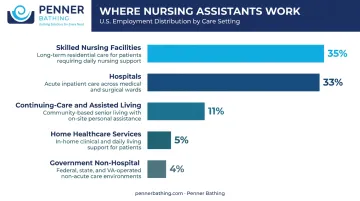
Skilled nursing facilities employ the largest share by a clear margin. That concentration matters because duties, pace, and patient relationships differ considerably from one setting to the next.
How Duties Shift by Setting
- Hospitals: Faster pace, higher acuity patients, closer work with RNs. PCAs may assist with time-sensitive bedside tasks and need to adapt quickly to changing patient conditions
- Skilled nursing facilities and long-term care: More ongoing relationships with residents, heavier ADL focus, consistent daily routines. High bathing volumes put a premium on efficient routines and proper infection control protocols
- Home health: One-on-one care, emphasis on supporting patient independence, direct communication with families
- Assisted living: Balance between independence and support; PCAs help maintain quality of life rather than managing acute illness
Specializations
Some PCAs develop expertise in specific patient populations: geriatrics, pediatrics, hospice, labor and delivery, or memory care. These specializations require additional training or certifications beyond entry-level requirements.
How to Become a Patient Care Assistant in 2026
The Typical Pathway
- Earn a high school diploma or GED — the baseline requirement across virtually all employers
- Complete a state-approved training program — federal regulations set a minimum of 75 clock hours, including at least 16 hours of supervised clinical practice; states may require more
- Obtain CPR/BLS certification — required by most facilities, though not universally mandated at the federal level
- Pass a state competency exam (required for CNA status and nursing home employment)
- Begin work — most employers provide additional on-the-job orientation regardless of prior training
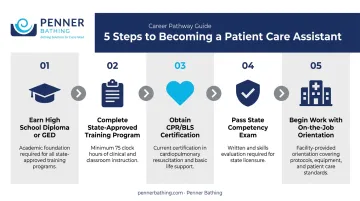
Training programs typically run from a few weeks to several months depending on the state and program format. Community colleges, vocational schools, and some long-term care facilities offer these programs, sometimes with tuition assistance for those who commit to employment.
Voluntary Certification (CPCT/A)
The NHA's Certified Patient Care Technician/Assistant credential is voluntary but worth pursuing. The exam covers patient care, phlebotomy, and EKG monitoring — expanding your scope beyond what a standard CNA credential covers. Many employers actively prefer candidates who hold it, and some list it as a requirement for clinical tech roles — check job postings in your target market to gauge demand.
Career Growth
The PCA role functions as a strong foundation for healthcare careers. Most nursing schools require prior clinical experience — PCAs already have it. Common advancement paths include:
- CNA (if not already certified)
- Licensed Practical Nurse (LPN)
- Registered Nurse (RN)
- Specialized clinical technician roles (phlebotomy, EKG, surgical tech)
The hands-on exposure also gives PCAs a practical advantage in nursing school applications — clinical hours already logged, patient interaction already documented.
Frequently Asked Questions
What are the main duties of a patient care assistant?
PCAs assist with activities of daily living — bathing, dressing, feeding, and toileting — while monitoring vital signs and observing for changes in condition. They support patient mobility and transfers, and report any concerns to the supervising nurse during and after each shift.
What is the difference between a patient care assistant and a CNA?
CNAs hold a state-regulated credential and must appear on a state registry to work in nursing homes, while PCA certification through NHA is voluntary. PCAs in some facilities can also perform additional clinical tasks like EKGs and phlebotomy, competencies tested in the CPCT/A exam that fall outside a CNA's standard scope.
What skills do you need to be a patient care assistant?
Core skills employers look for include:
- Clear communication and genuine compassion for patients
- Basic nursing knowledge and ability to follow care plans accurately
- Physical stamina for mobility assistance and transfers
- Reliability, attention to detail, and calm under pressure
Where do patient care assistants typically work?
Skilled nursing facilities employ the largest share (35%), followed by hospitals (33%), assisted living communities (11%), home health agencies (5%), and government settings. Some PCAs also work in rehabilitation centers and specialty care environments.
How long does it take to become a patient care assistant?
Most PCA and CNA training programs take a few weeks to several months, depending on state requirements and program format. Federal rules require a minimum of 75 training hours for nurse aide programs. Some entry-level positions hire candidates who complete on-the-job training, though formal certification strengthens most applications.