The problem? Many seniors assume a walk-in shower is unaffordable and never explore their options. That assumption leaves real money on the table.
Multiple federal programs, state grants, and nonprofit organizations exist specifically to help seniors cover — sometimes completely — the cost of accessible shower installations. This guide breaks down who qualifies, what programs are available, and how to take the first practical step toward a safer bathroom.
Key Takeaways
- Original Medicare rarely covers walk-in showers — Medicaid HCBS waivers and VA HISA grants are your strongest alternatives
- VA HISA grants provide up to $6,800 for qualifying veterans — and don't require a service-connected disability
- USDA Section 504 offers up to $10,000 in grants for rural homeowners aged 62+
- Area Agencies on Aging are free resources that connect seniors to local funding programs
- A physician's letter documenting medical necessity can make or break your funding application
Why Seniors Need a Walk-In Shower: Safety and Independence
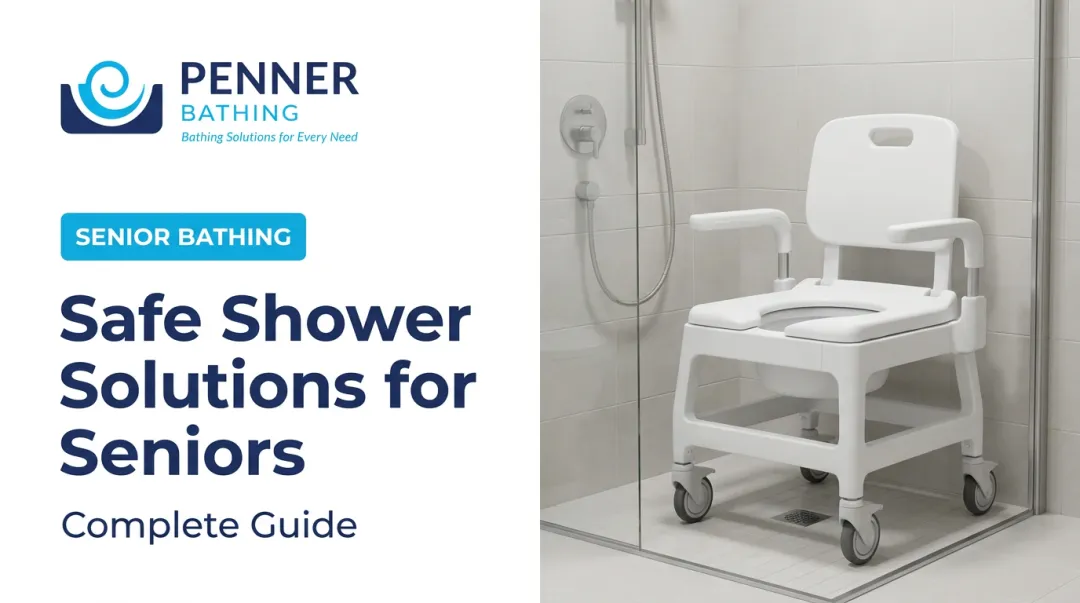
Standard bathtubs require stepping over a high ledge in a wet, slippery environment — one of the most dangerous movements an older adult with reduced balance or mobility can make. Walk-in and roll-in showers address this directly.
Key safety features that reduce fall risk:
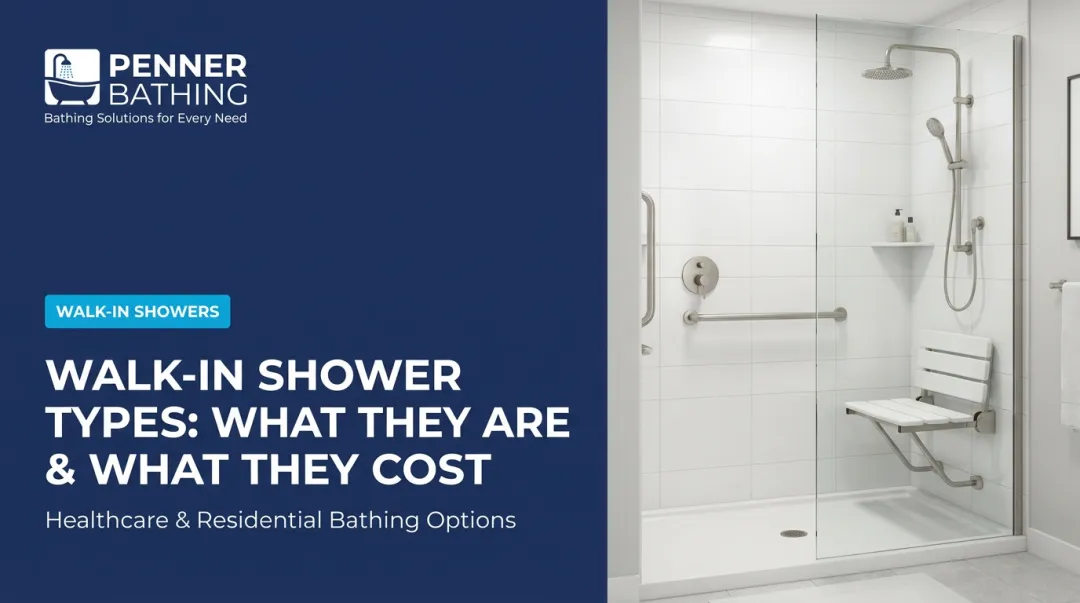
- Zero or low-threshold entry — eliminates the step-over hazard entirely
- Slip-resistant flooring — provides traction where standard tile fails
- Built-in seating — allows fully seated bathing without balance demands
- Grab bar compatibility — provides stable handholds during transfers
- Hand-held shower wands — allow full-body washing while seated
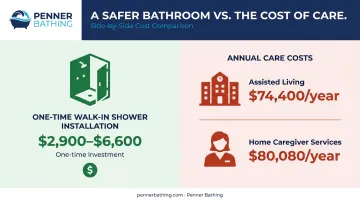
Beyond safety, there's a compelling financial argument for bathroom modifications. CareScout's 2025 national data puts the median annual cost of assisted living at $74,400 and non-medical home caregiver services at $80,080 per year. A one-time walk-in shower installation — even at the higher end of the cost range — is a fraction of one year's care costs. For seniors who want to stay home, that math makes a bathroom modification one of the more practical decisions available.
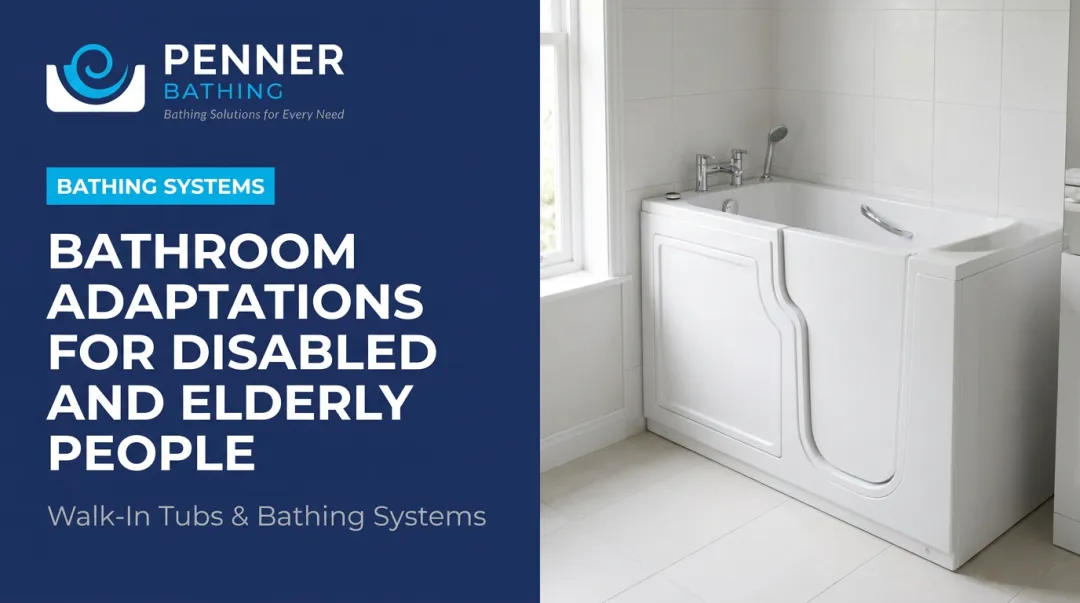
Penner Bathing's Dream Spa Walk-In Bath is one residential option built around this exact priority — low-threshold entry, built-in seating, and a hand-held shower wand designed to keep seniors safely seated throughout the entire bathing process.
How Much Does a Walk-In Shower for Seniors Cost?
Standard Installation Costs
For an accessibility-focused roll-in or zero-threshold shower, Angi's 2026 cost data places the installed range at $2,900–$6,600, with a $3,800 average for a standard roll-in installation. Custom zero-threshold designs with specialty materials or complex plumbing changes will run higher.
Factors that affect the final price:
- Bathroom size and existing layout
- Prefabricated vs. custom construction
- Material choice (fiberglass, acrylic, tile, or custom stone)
- Drain and supply-line relocation
- Floor reinforcement and waterproofing
- Seating, grab bars, and accessible controls
- Regional labor rates
What "Free" Actually Means
Most programs offer partial to full cost coverage — not a guaranteed blank check. Coverage depends entirely on eligibility. Someone who qualifies for a VA HISA grant, for instance, may receive up to $6,800 — which can cover the full cost of a standard roll-in installation.
Eligibility determines coverage, and many seniors leave funding unclaimed simply because they never applied.
Government Programs That Help Pay for a Walk-In Shower
Federal programs are the largest and most reliable sources of financial assistance for senior bathroom modifications. Eligibility typically depends on income, disability status, veteran status, or documented medical need.
Medicare and Medicare Advantage
Original Medicare (Parts A and B) does not cover walk-in showers. CMS's durable medical equipment framework excludes structural home modifications, and the Medicare Rights Center confirms that original Medicare never covers home modifications as a category.
Medicare Advantage (Part C) works differently. Since 2020, CMS has permitted some private Medicare Advantage plans to offer supplemental home safety modification benefits for chronically ill enrollees. Coverage varies significantly by plan and state, with no standard benefit across the board. Contact your specific plan provider and ask directly whether accessible shower installation qualifies under your plan's supplemental benefits.
Medicaid and HCBS Waivers
Medicaid is a stronger funding source than original Medicare for walk-in showers. Many states offer Home and Community-Based Services (HCBS) waivers that include "environmental accessibility adaptations" — a category that can cover accessible shower installations when medically necessary. New York's Medicaid program, for example, expressly names roll-in showers as a covered modification.
Coverage rules differ by state. A few things to keep in mind:
- Some states may deny a roll-in shower if a shower chair is deemed sufficient
- Approval typically requires documented medical necessity from a physician
- Benefits counselors can help you identify your state's specific waiver coverage
Contact your state Medicaid office or a local benefits counselor to confirm what your plan covers.
Veterans Affairs (VA) Grants
VA grants are among the most reliable funding sources for senior veterans. The Home Improvements and Structural Alterations (HISA) grant is particularly relevant:
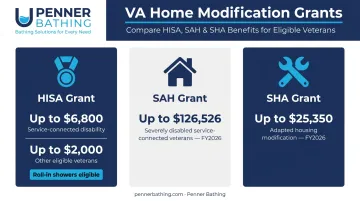
- Up to $6,800 for veterans with a service-connected disability, a Section 1151 disability, or a non-service-connected disability with a service-connected rating of at least 50%
- Up to $2,000 for disabilities outside those categories
- Roll-in showers are expressly named as eligible modifications
HISA doesn't require a service-connected disability for all benefit tiers, which opens the program to a broad range of aging veterans.
Two additional programs for veterans with qualifying service-connected disabilities:
- SAH (Specially Adapted Housing): Up to $126,526 for FY2026
- SHA (Special Home Adaptation): Up to $25,350 for FY2026
The Veteran-Directed Care (VDC) program gives veterans a flexible spending budget that may apply toward home modifications. VA approval is required before any spending, and while walk-in showers are not expressly named, grab bars and general home modifications are listed as eligible examples.
Grants and Nonprofit Programs for Seniors
USDA Section 504 Home Repair Program
The USDA's Section 504 program provides financial assistance to low-income homeowners in rural areas for health and safety repairs. Key details:
- Grants up to $10,000 (or $15,000 in disaster areas) for homeowners aged 62+ who cannot repay a loan
- Loans up to $40,000 for homeowners who can repay, at 1% fixed interest over 20 years
- Loans and grants may combine up to $50,000
- Applicant must own and occupy a home in an eligible rural area and meet USDA's income limits
Walk-in showers aren't specifically listed in USDA materials, so approval depends on how the local office classifies the modification. Frame it as a health and safety hazard removal.
Area Agencies on Aging
Area Agencies on Aging (AAAs) are federally funded local organizations that connect seniors to community resources. Many AAAs:
- Administer home modification assistance programs directly
- Refer seniors to local grants or subsidized contractors
- Help navigate state-funded programs
Search for your local AAA through the Eldercare Locator — it's free and connects you to resources specific to your ZIP code.
Habitat for Humanity and Rebuilding Together
If local AAA programs don't cover your needs, two national nonprofits offer free or subsidized modifications for low-income homeowners:
- Habitat for Humanity's Aging in Place program helps seniors with home repairs and accessibility modifications. Availability depends on local affiliate capacity.
- Rebuilding Together's Safe at Home program provides no-cost preventive accessibility modifications for older adults and people with disabilities. Documented examples include grab bars, handheld showerheads, and shower seats.
Both programs typically cover labor and sometimes materials. Eligibility and project scope vary by location.
State-Level Assistance Programs
Beyond federal and nonprofit options, some states run their own home modification programs for seniors that operate outside the Medicaid waiver system. Check with your state's housing authority or department of aging — eligibility rules and funding amounts vary widely by state.
Other Ways to Reduce Your Out-of-Pocket Costs
Tax Deductions
Walk-in shower installation may qualify as a deductible medical expense under IRS Publication 502 if the modification is medically necessary and physician-recommended. The deductible portion is the installation cost minus any increase in property value. Only qualifying expenses above 7.5% of adjusted gross income are deductible, and you must itemize.
IRS Publication 502 names ramps, grab bars, and widened doors as examples — but not accessible showers specifically. A tax professional can confirm whether your specific installation qualifies.
Home Equity and Financing Options
Seniors who own their homes have several financing paths:
| Option | How It Works | Key Consideration |
|---|---|---|
| Home equity loan | Lump sum against home equity, fixed repayments | Home secures the debt |
| HELOC | Revolving credit line against home equity | Variable payments; home at risk |
| Reverse mortgage (HECM) | Converts equity to funds; repayment deferred | Balance grows; strict maintenance obligations |
All three put home equity at risk. Consult a financial advisor before proceeding. Many walk-in bathing manufacturers and contractors also offer direct financing plans that spread costs into fixed monthly payments. Ask about financing options during any product consultation.
Senior Discounts and Special Pricing
Ask your provider directly. Some walk-in bathing companies offer senior pricing, health-condition rebates, or promotional discounts that aren't publicly advertised. Penner Bathing's team at 1-800-732-0717 can answer questions about available pricing options for the Dream Spa Walk-In Bath.
How to Get Started: Practical Next Steps
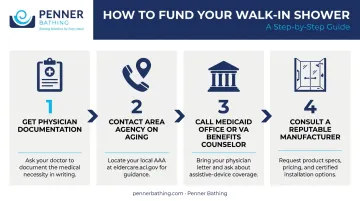
Get physician documentation. For Medicaid waivers, VA grants, and tax deductions, a written recommendation from a doctor or occupational therapist documenting medical necessity is essential. Without it, most programs won't move forward.
Contact your local Area Agency on Aging. Use the Eldercare Locator to find your local AAA. These services are free and can identify which programs you personally qualify for — saving hours of independent research.
Call your state Medicaid office or VA benefits counselor. If you're a veteran or Medicaid-eligible, these are the highest-value calls to make. Benefits counselors help navigate paperwork and applications at no cost.
Consult a reputable manufacturer. Many grant and insurance programs require specific product documentation. A manufacturer can provide the specs you need and help you select a model that meets program requirements. Penner Bathing has supplied walk-in bathing systems to care facilities and residential customers since 1980, and can provide product specifications formatted for funding applications. Reach them at pennerbathing.com or 1-800-732-0717.
Frequently Asked Questions
Can a senior get a free walk-in shower?
Yes, a fully subsidized installation is possible through programs like Medicaid HCBS waivers, VA HISA grants, or nonprofits such as Rebuilding Together. Eligibility depends on income, disability status, veteran status, and location — so the answer varies by individual circumstances.
How much does a walk-in shower cost for seniors?
A standard roll-in or zero-threshold shower installation typically runs $2,900–$6,600, with the average around $3,800 for a standard accessible design. Custom configurations cost more. Funding programs can offset a significant portion or all of this amount for qualifying applicants.
How can I get Medicare to pay for a walk-in shower?
Original Medicare does not cover walk-in showers. Medicare Advantage plans may offer supplemental home modification benefits for chronically ill enrollees — but coverage varies by plan. Contact your plan provider and ask about home safety modification benefits.
What is the HISA grant for veterans and does it cover walk-in showers?
The VA's HISA grant provides up to $6,800 for qualifying veterans to fund home accessibility modifications, and roll-in showers are expressly named as eligible. Veterans do not need a service-connected disability to qualify for all tiers of this benefit, which makes this a viable option for a broad range of aging veterans.
Does Medicaid cover walk-in shower installation for seniors?
Coverage depends on the state. Many states offer HCBS waivers that cover accessible shower installations when medically necessary, but rules and approval standards vary. Contact your state Medicaid office or a benefits counselor to confirm what your state's waiver covers.
Are walk-in shower costs tax deductible for seniors?
Walk-in shower installation may qualify as a deductible medical expense under IRS rules if it is medically necessary and physician-recommended — subject to the 7.5% AGI threshold and itemization requirements. Consult a tax professional to confirm eligibility for your specific situation.