
The consequences range from bruises and sprains to hip fractures, head trauma, and worse — especially for older adults. A single fall on a wet bathroom floor can alter the course of someone's life.
This guide covers everything that reduces that risk: proper walking technique, footwear, environmental controls, and the structural solutions that matter most for seniors and caregivers.
Key Takeaways
- Slow your pace and take short, flat-footed steps on any wet surface.
- Slip-resistant footwear is the most reliable individual-level protection you can wear.
- Bathrooms and stairways are the highest-risk wet floor environments — always use grab bars and handrails.
- Seniors face compounding risks: muscle weakness, slower reflexes, and lower bone density all increase injury severity.
- Environmental controls (mats, signage, drainage, lighting) work alongside technique, not instead of it.
Understanding the Risks of Wet Floors
Water dramatically reduces the friction between your shoe and the floor. What feels stable on dry tile can become treacherous with even a thin moisture film. Most people walk at a pace calibrated for dry conditions, leaving almost no margin to self-correct when a slip begins.
What the Injuries Look Like
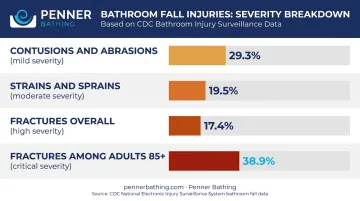
Wet floor falls aren't just embarrassing stumbles. CDC bathroom surveillance data shows the injury breakdown for bathroom falls alone:
- 29.3% contusions and abrasions
- 19.5% strains and sprains
- 17.4% fractures — rising to 38.9% among adults 85 and older
- Rearward falls — the most common wet-floor pattern — frequently strike the back or top of the head, and can cause spinal injuries among the most severe outcomes
Who's Most at Risk
Wet floors aren't equally dangerous for everyone. The populations with the highest exposure and consequence include:
- Seniors — reduced muscle strength, slower reaction time, lower bone density, and balance-affecting medications combine into a serious vulnerability
- Post-surgical patients — diminished stability during recovery
- Workers in wet environments — healthcare, food service, and janitorial staff face repeated daily exposure
- People with mobility impairments — limited ability to compensate when balance shifts unexpectedly
For elderly individuals specifically, the bathroom represents the highest-risk environment in the home. Bathing, showering, and entering or exiting a tub accounted for 37.3% of all bathroom injuries in the CDC dataset. That figure underscores why fall prevention in wet spaces matters most for the people who use them most often.
How to Walk Safely on Wet Floors
Technique is your immediate line of defense — available before any mat is placed or sign is posted. Here's how to move through wet areas with reduced risk.
General Walking Precautions on Any Wet Surface
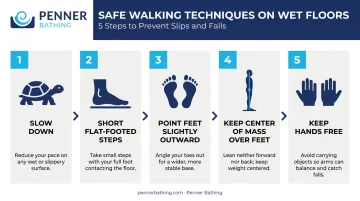
The adjustments that matter most:
- Slow down — walking faster raises the friction demand on your shoes and reduces the time available to recover from a slip
- Take short, flat-footed steps — avoid heel-striking, which concentrates force on a small contact point
- Point feet slightly outward — this widens your base of support and improves lateral stability
- Keep your center of mass over your feet — leaning forward shifts your weight ahead of your base, increasing fall probability
- Keep hands free — carrying bags, laundry, or anything heavy shifts your center of gravity and removes your arms from balance duty
Distraction is a genuine hazard. A study of young adults found that texting while approaching a low-friction surface impaired adaptive gait and increased modeled fall risk. On a wet floor, a moment of divided attention removes the margin that lets you self-correct. Put the phone away before entering a wet area — not halfway through.
At corners, make wide turns. Weight shifts sharply during tight pivots, which is exactly when a slip is most likely to catch you off-guard.
Navigating High-Risk Wet Areas: Bathrooms and Stairways
Bathrooms are uniquely dangerous because multiple hazards converge at once: confined space that limits recovery room, continuously wet surfaces, physical fatigue from bathing, and a slick tub or shower floor that drops away from where you're standing. That combination demands more deliberate technique than almost any other wet-floor situation.
Safe technique for wet bathroom floors:
- Step out of the tub or shower slowly, using a grab bar if one is installed
- Place both feet fully on the bath mat before standing upright — don't pivot while one foot is still in the tub
- Dry your feet before walking on tile
Avoid rushing to answer a door or phone while wet and barefoot — the urge to move quickly is one of the most common triggers for bathroom falls.
For wet stairs, indoors or out:
- Use the handrail on every descent and ascent, not just when it feels necessary
- Place the entire foot on each step — toes hanging off the edge reduce your contact surface
- Take one step at a time; don't skip steps or rush
- Be especially cautious on outdoor stairs after rain and uncarpeted interior stairs after mopping
Special Considerations for Seniors and Mobility-Challenged Individuals
Falls cause approximately 3 million emergency department visits and nearly 319,000 hip-fracture hospitalizations among older Americans each year. The NCOA reports that falls caused 38,000 deaths among adults 65 and older in 2021. Those numbers aren't just about wet floors — but wet bathroom floors are where a significant portion of that risk lives.
The physiological reasons seniors face amplified danger:
- Muscle weakness limits the explosive correction needed to recover from a slip
- Slower proprioception means the brain receives delayed signals about body position
- Reduced reaction time narrows the window to grab something or shift weight
- Medications — particularly psychoactive drugs and those causing dizziness — are a modifiable but frequently overlooked factor
Practical strategies for seniors on wet floors:
- Use a walker or cane consistently, including for short indoor distances on wet surfaces
- Wear non-slip grip socks or proper footwear at all times indoors — bare feet on tile are high-risk
- Communicate with caregivers before entering wet areas
- Install grab bars at tub entry, shower entry, and next to the toilet
For seniors and residents in long-term care settings, the most dangerous moment in a bathroom routine is stepping over a traditional tub ledge onto a wet floor while fatigued from bathing. When technique alone isn't enough to manage that risk, structural design becomes the next layer of protection. Penner Bathing's walk-in bath solutions are built around this problem: the wide swing-out door lets users sit down and swing their legs into the tub, removing the step-over moment entirely before it can become a fall.
Preventing Wet Floor Hazards Before They Happen
Good walking technique helps, but environmental controls are what reduce wet-floor risk at scale. Property owners, facility managers, caregivers, and households can all take concrete steps — many of them simple and low-cost — to keep wet floors from becoming injury sites.
Footwear
Slip-resistant footwear is the most consistent individual-level control available. A NIOSH randomized trial covering approximately 17,000 food-service workers found a 67% reduction in slip-injury workers' compensation claims when highly rated slip-resistant shoes were provided.
What to look for:
- Rubber outsoles with a textured tread pattern
- Closed-toe design
- ASTM F2913 testing and F3445 performance specification compliance, where applicable
High-risk footwear choices to avoid on wet floors:
- Socks without grip dots
- Smooth-soled dress shoes
- Flip-flops or open-heeled footwear
- Worn-out soles with flattened tread
Non-Slip Mats, Signage, and Drainage
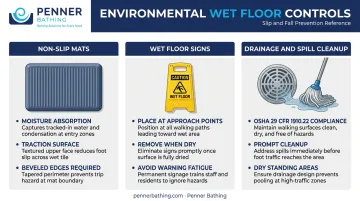
These three controls address wet-floor risk at the source — before someone steps into the hazard:
1. Non-slip mats — Place at building entrances, bathroom exits, and kitchen sinks. Mats absorb moisture and provide traction, but only if they have beveled edges. A mat without beveled edges creates a new trip hazard at its border.
2. Wet floor signs — Post them at approach points before someone encounters the hazard, not in the middle of it. Remove them promptly once the surface is dry — a sign left out permanently trains people to ignore it.
3. Drainage and spill cleanup — OSHA's 29 CFR 1910.22(a)(2) requires workroom floors to be maintained in a clean and, as far as feasible, dry condition. When wet processes are involved, drainage must be maintained and dry standing places — mats, platforms — must be provided where feasible. Prompt spill cleanup prevents standing water from becoming a sustained hazard.
Lighting and Visibility
Wet surfaces are hardest to see in low light. A care-home study found that upgraded lighting was associated with a 43% lower resident fall rate in the following year. Better visibility directly supports hazard detection — including wet surfaces that are nearly invisible in dim conditions.
Practical recommendations:
- Maintain adequate ambient lighting in bathrooms, kitchens, and hallways
- Install nightlights in hallways and bathrooms for nighttime trips — particularly important for seniors
- Inspect and replace burned-out bulbs promptly, especially in stairwells
Common Wet Floor Safety Mistakes to Avoid
Mistake 1: Rushing through a wet area. Speed eliminates the body's ability to self-correct a slip. Even a few hurried steps on a wet floor significantly increase fall risk. In environments where wet floors are routine — healthcare facilities, commercial kitchens, bathrooms — slowing down needs to become an ingrained habit, not a one-time reminder.
Mistake 2: Assuming a surface is "dry enough." Tile, polished concrete, and linoleum can retain an invisible moisture film that sharply reduces traction — even when no standing water is visible. If an area was recently wet, treat it as still wet until you've confirmed otherwise by touch or adequate time has passed.
Mistake 3: Skipping handrails and grab bars. Many serious falls happen because someone reached for a grab bar a moment too late, or there wasn't one available. Handrails and grab bars should be used consistently on any stairway or bathing area — not just when balance is already failing.
In care facilities and home bathrooms especially, their presence is non-negotiable.
Conclusion
Walking safely on wet floors depends on three layers working together: environmental controls (mats, signage, drainage, lighting), proper footwear, and consistent behavioral adjustments (pace, technique, attention). Each layer compensates for gaps the others can't cover.
For caregivers, facility managers, and homeowners with elderly residents, the real question is whether the physical environment is designed to reduce wet floor exposure in the first place — particularly in bathrooms. Penner Bathing's walk-in bath solutions take a structural approach to the most hazardous daily moment for seniors: eliminating the step-over tub entry entirely, rather than relying on technique to manage a danger built into standard tub design.
The Dream Spa Walk-In Bath starts at $5,950 for residential aging-in-place customers. For long-term care facilities, Penner's healthcare bathing systems offer the same structural safety with features built for clinical environments.
Technique matters. So does designing out the hazard. When both work together, that's where real protection begins.
Frequently Asked Questions
What is the safest way to walk on a slippery surface?
Slow your pace significantly, take short flat-footed steps rather than heel-striking, and point your feet slightly outward to widen your base of support. Keep your hands free so your arms can assist with balance, and give the surface your full attention — no phone use, no rushing.
Is it safe to walk on wet floors?
Wet floors carry real injury risk. That risk drops significantly when you adjust your gait, wear slip-resistant footwear, and use handrails or grab bars wherever they're available. Avoiding wet floors entirely is always the safer choice when that's an option.
What type of footwear is best for walking on wet floors?
Rubber-soled, closed-toe shoes with a textured tread pattern are your best option. Smooth-soled dress shoes, socks without grip dots, and worn-out footwear all significantly increase slip risk on wet surfaces, even when the wetness isn't immediately visible.
Why are wet floors especially dangerous for elderly individuals?
Aging reduces muscle strength, balance, and reaction time — all of which are needed to self-correct a slip before it becomes a fall. Lower bone density means falls are far more likely to result in serious fractures, particularly hip breaks, which carry significant mortality risk in older adults.
How can seniors reduce their risk of slipping on wet bathroom floors?
Install grab bars at tub entry and near the toilet, use non-slip bath mats with beveled edges, and wear grip socks or slip-resistant footwear indoors. Move deliberately when entering or exiting any bathing area. Walk-in bath options can also eliminate the step-over tub entry that causes many bathroom falls.
What should you do immediately if you see a wet floor?
Avoid the area if possible and place a wet floor warning sign at the approach point, not in the middle of the hazard. Report it to building staff or a caregiver if you can't clean it yourself. Don't assume someone else has already handled it.