"Taking healthcare to the patient" flips this dynamic entirely. Rather than requiring patients to come to care, providers bring services — therapy, wound care, bathing, monitoring — directly to wherever the patient lives. For nursing home and assisted living residents, this isn't a luxury. It's often the only model that works.
This article covers what in-facility care delivery actually means, the meaningful benefits it creates for patients and care teams, the real challenges facilities face when implementing it, and practical ways to address those challenges — including the role of purpose-built equipment like therapeutic bathing systems.
Key Takeaways
- In-facility care reduces transport risks, preserves dignity, and supports care continuity
- About 1 in 43 nursing-home residents has a healthcare-associated infection on any given day — making infection control a core challenge
- 77% of nursing homes reported moderate or high staffing shortages in 2023
- Therapeutic bathing delivers pain relief, relaxation, and hygiene without requiring patient transport
- Built-in antimicrobial protection and automatic disinfection reduce infection risk in shared spaces
What "Taking Healthcare to the Patient" Means
Patient-centered care delivery covers a broad spectrum. On one end: telehealth consultations and remote monitoring. On the other: hands-on, in-room services like wound care, physical therapy, and therapeutic bathing. Every point on that spectrum shares the same goal: reducing the distance between patients and the care they need.
This model has gained traction as the U.S. aging population grows. According to the Administration for Community Living, 57.8 million Americans were age 65 or older in 2022, representing 17.3% of the population — a share projected to reach 22% by 2040. As demand for long-term care services grows, institution-centric care models become increasingly difficult to scale.
Who Benefits Most
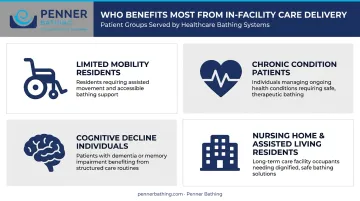
Not every patient needs care delivered to them. But several populations do:
- Residents with limited mobility who cannot safely transfer to and from transport vehicles
- Patients with chronic conditions — arthritis, heart disease, diabetes — requiring frequent monitoring
- Individuals with cognitive decline who experience significant disorientation from environmental changes
- Nursing home and assisted living residents for whom frequent facility exits are logistically impractical
For these populations, in-facility care delivery isn't a workaround — it's the most clinically appropriate approach, and the one most likely to produce consistent outcomes.
Key Benefits of In-Facility Care Delivery
Improved Patient Dignity and Comfort
Receiving care in a familiar environment matters more than it might seem. A 2017 meta-analysis covering nearly 4,000 people with dementia — the majority in long-term care settings — found that person-centered care was associated with significantly less agitation, fewer neuropsychiatric symptoms, and reduced depression. Patients who aren't subjected to the disorientation of transport are more cooperative with care plans and more at ease during procedures.
That cooperation has direct clinical weight — reduced agitation means fewer interventions, less medication, and lower fall risk.
Better Health Outcomes and Care Continuity
When care comes to the patient consistently, fewer appointments get missed. Staff observe the patient's daily baseline and catch changes early — before a minor decline becomes a hospitalization.
Research supports this. Hospitals with formal skilled nursing facility networks achieved a 4.5 percentage-point greater relative reduction in 30-day readmissions for patients discharged to SNFs compared to hospitals without such networks. Structured continuity between care partners isn't just a logistical nicety — it has measurable clinical consequences.
Reduced Transport Risks
Transporting elderly or medically fragile patients carries real risks. CDC infection-control guidance explicitly requires facilities to communicate residents' infection status before transport and specifies source-control precautions during transit. Physical movement itself adds further exposure for patients with:
- Osteoporosis or fracture risk from repositioning and vehicle vibration
- Cardiovascular conditions sensitive to exertion and temperature changes
- Unstable gait that increases fall risk during loading and unloading
On-site care removes these risks before they can compound.
Enhanced Staff Efficiency
In a care facility, delivering services on-site means clinical staff can see multiple patients in sequence without coordinating external transport. Specialized equipment extends that efficiency further by cutting per-patient setup time.
Penner Bathing's bathing systems, for example, include fast-fill reservoir systems that reduce wait time between patients — allowing staff in high-volume settings to manage more residents per shift without added personnel. Features like automatic disinfection also eliminate time staff would otherwise spend manually sanitizing equipment between uses.
Supports Patient Rights and Self-Determination
Federal regulation is unambiguous here. Under 42 CFR 483.10, nursing home residents have the right to dignified existence, self-determination, and participation in their care plans — including the right to request or refuse treatment and to participate in person-centered care planning.
Bringing care to the patient directly supports these rights. Receiving treatment in one's own space, on a consistent schedule, with familiar staff, is meaningfully different from being transported to a clinical environment on someone else's timetable.
Unique Benefits for Long-Term Care and Assisted Living Settings
Long-term care facilities occupy a unique position in this model. Residents already live on-site. Staff are present daily. Personalized routines are built into care plans by requirement. This makes in-facility care not just feasible but therapeutically optimal.
Therapeutic Bathing as In-Facility Care
Bathing in a long-term care setting is often discussed as a hygiene task. For residents with arthritis, chronic joint pain, or limited mobility, a therapeutic bath provides:
- Muscle and joint pain relief through hydrotherapy
- Whole-body relaxation and reduced physical tension
- Psychological comfort and sensory engagement
- Improved skin hygiene and hydration without physical strain
Penner Bathing's healthcare bathing systems — the Premier, Cascade, Contour, and Pacific models — are designed to deliver this level of care within nursing home, assisted living, and hospital environments. The Cascade, for instance, includes multiple entry configurations (left, right, and end-opening) and a height-adjustable transfer post. Bariatric options support residents up to 600 lbs, and a home-like aesthetic helps reduce the institutional feel that can heighten patient anxiety.
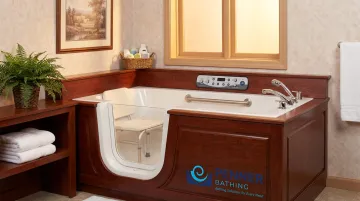
PennAire Microbubble Technology, available as an enhancement, infuses bath water with billions of oxygenated microbubbles that penetrate skin pores for deep cleansing, increase skin hydration by 46% (per Penner Bathing product testing), and provide gentle exfoliation — meaningful for elderly residents prone to skin breakdown.
Consistent Caregiver Relationships
In long-term care, residents interact with the same staff over months or years. This creates clinical advantages that no appointment-based system can replicate: staff recognize subtle changes in behavior or mobility, understand individual pain tolerances, and build trust that makes patients more cooperative during care.
Aging in Place — Even Within a Facility
The Federal Long Term Care Insurance Program's Care Navigator explicitly includes assisted-living apartments as valid aging-in-place settings. The principle applies: even residents who live in a care facility benefit from maximizing their autonomy, comfort, and routine stability. In-facility care delivery directly supports this by keeping the patient's daily experience as consistent as possible.
Family Peace of Mind
When families know their loved one receives therapeutic services — including bathing — without the disruption of transport, it builds trust in the facility. That trust translates into stronger family engagement with the care team, which research consistently links to better care plan adherence and resident outcomes.
Challenges of Taking Healthcare to the Patient
Infection Control in Shared Spaces
Hands-on care in patient rooms and shared bathing areas carries real infection risk. On any given day, approximately 1 in 43 nursing-home residents has at least one healthcare-associated infection. Shared equipment — particularly bathing systems used by multiple residents daily — creates direct cross-contamination pathways when cleaning protocols aren't rigorous and consistent. That risk doesn't shrink with good intentions; it shrinks with reliable process.
Staffing Constraints
In-facility care delivery requires staff who can manage multiple care functions within a single shift. That's a tall order when approximately 77% of nursing home providers reported moderate or high staffing shortages in a 2023 AHCA survey. Cross-training is valuable but consumes time that already-stretched teams don't have.
Adding therapeutic services without adding headcount means something else has to give — typically workflow design or equipment efficiency.
Equipment Suitability
Not all clinical equipment is designed for residential or semi-residential environments. A bathing system for a nursing home must be:
- Safe for patients with limited mobility, cognitive decline, or bariatric needs
- Operable by staff with varying levels of training
- Durable enough for high-frequency, multi-resident daily use
- Appropriate for spaces where residents live, not just receive care
Equipment that fails any of these criteria creates risk — for patients, staff, and the facility's compliance standing.
Regulatory Compliance and Documentation
Under 42 CFR 483.21, nursing facilities must develop comprehensive, person-centered care plans within seven days of each resident's comprehensive assessment — and review them after every subsequent assessment. Every therapeutic service delivered in-facility must be documented, auditable, and defensible under CMS survey guidance.
Informal or inconsistent care delivery creates documentation gaps that surveyors will find — regardless of how well the care itself was delivered.
Overcoming the Challenges: Practical Solutions
Infection Control: Equipment That Works Around the Clock
Manual disinfection protocols fail when staff are rushed, undertrained, or simply human. The more reliable solution is equipment that doesn't depend on perfect manual execution.
Penner Bathing's systems include built-in BioCote® antimicrobial protection embedded directly into the product materials — active 24 hours a day, seven days a week, for the lifetime of the unit. Unlike surface coatings, it doesn't degrade over time.
Combined with automatic disinfection standard on all models, these features reduce the infection control burden on staff without eliminating the need for good hygiene practices.
One important caveat: BioCote® reduces bacterial colonization on surfaces and is designed to work alongside cleaning protocols, not replace them. Facilities should treat it as a meaningful additional layer of protection, not a standalone solution.
Stretch Staffing Capacity with Smarter Workflows
When staff time is limited, the right equipment multiplies their capacity. Key features to look for:
- Fast-fill reservoirs that reduce wait time between residents
- Height-adjustable transfer systems that allow single-caregiver bathing assistance without additional staff
- Automatic disinfection cycles that eliminate manual sanitization steps
- Intuitive controls that reduce training time and operation errors
Penner Bathing offers on-site staff training for facilities — a practical step that shortens the learning curve and ensures staff are using equipment efficiently from day one. Facilities should also audit how much time staff currently spend per bathing session and identify where equipment features can recover that time.
Build Compliance Into the Care Plan
Therapeutic bathing — and any other in-facility care service — should be treated as a formal component of the resident's care plan, not an informal add-on. This means:
- Include therapeutic bathing schedules in the written care plan
- Assign specific staff and time slots — not ad hoc delivery
- Reassess frequency and approach at each quarterly and comprehensive review
- Maintain records that would survive a CMS survey
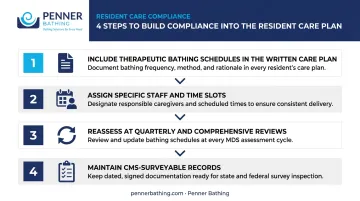
This approach satisfies the documentation requirements of 42 CFR 483.21 while also ensuring residents actually receive the care they're entitled to consistently.
Frequently Asked Questions
What does it mean to take care of a patient?
Taking care of a patient means addressing their physical, emotional, and medical needs in a respectful, holistic way — providing access to treatments, therapies, and daily care routines that support health and dignity. Care may occur in a hospital, a care facility, or at home.
What are the 7 patient rights in healthcare?
Core patient rights include dignified care, informed consent, privacy, continuity of care, participation in care decisions, access to condition information, and the right to file a grievance. In federally regulated nursing facilities, these rights are codified under 42 CFR 483.10 and the Patient Self-Determination Act.
What are the most common models of taking healthcare to the patient?
The primary models include in-facility care delivery (nursing homes, assisted living), telehealth and remote monitoring, mobile clinics, and home health visits. The right model depends on the patient's condition, mobility level, and care setting.
How does in-facility care benefit elderly patients specifically?
It reduces the physical and cognitive stress of transport, supports consistent daily routines, and allows familiar staff to identify health changes early — all critical for aging patients managing complex, chronic conditions.
What role does therapeutic bathing play in long-term patient care?
Therapeutic bathing — particularly hydrotherapy — reduces muscle and joint pain, promotes relaxation, and supports hygiene for patients with limited mobility. Delivered directly in nursing home and assisted living settings, it eliminates transport stress while maintaining consistent, dignified care.