
Introduction
Falls remain one of the most serious — and preventable — safety threats in healthcare settings. According to the CDC, older adults experience approximately 3 million fall-related emergency department visits and 1 million hospitalizations annually. A CDC-authored study estimated $80 billion in 2020 healthcare spending attributable to nonfatal older adult falls alone.
A fall risk nursing diagnosis is the clinical starting point for changing those numbers. Rather than responding after a fall occurs, nurses use structured, NANDA-I-guided care plans to identify vulnerability early and deploy targeted interventions before harm happens.
This guide walks nurses and care teams through the full process:
- Identifying multifactorial risk factors
- Selecting the right assessment tool
- Writing SMART goals with real examples
- Applying evidence-based interventions across care settings
- Three complete care plan examples ready to adapt
Key Takeaways
- Fall risk is a risk-type nursing diagnosis — nurses intervene before the fall, not after
- The current NANDA-I labels are "Risk for Adult Falls" (code 00303) and "Risk for Child Falls"
- A valid care plan needs: diagnosis statement, SMART goals, individualized interventions, and evaluation criteria
- Morse Fall Scale and Hendrich II are the most widely used standardized assessment tools
- High-risk patients need layered, multifactorial strategies — one intervention on its own is never enough
Risk Factors for Falls
Fall risk is multifactorial — nurses must assess across biological, pharmacological, environmental, and behavioral domains simultaneously, because no single factor captures the complete picture.
Physiological and Health-Related Factors
The strongest individual predictor of a future fall is a history of previous falls. The CDC notes that falling once doubles the likelihood of falling again. Additional physiological contributors include:
- Age-related muscle weakness and deconditioning
- Impaired gait, balance, or coordination
- Sensory deficits — particularly vision loss
- Neurological conditions: stroke, Parkinson's disease, dementia
- Orthostatic hypotension causing dizziness upon position change
Cognitive impairment compounds physical risk in ways that are easy to underestimate. In a study of nearly 30,000 hospital admissions, delirium was associated with 2.81 times the odds of an inpatient fall.
Dementia and delirium impair judgment, spatial awareness, and a patient's ability to recognize or follow safety precautions. Even patients with mild physical limitations become high-risk when cognition is affected.
Medication-Related Factors
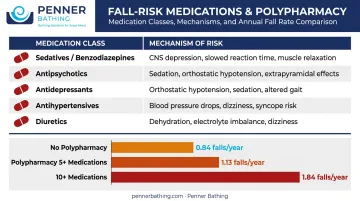
Several drug classes directly increase fall risk through distinct mechanisms:
| Medication Class | Mechanism |
|---|---|
| Sedatives / benzodiazepines | Sedation, ataxia, impaired psychomotor function |
| Antipsychotics | Sedation, orthostatic hypotension, impaired motor response |
| Antidepressants | Ataxia, psychomotor impairment, syncope |
| Antihypertensives | Orthostatic hypotension, dizziness, bradycardia |
| Diuretics | Volume depletion, electrolyte disturbance, urinary urgency/nocturia |
Polypharmacy — typically defined as five or more concurrent medications — multiplies risk through drug interactions and cumulative side effects. Long-term care data shows fall rates of 1.13 per person-year with polypharmacy versus 0.84 without it; patients on more than 10 medications reached 1.84 falls per person-year.
Environmental and Behavioral Factors
Physical surroundings and patient behavior are modifiable risk factors — and the most actionable ones for nursing staff to address:
Environmental hazards:
- Poor or absent night lighting
- Cluttered pathways and cords across floors
- Absence of grab bars or handrails in bathrooms
- Unsafe or unfamiliar room layouts
- Improper footwear (socks without grip, ill-fitting slippers)
Behavioral risk factors:
- Inactivity leading to deconditioning
- Improper or inconsistent use of assistive devices
- Attempting to ambulate without calling for assistance
Fall Risk Nursing Diagnosis: The NANDA-I Framework
A nursing diagnosis, per NANDA-I, is a clinical judgment about a human response — or vulnerability to a response — to health conditions or life processes. NANDA-I recognizes four diagnostic categories: problem-focused, risk, health-promotion, and syndrome.
"Risk for Falls" is a risk-type diagnosis, meaning the undesirable outcome has not yet occurred. The diagnostic statement is supported by risk factors only — not signs and symptoms. There is no "as evidenced by" component.
Current NANDA-I Labels
The 2021–2023 NANDA-I taxonomy (12th edition) introduced age-specific labels:
- Risk for Adult Falls — code 00303, approved in 2020
- Risk for Child Falls — code 00306
Both labels replaced the previously used "Risk for Falls." The legacy label still appears in older records, so familiarity with all three is useful in practice.
Sample Diagnostic Statements
Adapt these templates to fit individual patient presentations:
- "Risk for Adult Falls related to impaired gait and polypharmacy"
- "Risk for Adult Falls related to cognitive impairment and unfamiliar environment"
- "Risk for Adult Falls related to antihypertensive medication use and lower extremity weakness"
- "Risk for Adult Falls related to altered mental status and orthostatic hypotension"
Fall Risk Assessment Tools
Standardized tools convert clinical observation into an objective risk score, creating a documented baseline for tracking changes over time. Reassessment should occur at each of these points:
- Admission
- After any change in clinical status or cognition
- Immediately following a fall event
- At regular intervals throughout the care episode
The Morse Fall Scale
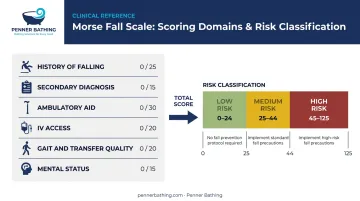
The Morse Fall Scale scores patients across six domains:
- History of falling
- Secondary diagnosis
- Ambulatory aid used
- IV access or heparin lock
- Gait and transfer quality
- Mental status
Scores range from 0 to 125. The widely used risk bands are 0–24 (low), 25–44 (medium), and 45+ (high risk), though some institutions adopt different local thresholds. The original Morse prospective study validated the tool across acute, rehabilitation, and geriatric units.
The Hendrich II Fall Risk Model
The Hendrich II incorporates eight factors: confusion/disorientation/impulsivity, depression, altered elimination, dizziness/vertigo, male sex, antiepileptic medication use, benzodiazepine use, and performance on the Get Up and Go test. A score of 5 or higher classifies the patient as high risk.
Additional tools by setting:
- PH-FRAT (Falls Risk Assessment Tool): designed for sub-acute and long-term care and residential settings
- Humpty Dumpty Fall Scale: used in pediatric inpatient settings (a 2025 multicenter study found limited discrimination with AUC 0.568, so pair results with clinical judgment)
Tool selection should match the patient population — a tool validated for acute-care adults is not automatically appropriate for pediatric or community-based patients.
SMART Nursing Goals for Fall Risk
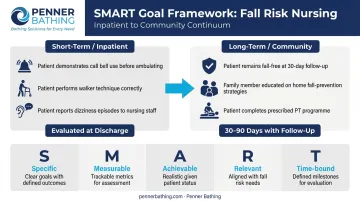
A SMART goal in nursing is Specific, Measurable, Achievable, Relevant, and Time-bound. Vague outcomes fail this standard. "Patient will be safe" is not a nursing goal — it is a wish. Goals must describe an observable patient behavior and specify when that behavior will be evaluated.
Short-Term Goal Examples
During active hospitalization or early care:
- "The patient will keep the call bell within reach and use it before attempting to ambulate throughout hospitalization."
- "The patient will demonstrate correct walker technique under nursing supervision by [specific date]."
- "The patient will report dizziness before changing position at each nursing assessment."
Long-Term Goal Examples
For discharge planning and community follow-up:
- "The patient will remain free of falls throughout the duration of hospitalization."
- "The patient and family will verbalize three individualized fall prevention strategies before discharge."
- "The patient will complete outpatient physical therapy evaluation within 30 days of discharge and implement home safety modifications."
Goal timeframes should match the care setting. Inpatient goals are typically evaluated at discharge; home-based behavioral goals need a longer horizon of 30 to 90 days, with a follow-up mechanism built into the plan.
Nursing Interventions to Reduce Fall Risk
No single intervention reliably prevents falls. Evidence consistently supports individualized, multifactorial approaches that layer multiple strategies based on the patient's specific risk profile and score. Universal precautions alone are insufficient for high-risk patients.
Environmental and Safety Modifications
Standard environmental interventions for all fall-risk patients:
- Keep bed in the lowest locked position
- Ensure adequate room lighting, especially at night
- Keep pathways clear of equipment and cords
- Place call bell and personal items within reach — verify the patient can demonstrate use
- Use non-skid footwear that fits securely
- Use bed and chair alarms selectively for patients who attempt to rise unassisted
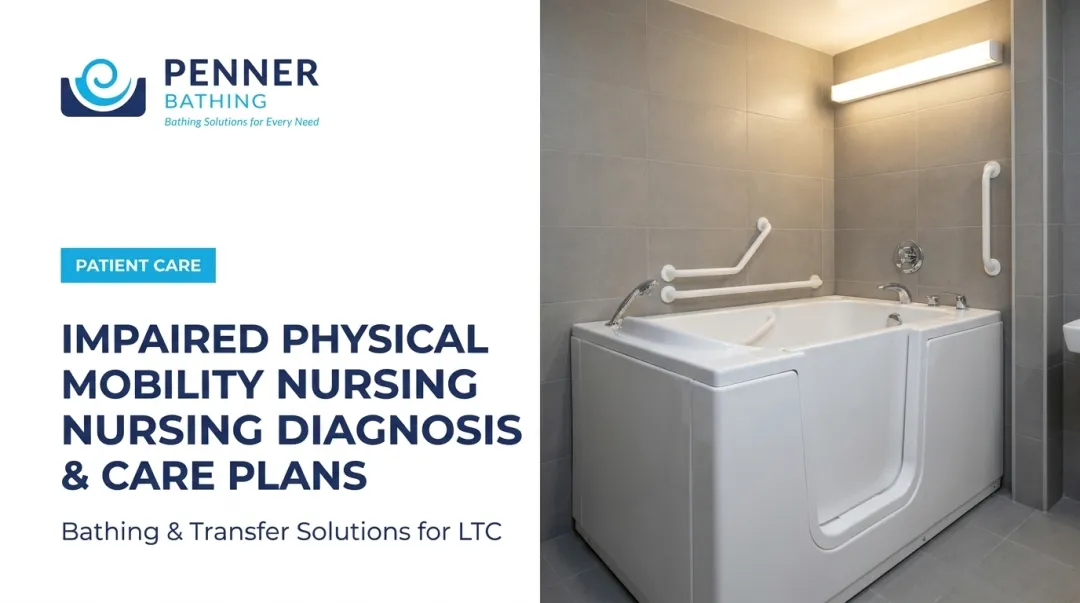
In long-term care and assisted living settings, the bathing environment is a frequently overlooked fall risk — one that involves multiple transfers, wet surfaces, and moments of physical vulnerability. Specialized healthcare bathing systems can reduce these hazards structurally, rather than relying solely on staff vigilance.
Penner Bathing, which manufactures systems for nursing homes, assisted living facilities, and hospitals, designs specifically around these transfer risks. Key safety features include:
- Height-adjustable transfer posts and multiple door-entry configurations (left, right, and end-opening)
- Rail-free designs that eliminate entanglement hazards
- Integrated transfer chairs with safety belts and bariatric capacity up to 600 lbs
- Automatic disinfection that reduces wet floor hazards by minimizing manual cleaning in the bathing area
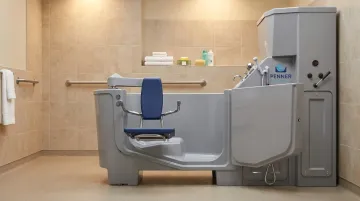
These structural features complement, rather than replace, the nursing assessment and individualized care planning that drive any effective fall prevention program.
Mobility, Assistive Devices, and Monitoring
Mobility interventions require individualization, not uniformity:
- Assistive device selection: Ensure canes and walkers are properly sized and fitted — an ill-fitted device is worse than none
- Fall risk identification: Colored wristbands, door signs, and chart flags communicate risk to the full care team. The AHRQ's Fall TIPS approach takes this further by communicating patient-specific risks alongside matched interventions, rather than generic alerts
- Hourly rounding: Especially for toileting and access needs — AHRQ data notes toileting-related falls as a distinct high-risk circumstance, with 38.3% of one hospital cohort experiencing moderate or severe injury during toilet-related falls
- PT referral: For gait training, strength and balance exercises, and assistive device prescription
- OT referral: For ADL safety assessment and home modification planning, especially for patients returning home
Medication Review and Cognitive Interventions
The nurse's role in medication safety goes beyond documentation:
- Identify fall-risk-increasing drugs (FRIDs) in the medication list
- Observe and document peak medication effects — sedation, orthostasis, confusion
- Collaborate with pharmacy and prescribers to advocate for dosage adjustment or substitution where appropriate
- Note that medication review alone has inconsistent evidence for reducing falls; it is most effective as one component of a multifactorial plan
For patients with delirium or dementia:
- Frequent reorientation using consistent environmental cues
- Maintain familiar objects in the room
- Involve family members in supervision during high-risk periods
- Consider sitters only as a last resort — a VA systematic review found insufficient evidence that adding sitters reliably reduces falls on their own
Patient and Family Education
Education should be direct, personalized, and documented:
- Explain the patient's specific risk factors — not a generic fall prevention handout
- Provide rationale for each safety precaution so patients understand why the measures matter
- Have both patient and caregivers verbalize understanding and demonstrate safe behaviors (using call bell, transferring with assistance, etc.)
- Document the education provided and the patient's demonstrated comprehension before discharge
Fall Risk Nursing Care Plan Examples
The care plans below follow a standard format — diagnostic statement, expected outcomes, and key nursing interventions — and should be adapted to each patient's individual clinical presentation.
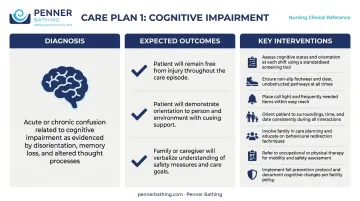
Care Plan 1: Risk for Falls Related to Cognitive Impairment
Diagnostic statement: Risk for Adult Falls related to altered mental status, lower limb weakness, and poor balance secondary to advanced age and delirium.
Expected outcomes:
- Patient remains free from falls during hospitalization
- Patient is assisted with all mobility by staff
- Patient and family verbalize understanding of safety measures before discharge
Key nursing interventions:
- Evaluate mental status each shift using a standardized tool
- Coordinate neurological evaluation if new deficits emerge
- Maintain bed alarm and active call bell at all times
- Ensure non-slip footwear is worn during all mobility
- Reorient patient frequently; keep familiar objects at bedside
- Involve family in supervision during high-risk periods
- Refer to PT (gait/balance) and OT (home safety planning)
- Educate family on post-discharge safety follow-up and warning signs
Care Plan 2: Risk for Falls Related to Environmental Hazards and Polypharmacy
Diagnostic statement: Risk for Adult Falls related to inadequate home lighting, cluttered living environment, and antihypertensive/sedative medication use in an elderly patient living alone.
Expected outcomes:
- Patient verbalizes three specific environmental changes to implement at home
- Patient and family complete a home safety plan within 30 days of discharge
- Patient remains free of falls during hospitalization
Key nursing interventions:
- Review full medication regimen with pharmacist; flag Fall Risk Increasing Drugs (FRIDs) for prescriber review
- Educate patient on orthostatic hypotension — instruct on slow position changes (sit at edge of bed before standing)
- Provide a written home safety checklist before discharge
- Coordinate home health OT visit for environmental assessment
- Assess for community support resources that assist older adults with home modifications
- Ensure patient can demonstrate call bell use and ambulation with assistance before discharge
Care Plan 3: Risk for Falls Related to Impaired Mobility and Assistive Device Misuse
Diagnostic statement: Risk for Adult Falls related to improper use of walker and orthostatic hypotension.
Expected outcomes:
- Patient demonstrates correct walker technique before discharge
- Patient reports no dizziness upon standing at each mobility assessment
- Patient remains free of injury throughout hospitalization
Key nursing interventions:
- Assess current walker use technique; correct grip height and gait pattern immediately
- Engage PT for supervised gait training and formal device fitting
- Implement slow position-change protocol at each mobility event
- Monitor blood pressure in lying, sitting, and standing positions
- Ensure adequate lighting in the room and hallways during ambulation
- Apply fall-risk wristband and post door sign; communicate status at handoff
- Educate patient and family on correct device use and when to seek assistance
Frequently Asked Questions
What are SMART nursing goals for fall risk?
SMART goals are Specific, Measurable, Achievable, Relevant, and Time-bound. A well-written fall risk goal might read: "The patient will remain free of falls throughout hospitalization" or "The patient will demonstrate correct walker use before discharge on [date]." Each goal should be tailored to the patient's specific risk factors, not copied from a generic template.
What are the nursing interventions to reduce fall risk?
Core intervention categories include:
- Environmental safety: bed alarms, adequate lighting, non-slip footwear, clear pathways
- Medication review: identify and reduce fall-risk-increasing drugs
- Mobility assistance: correct assistive device fitting and supervised ambulation
- Risk identification: wristbands, door signage, and care team communication
- Referrals and education: PT/OT referrals and patient/family teach-back sessions
What are the 5 P's of fall prevention?
The 5 P's provide a structured framework for hourly rounding: Pain, Position, Placement (of personal items within reach), Potty (addressing toileting needs proactively), and Peripheral IV/equipment (checking lines and devices). Note that some facilities use slight variations — the fifth P may include pump, possessions, or personal needs depending on local protocol.
What is the NANDA-I nursing diagnosis for fall risk?
The current NANDA-I labels are "Risk for Adult Falls" (code 00303, approved 2020) and "Risk for Child Falls." These updated from the previously used "Risk for Falls." Because this is a risk-type diagnosis, it requires documented risk factors rather than signs and symptoms, meaning "as evidenced by" does not apply.
What are the most common risk factors nurses assess for falls?
Top risk factors include: history of previous falls, age 65 or older, cognitive impairment (especially delirium), use of high-risk medications (sedatives, benzodiazepines, antihypertensives), impaired gait or balance, sensory deficits such as poor vision, and environmental hazards in the patient's room or home setting.
How often should fall risk be reassessed in a hospital or long-term care setting?
In hospitals, reassessment should occur at admission, after any change in clinical status or cognition, and immediately following a fall. In long-term care, CMS guidelines require evaluation at admission, quarterly (no more than 92 days apart), annually, after a significant condition change, and after any fall event.