
Here's the thing many people get wrong: using a bath aid isn't about giving up independence. It's how you keep it. The right aid lets people bathe safely, on their own schedule, without needing to call for help.
This guide covers the top five bath aids — from no-install solutions to permanent walk-in baths — and explains how to match each one to a specific mobility challenge.
Key Takeaways
- Bathroom falls are a genuine risk, particularly for adults over 65, and the tub is a primary danger zone
- Each of the five aids covered here — grab bars, non-slip mats, bath seats/boards, bath steps, and walk-in baths — targets a specific mobility challenge, so the right fit depends on your situation
- The severity and progression of mobility limitations should drive your choice — simpler aids suit mild difficulty, while walk-in baths are better suited for significant or worsening conditions
- Those with progressive mobility loss often save time and cost by choosing a permanent solution from the start rather than replacing aids later
- An occupational therapist can assess your specific needs and help identify funding programs
Why Getting In and Out of the Tub Gets Harder With Age
Stepping over a tub wall looks simple. In reality, it requires coordinating several physical abilities at once, and each one tends to decline with age.
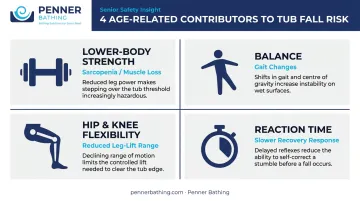
The four main contributors:
- Lower-body strength: Sarcopenia (age-related muscle loss) is associated with increased fall risk in older adults across multiple large studies
- Balance: Impaired balance and gait changes are well-documented fall risk factors, assessed clinically through tools like the CDC's Timed Up and Go test
- Hip and knee flexibility: Reduced range of motion makes the high leg-lift required to clear a tub wall increasingly difficult
- Reaction time: Slower step initiation means that when balance is lost, recovery is harder — especially on a wet surface
A study of 1,172 falls among high-risk community-dwelling adults over 65 found that 17.3% of injurious falls occurred in bathrooms, and bathroom falls were 2.4 times more likely to cause injury than falls in the living room.
The right solution depends entirely on which of these challenges is most limiting. Someone struggling mainly with leg-lifting needs a different aid than someone whose primary problem is lowering themselves into deep water. The five aids covered below are matched to those specific limitations.
Top 5 Bath Aids to Safely Get In and Out of the Tub
These five aids are selected based on safety evidence, ease of use, accessibility, and the range of users they serve — from those with mild difficulty to those with significant mobility challenges.
1. Grab Bars and Rails
Grab bars are wall-mounted or clamp-on handrails that give users a stable grip point during tub entry and exit. Mechanically, they work by letting the user bear weight through their arms to stabilize balance while lifting a leg or lowering their body, reducing the demand on leg strength alone.
A controlled study of 63 adults found that access to a grab bar made balance recovery during a perturbed bathtub exit 75.8% more likely. That's a significant biomechanical advantage from a relatively simple device.
Two main types:
- Wall-anchored bars: More secure and suitable for full weight-bearing; must be installed into studs or solid backing by a qualified installer
- Clamp-on or suction-cup bars: Portable and require no drilling, but less reliable for users who need to bear significant weight
| Attribute | Detail |
|---|---|
| Key Feature | Available in multiple lengths and angles; clamp-to-tub-rim models require no drilling |
| Best For | People with balance concerns who can otherwise step in and out independently |
| Installation Note | Wall-mounted bars must be anchored into studs or solid backing; ADA guidance specifies withstanding 250 lbs of applied force |
2. Non-Slip Bath Mats
Non-slip mats are textured rubber or suction-cup mats placed on the tub floor and/or the bathroom floor outside the tub. Their role is straightforward: add friction to wet surfaces at the moment of entry, during bathing, and during exit — all three being slip-risk windows.
They're the lowest-cost, easiest-to-implement safety measure on this list. No tools, no installation. And they work as a baseline layer whether used alone or alongside every other aid here.
One important caveat: not all suction-cup mats are created equal. The CPSC recalled approximately 1.4 million AquaRug shower rugs after receiving 60 fall reports and 30 injury reports when suction cups failed. Check suction cups regularly and replace the mat as soon as the texture smooths out.
| Attribute | Detail |
|---|---|
| Key Feature | Suction cups grip the tub floor; textured surface adds friction underfoot |
| Best For | Anyone using a standard tub — a baseline addition for every other aid on this list |
| Maintenance Note | Inspect suction cups regularly; replace when grip weakens or texture wears down |
3. Bath Seats and Bath Boards
Bath seats are placed inside the tub, raising the effective floor level. Bath boards span the full width of the tub, creating a raised sitting platform at tub-rim height. Both reduce the distance a person must lower and raise themselves, which is often the most physically demanding part of the whole process.
Bath boards offer a particularly useful staged entry method:
- Sit on the board at tub-rim height
- Swing legs into the tub
- Lower onto an interior bath seat if needed
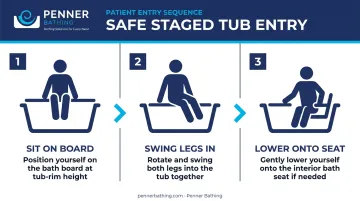
This approach nearly eliminates the need to lower all the way to the tub floor and significantly reduces the arm strength required to push back up from deep water.
Fitting matters. Assistive-technology guidance recommends checking that the declared weight capacity exceeds the user's weight, that the board spans level tub rims securely, and that drainage holes prevent water pooling. Acrylic tubs may require special assessment since concentrated loads can stress the surface.
| Attribute | Detail |
|---|---|
| Key Feature | Bath boards clamp across the tub width; bath seats use suction feet or rim hangers; most include non-slip surfaces and drainage holes |
| Best For | People who can step over the tub wall but struggle to lower to the tub floor or push themselves back up |
| Combination Tip | Pairing a bath board with an interior seat creates a staged descent — the safest approach for those with limited arm strength |
4. Bath Steps
Bath steps are raised platforms placed beside the tub that reduce the height a user must lift their leg to clear the tub wall. Most are made of non-slip plastic or aluminum, are lightweight, and can be repositioned easily.
They serve a specific user: someone whose main challenge is leg-lifting, due to hip or knee stiffness, arthritis, or reduced flexibility, rather than balance or seated stability. If you can bear weight and balance reasonably well but struggle with the leg-lift itself, a step can make tub entry feel dramatically more manageable.
Critical pairing note: Steps reduce entry height but do nothing for balance. They work best when used alongside a grab bar within easy reach. Using steps without a fixed support point nearby creates a new risk in the process of solving an old one.
| Attribute | Detail |
|---|---|
| Key Feature | Non-slip tread surface; rubber feet to prevent sliding on the bathroom floor; some models are height-adjustable or stackable |
| Best For | People with limited hip/knee flexibility who can otherwise bear weight and balance adequately |
| Safety Note | Not appropriate as a standalone solution for users with significant balance impairments — always pair with a grab bar |
5. Walk-In Bath
Walk-in baths take a fundamentally different approach: instead of helping users navigate a standard tub more safely, they eliminate the tub wall entirely.
The entry sequence looks like this:
- Open the watertight side door
- Step in over a minimal low threshold
- Sit on the built-in seat
- Close the door, then fill the tub
- Drain fully before opening the door to exit
This design addresses leg-lifting, entry balance, seated stability, and temperature comfort in one solution. The built-in seat means users remain seated throughout the entire bathing experience, not just during washing.
One practical consideration: because the door must be closed before filling, users wait inside as the tub fills and drains. This is inherent to the design. Penner Bathing's Dream Spa Walk-In Bath includes a heated seat, heated back support, and a heated air system as standard features, making that wait noticeably more comfortable.
The Dream Spa Walk-In Bath starts at $5,950, well below competitors who bundle full bathroom remodeling packages, and is designed to replace an existing standard tub without major structural renovation. It includes an Aqua-Aire Jet System for hydrotherapy to ease joint and muscle pain. Optional PennAire Microbubble Technology is available for users seeking a more intensive therapeutic experience.
| Attribute | Detail |
|---|---|
| Key Feature | Low-threshold side door with watertight seal; built-in seating; heated seat, back, and air system standard; Aqua-Aire hydrotherapy jets |
| Best For | Individuals with significant or progressive mobility limitations who want a permanent, independent bathing solution |
| Investment Note | Starting at $5,950, walk-in baths replace the need for multiple individual aids; explore VA HISA grants (up to $6,800 for eligible veterans), HUD home modification programs, and Canadian Home Accessibility Tax Credit options |

How to Choose the Right Bath Aid for Your Needs
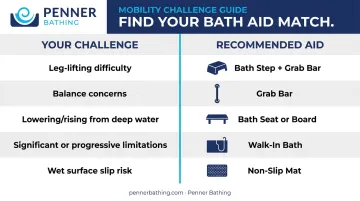
Start by identifying your primary challenge:
| Primary Challenge | Best Starting Aid |
|---|---|
| Leg-lifting over the tub wall | Bath step (paired with grab bar) |
| Balance while standing/transferring | Grab bar |
| Lowering into or rising from deep water | Bath seat or bath board |
| Significant or progressive mobility limitations | Walk-in bath |
| Wet surface slip risk | Non-slip mat (add to any of the above) |
A few practical factors beyond mobility level:
- Bathroom size: Compact walk-in baths are designed to fit a standard tub footprint, but confirming measurements before purchase is essential
- Installation availability: Wall-anchored grab bars require a qualified installer; bath steps and mats require none
- Budget: Starting simple and layering aids as needs evolve is reasonable — but for significant or worsening limitations, a walk-in bath may be more cost-effective than assembling multiple aids over time
For complex or changing mobility needs, consulting an occupational therapist (OT) before purchasing is a smart move. A 2023 Cochrane review found that home fall-hazard interventions delivered by OTs were associated with a 38% lower fall rate among higher-risk individuals.
OTs can assess your home environment, match specific aids to individual needs, and point you toward funding programs or grants for bathroom modifications.
Conclusion
The right bath aid doesn't just reduce fall risk — it restores confidence in a daily routine most people take for granted. Matching the tool to the actual mobility challenge is the most practical first step anyone can take, and often the most impactful one.
For those whose needs have grown beyond individual aids, Penner Bathing's Dream Spa Walk-In Bath offers a made-in-America residential bathing solution backed by over 40 years of experience in healthcare bathing brought to the home market. Call Penner at 1-800-732-0717 to learn more or to talk through your options with their team.
Frequently Asked Questions
How can I get in and out of the bath safely?
Use a non-slip mat inside and outside the tub, a grab bar positioned for both entry and exit, and a bath seat or board if lowering to the floor is difficult. Always ensure the floor is dry before stepping out and take your time — rushing is when most slips happen.
How can elderly people get in and out of the bath safely?
The most effective strategy layers aids based on individual need: grab bars for balance, bath steps for leg-lifting difficulty, bath seats or boards for lowering challenges, and walk-in baths for those with significant or progressive limitations. An OT assessment helps identify which combination fits best.
What is the safest bath aid for someone with limited upper body strength?
A walk-in bath is typically the safest option, since users remain seated throughout and don't need to push themselves up from a low position in water. Bath boards and seats require more arm strength to lower and rise safely and may not be appropriate for those with significant upper-body weakness.
Are walk-in baths worth it for seniors?
For seniors with ongoing or progressive mobility challenges, walk-in baths are generally the most comprehensive long-term solution, addressing every entry and exit challenge in one permanent installation. Simpler aids may suffice for mild difficulty, but a walk-in bath becomes the more cost-effective choice when needs are significant or likely to worsen.
Can grab bars be installed without drilling into the wall?
Clamp-on and suction-cup grab bars exist as no-drill alternatives, but wall-anchored bars are significantly more reliable for full weight-bearing. If drilling isn't possible, choose a clamp-style bar that attaches to the tub rim. Suction-cup models carry a documented failure risk under sustained load and should not be relied on as a primary support.
What should I look for when choosing a bath seat?
Check weight capacity first — it must exceed your weight. Also confirm the seat fits your tub dimensions, has a non-slip surface, includes drainage holes to prevent water pooling, and offers a backrest if additional trunk support is needed. If the tub is acrylic, consult a specialist before purchasing a suspended or rim-hanging model.