
Transformational leadership offers a practical, research-supported response to these challenges. Rather than managing through compliance and task delegation, it builds teams that are motivated, resilient, and invested in a shared mission.
This article covers what transformational leadership actually means in nursing, its four core components, its measurable impact on patients and staff, and the specific practices that make it work — including its particular relevance in long-term care and assisted living environments.
Key Takeaways
- Four pillars drive transformational nursing leadership: Idealized Influence, Inspirational Motivation, Intellectual Stimulation, and Individualized Consideration.
- Patient safety, burnout, and retention all improve when this leadership style is consistently applied, per ongoing research.
- Replacing one bedside RN costs ~$56,300 — making leadership-driven retention a direct financial priority.
- Long-term care turnover hit 55.27% in 2021–2022, making effective nurse leadership more urgent than ever.
- Proven practices include leading by example, building psychological safety, mentoring individually, and recognizing staff contributions.
What Is Transformational Leadership in Nursing?
Transformational leadership is a management philosophy built on inspiration rather than instruction. Where traditional management focuses on task completion and rule enforcement, transformational leadership asks something more: that leaders elevate their teams toward a shared purpose, encourage growth, and drive lasting change.
The theoretical foundation traces to political scientist James MacGregor Burns, who introduced "transforming leadership" in 1978 — the idea that leaders and followers raise one another to higher levels of motivation and morality. Bernard Bass later adapted the model for organizational settings, developing the Multifactor Leadership Questionnaire (MLQ), which nursing researchers went on to apply to nurse-manager behaviors and unit outcomes.
How It Differs from Traditional Management
The distinction matters in practice, not just in theory:
- Traditional management sets expectations, monitors compliance, and responds to deviations — useful for routine tasks in stable environments.
- Transformational leadership builds vision, invests in people's growth, and motivates teams to exceed what they thought possible.
In complex, high-stakes care environments, transformational approaches consistently show stronger associations with staff satisfaction and patient safety outcomes — a pattern that holds across hospital units, long-term care facilities, and assisted living settings alike.
Why This Matters Now
The nursing workforce is stretched. The 2024 NSI report, drawing on data from 400 acute-care hospitals, recorded an 18.4% staff-RN turnover rate and a 9.9% RN vacancy rate. These aren't abstract statistics — they represent real gaps in care continuity. Transformational leadership addresses the root causes of turnover: lack of recognition, limited autonomy, and the feeling that work has no larger meaning.
The Four Key Components of Transformational Leadership in Nursing
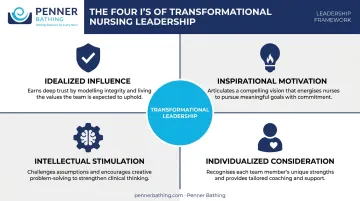
Burns and Bass's model is organized around what researchers call the "Four I's" — four distinct dimensions of how transformational leaders engage their teams. Each one addresses a different aspect of what motivates nurses to do their best work.
Idealized Influence
This is about credibility earned through behavior. Transformational nurse leaders don't hold their teams to standards they're unwilling to meet themselves. They show up — maintaining composure under pressure, taking accountability when things go wrong, and demonstrating the clinical and ethical standards they expect from others.
When nurses see their leader behave with integrity consistently, trust follows. That trust is what makes the other three dimensions possible.
Inspirational Motivation
Beyond day-to-day management, transformational leaders articulate a vision worth working toward. In nursing, that means connecting individual roles to larger purposes — patient dignity, care quality, community health — and communicating that connection consistently.
The goal is sustained meaning, not a one-time speech. It's the ongoing practice of helping team members see why their work matters — especially on the difficult days when it's hardest to remember.
Intellectual Stimulation
Transformational leaders actively encourage their teams to question assumptions and propose new approaches. In practice, this looks like:
- Welcoming staff suggestions for process improvements
- Treating mistakes as learning opportunities rather than disciplinary triggers
- Asking nurses what they observe on the floor — and actually acting on the answers
Over time, that openness shifts how staff engage with problems — they bring solutions instead of waiting to be told what to do.
Individualized Consideration
What this looks like in practice: a charge nurse mentoring a new grad differently than a 15-year veteran, or a manager adjusting workload expectations for someone managing a personal crisis. Transformational leaders recognize that a single management template doesn't fit everyone, so they tailor coaching and mentorship to each person's specific strengths, goals, and stage of career.
This one-to-one investment signals something powerful: that the organization sees nurses as people, not just staffing units.
Why Transformational Leadership Matters: Impact on Patients and Teams
The research case for transformational leadership in nursing is consistent. Most studies are observational — they identify associations, not guarantees — but the direction of those associations holds across multiple outcomes.
Patient Safety and Care Quality
A 2023 systematic review published in PMC linked transformational nursing leadership with fewer adverse events — including medication errors, falls, and pressure injuries — and with better patient satisfaction scores across included studies. The mechanisms make sense: leaders who foster open communication and psychological safety create environments where nurses flag concerns early, rather than after a near-miss becomes an incident.
Coordinated, collaborative care planning reduces handoff errors. A culture that treats safety as a shared responsibility rather than a compliance checkbox performs more safely than one built on fear of punishment.
Nurse Satisfaction and Burnout Reduction
A 2023 integrative review of 17 studies found a consistently positive relationship between transformational leadership and hospital nurses' job satisfaction. The relationship between leadership and burnout runs in the opposite direction — nurses working under transformational leaders show lower rates, mediated by factors like empowerment, organizational commitment, and a healthier work environment.
Autonomy, recognition, growth, and purpose are precisely what burnout erodes. Transformational leadership directly replenishes those conditions.
Retention and Its Financial Reality
NSI estimated that replacing a single bedside RN costs approximately $56,300, with average annual hospital turnover losses reaching $4.82 million. A 2024 integrative review confirmed that constructive leadership, healthier work environments, and job satisfaction are linked with retention — though no single study has isolated a retention-rate gain attributable solely to transformational leadership style.
What the evidence does support clearly: nurses who feel mentored, valued, and connected to a meaningful mission are more likely to stay.
Organizational and Cultural Benefits
Strong retention and satisfaction at the unit level eventually reshape the broader institution. Transformational leadership distributes leadership capacity across departments, building more resilient structures that don't depend on any single manager to function.
The cultural effects are also real. Open communication norms, mutual trust, and shared accountability reduce interpersonal conflict and smooth the hierarchical friction that drains energy in any large organization.
Transformational vs. Other Leadership Styles in Nursing
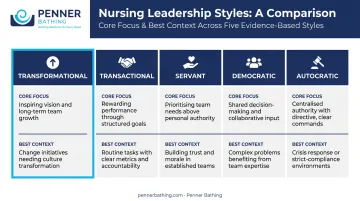
Understanding transformational leadership is easier with context. Here's how it fits within the broader landscape of nursing leadership styles:
| Style | Core Focus | Best Context |
|---|---|---|
| Transformational | Vision, inspiration, growth, innovation | Culture change, quality improvement, workforce challenges |
| Transactional | Explicit expectations, rewards, corrective action | Protocol-driven tasks, short-term performance requirements |
| Servant | Staff and patient needs first; listening and stewardship | Relationship-building, interdisciplinary trust |
| Democratic | Shared decision-making, staff input | Non-urgent policy or workflow decisions |
| Autocratic | Leader decides with minimal input | Time-critical emergencies requiring immediate direction |
Transactional leadership isn't a lesser approach — it works well for routine, protocol-driven tasks where clear expectations and consistent follow-through matter most. Its limitation is that it offers little room for motivation beyond compliance.
Transformational and servant leadership share real common ground: both emphasize empathy, ethical behavior, and a genuine focus on the people being led. Where they differ is in direction. Servant leadership prioritizes meeting the team's existing needs; transformational leadership pushes teams toward growth and innovation, which is why it tends to outperform during organizational transitions or periods of workforce instability.
Best Practices for Applying Transformational Leadership in Nursing
Theory shapes thinking. Daily behavior shapes culture. The practices below are where transformational leadership actually takes hold — not in workshops or vision statements, but in the choices nurse leaders make on the floor every shift.
Lead by Example, Every Day
Role modeling isn't a grand gesture. It's showing up on time, staying calm during difficult conversations, owning mistakes openly, and treating every patient interaction as if someone is watching — because nurses are always watching their leaders.
The cultural tone of a unit is set primarily by what the leader visibly does, not what they say in team meetings.
Build Psychological Safety Through Communication
Nurses need to feel safe raising concerns before something goes wrong. Creating that safety requires:
- Regular team check-ins where honest feedback is welcomed — not just tolerated
- Transparent decision-making that explains the reasoning, not just the outcome
- Active listening that actually changes behavior occasionally (or people stop talking)
A 2024 systematic review identified leadership support, communication norms, and nonpunitive responses as the most modifiable factors influencing healthcare workers' willingness to speak up.
Make Mentorship Personal
Annual performance reviews are not mentorship. Transformational leaders have ongoing conversations about each nurse's growth trajectory — what they're working toward, where they're getting stuck, and what support would actually help.
The structure is consistent across every nurse: identify strengths, set growth-oriented goals, check in on progress. What varies — and must vary — is the content of each conversation.
Address Conflict Before It Escalates
Ignored conflict doesn't resolve — it compounds. A disagreement left to fester becomes a cultural problem. Transformational leaders intervene early, bring all parties into open dialogue, and guide the conversation toward solutions rather than verdicts. The goal is resolution, not determining fault.
Recognize Both Milestones and Everyday Excellence
Recognition doesn't have to be formal to be effective. Acknowledging a nurse who handled a difficult family interaction well, or who stayed late to ensure a clean handoff, reinforces exactly the behaviors that build a strong unit culture.
Formal recognition matters too — but the informal, specific, timely acknowledgment of good work is often what nurses remember longest.

Transformational Leadership in Long-Term Care and Assisted Living Settings
Long-term care environments present leadership challenges that acute-care settings rarely face at the same intensity: high staff-to-resident ratios, the emotional weight of end-of-life care, continuity demands that make every staff departure disruptive, and interdisciplinary teams that require constant coordination. continuity demands that make every staff departure disruptive, and interdisciplinary teams requiring constant coordination.
The staffing data makes the stakes concrete. Total nursing-staff turnover in US nursing homes averaged 55.27% in 2021–2022 — a rate that, combined with workforce shortages (63% of assisted living providers reported staffing shortages in a recent survey), creates persistent instability in the care environment.
Championing Both Residents and Staff
Transformational nurse leaders in these settings carry a dual mandate: they advocate for resident dignity while protecting the well-being of the staff delivering that care. These two goals reinforce each other. Staff who feel supported and equipped deliver better care. Residents who receive consistent, attentive care have better outcomes.
Investment in the right tools is a leadership decision, not just an operations one. Facilities that equip care teams with purpose-built bathing systems — like those from Penner Bathing, serving long-term care and assisted living facilities since 1980 — directly reduce the physical burden of daily bathing routines. Key features that make a measurable difference:
- Automatic disinfection reduces infection control errors without adding staff steps
- Fast-fill reservoirs cut bathing time and ease scheduling pressure
- Rail-free transfer designs lower injury risk during resident transfers
- Ergonomic lift systems reduce cumulative physical strain on caregivers

Penner Bathing's systems — including the Cascade and Premier Transfer models — are built for high-acuity care environments, with bariatric-capable lifts supporting up to 450 lbs and multiple entry configurations that adapt to individual resident mobility needs. For a transformational nurse leader, advocating for equipment like this reflects the core mandate: build environments where both patients and caregivers feel respected.
Driving Quality Improvement
Facility-wide quality improvement doesn't happen without someone pushing for it. In long-term care, that person is usually the transformational nurse leader — the one making the case to administration for ergonomic equipment, staff training, and care technologies that actually reduce burden. When that case gets made, the message is clear: staff physical safety matters, and resident comfort does too.
That advocacy shapes culture over time. Teams that see leadership investing in better tools respond with higher engagement and lower turnover — two outcomes that directly improve care quality for residents.
Frequently Asked Questions
What is transformational leadership in nursing?
Transformational leadership in nursing is a vision-driven approach where nurse leaders inspire their teams to exceed expectations, pursue shared goals, and drive meaningful improvements in patient care. It prioritizes mentorship, trust, and purpose over compliance and task management.
What are the key components of transformational leadership in nursing?
The Four I's framework defines the core components:
- Idealized Influence — role modeling integrity and ethical conduct
- Inspirational Motivation — communicating a compelling shared vision
- Intellectual Stimulation — encouraging critical thinking and innovation
- Individualized Consideration — tailoring mentorship to each nurse's needs
What are the four leadership styles in nursing?
The most commonly referenced styles are transformational, transactional, servant, and democratic (with autocratic sometimes included as a fifth). Research consistently links transformational leadership to improved patient safety and nurse satisfaction outcomes.
How does transformational leadership affect nurse retention?
It improves retention by increasing job satisfaction, supporting professional development, and building an environment where nurses feel genuinely valued. This directly counters the burnout and disengagement that most often precede resignation.
What is the difference between transformational and transactional leadership in nursing?
Transactional leadership relies on structured expectations, contingent rewards, and corrective action for non-compliance. Transformational leadership focuses on intrinsic motivation, shared vision, and ongoing growth. It generally shows stronger associations with long-term retention and overall culture health.
How can a nurse develop transformational leadership skills?
Key development paths include pursuing advanced education (BSN, MSN, or leadership certifications), seeking mentorship from experienced nurse leaders, practicing active listening and self-reflection, and volunteering for leadership roles within clinical or unit teams.