For nursing home administrators, assisted living directors, and hospital compliance officers, the challenge isn't just knowing the rules — it's keeping pace as they change, training staff who are already stretched thin, and building systems that hold up when a surveyor walks through the door.
This guide covers what you need to know for 2026: the core federal regulatory framework, long-term care-specific requirements, the real consequences of falling short, and practical steps to build a compliance program that works.
Key Takeaways
- HIPAA violations now carry penalties up to $2,190,294 per calendar year for the most serious tier
- CMS's numerical minimum staffing mandates were formally repealed effective February 2, 2026
- Nearly 27% of nursing facilities received a serious deficiency involving actual harm or immediate jeopardy in 2025
- Thorough documentation — care plans, incident reports, staff training logs — is your primary defense in surveys, audits, and litigation
- Bathing equipment with automatic disinfection reduces manual infection control steps and strengthens survey-ready documentation
What Is Healthcare Regulatory Compliance?
Healthcare regulatory compliance means meeting all applicable federal, state, local, and industry standards to protect patients, staff, and your organization through systematic, documented frameworks — not a one-time audit, but an ongoing operational discipline.
Those requirements come from multiple directions at once:
- Federal law sets a national baseline
- State regulations often add stricter requirements on top of that baseline
- Local codes — fire, building, safety — add another layer entirely
- Overlapping or conflicting rules across these levels require careful, documented navigation
Understanding these layers is only part of the picture. Compliance also extends well beyond clinical staff — administrators, vendors, equipment suppliers, and any business associate handling patient data or participating in care delivery all fall within scope. A billing vendor's HIPAA misstep, for example, can trigger federal penalties that land on your facility.
Key Federal Regulations Healthcare Facilities Must Know in 2026
HIPAA and HITECH
HIPAA protects patient health information (PHI) through three rules: the Privacy Rule, the Security Rule, and the Breach Notification Rule. HITECH expanded HIPAA's scope and significantly increased penalty exposure.
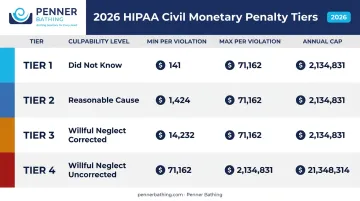
As of January 28, 2026, HHS's annual inflation adjustment set the current penalty tiers under 45 CFR 160.404:
| Tier | Culpability | Minimum Per Violation | Maximum Per Violation | Annual Cap |
|---|---|---|---|---|
| 1 | Did not know | $145 | $73,011 | $2,190,294 |
| 2 | Reasonable cause | $1,461 | $73,011 | $2,190,294 |
| 3 | Willful neglect, corrected | $14,602 | $73,011 | $2,190,294 |
| 4 | Willful neglect, uncorrected | $73,011 | $2,190,294 | $2,190,294 |
For context, Montefiore Medical Center settled a HIPAA investigation for $4.75 million in February 2024 following a malicious insider incident — a reminder that even internal threats carry major financial consequences.
CMS Conditions of Participation
Facilities participating in Medicare and Medicaid must meet CMS Conditions of Participation, covering clinical care quality, patient rights, and facility safety standards. Non-compliance can result in exclusion from federal health programs entirely, not just financial penalties.
EMTALA and the Anti-Kickback Statute
EMTALA requires facilities to provide emergency medical screening and stabilizing care regardless of a patient's ability to pay. As of January 28, 2026, the civil monetary penalty is $136,886 per violation for hospitals with 100 or more beds — up from the $133,420 figure cited as recently as late 2024.
Billing fraud carries its own set of serious consequences. The Anti-Kickback Statute and False Claims Act prohibit financial incentives for patient referrals where federal programs are billed. DOJ recovered more than $6.8 billion in False Claims Act settlements in FY2025, with more than $5.9 billion arising specifically from healthcare matters. Fraudulent billing carries statutory penalties including treble damages and permanent exclusion from Medicare and Medicaid.
OSHA Workplace Safety Standards
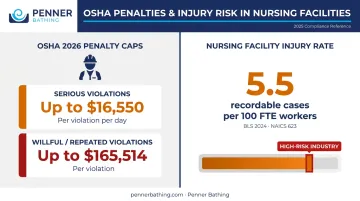
OSHA protects healthcare workers through standards covering bloodborne pathogens, ergonomics, and workplace hazard reporting. The 2026 penalty ceilings reflect how seriously regulators treat violations:
- Serious violations: up to $16,550 per incident
- Willful or repeated violations: up to $165,514 per incident
The injury risk in patient-handling environments is concrete, not theoretical. BLS data for 2024 shows nursing and residential care facilities (NAICS 623) reported 5.5 total recordable cases per 100 full-time workers — among the highest rates across all industries. Bathing and mobility assistance rank as some of the highest-risk tasks for staff musculoskeletal injuries, making compliant equipment and proper staff training a direct line item in any OSHA risk management plan.
Compliance Requirements for Long-Term Care and Assisted Living Facilities
Long-term care facilities operate in a uniquely dense compliance environment. They must satisfy CMS nursing facility requirements, state licensing standards, resident rights protections, and infection control mandates — all at once, all the time.
CMS Nursing Facility Requirements and Resident Rights
CMS's Requirements of Participation (42 CFR Part 483) cover resident assessment, care planning, staffing ratios, resident dignity, and grievance procedures. CMS memorandum QSO-25-14-NH, revised March 10, 2025 and effective April 28, 2025, updated Appendix PP survey guidance across multiple areas including chemical restraints, infection control, and resident assessments.
On staffing: the numerical minimum staffing mandates from the April 2024 final rule — including the 3.48 total nursing hours per resident day and 24/7 RN requirements — were formally repealed by an interim final rule effective February 2, 2026. Public Law 119-21 bars implementation of those specific numeric standards through September 30, 2034. Retained requirements still include an RN onsite for at least eight consecutive hours per day, seven days per week, plus a full-time RN director of nursing.
Resident rights provisions require documented policies covering:
- Privacy and dignity in all personal care activities, including bathing
- Freedom from abuse, neglect, and unnecessary restraints
- Grievance procedures accessible to residents and families
- Individualized care planning based on resident assessment
Infection Control Standards in Care Facilities
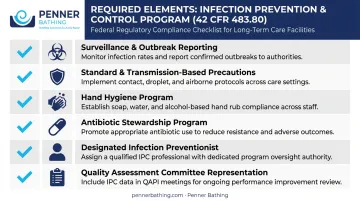
Under 42 CFR 483.80, long-term care facilities must maintain a written infection prevention and control program that includes:
- Surveillance and outbreak reporting protocols
- Standard and transmission-based precautions
- Hand hygiene programs
- An antibiotic stewardship program
- A designated infection preventionist with specialized training, working at least part-time at the facility
- Representation on the quality assessment and assurance committee
Post-pandemic CMS scrutiny of infection control has intensified, and 27% of nursing facilities received a serious deficiency — involving actual harm or immediate jeopardy — over a recent survey cycle, per KFF's 2025 analysis of CMS data. For facilities working to reduce deficiency exposure, equipment selection is one operational lever that directly affects infection control outcomes.
Penner Bathing's hydrotherapy systems include built-in BioCote® antimicrobial protection (integrated into the surface material itself, operating continuously without requiring activation) alongside automatic disinfection standard on all models. BioCote® is not a substitute for cleaning protocols — Penner's documentation makes that clear — but it functions as a supplementary layer of surface-level microbial control between disinfection cycles.
The automatic disinfection system circulates disinfecting solution through internal plumbing pathways, targeting the areas most susceptible to cross-contamination between residents. This reduces the variability that comes with manual cleaning routines.
For facilities seeking compliance documentation on these features, Penner Bathing offers direct consultation and can provide technical specifications. Their team is reachable at 800-732-0717.
State Licensing and Survey Readiness
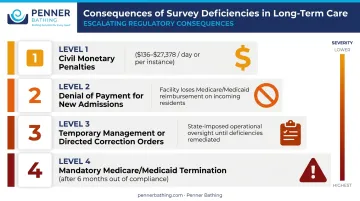
State health departments conduct annual and complaint-driven surveys on a 9- to 15-month cycle. Survey deficiencies — F-tags — carry real consequences:
- Civil monetary penalties ranging from $136 to $27,378 per day (or $2,739 to $27,378 per instance) as of January 28, 2026
- Denial of payment for new admissions
- Temporary management or directed correction orders
- Facilities failing to return to substantial compliance within six months face mandatory termination from Medicare and Medicaid
An average of 9.5 deficiencies per facility per survey cycle were recorded in KFF's 2025 national analysis. All deficiency citations are publicly posted on the CMS Care Compare website — visible to prospective residents, families, and referral sources.
The Real Consequences of Healthcare Non-Compliance
Financial Penalties
Fines stack across agencies. A single data breach can trigger HIPAA civil monetary penalties, state-level breach law fines, and potential False Claims Act exposure simultaneously. The $4.75 million Montefiore settlement wasn't an outlier — it reflects the scale of penalties that follow documented violations.
For nursing facilities, per-day CMPs accumulate quickly. A facility out of compliance for 30 days at the upper-range rate could face more than $800,000 in fines before any federal program exclusion is factored in.
Operational and Reputational Impact
Non-compliance triggers consequences beyond the check written to regulators:
- Corrective action plans with government-assigned deadlines
- Increased oversight and monitoring visits
- Loss of Medicare/Medicaid reimbursement
- CMS Care Compare citations visible to the public
- Staff recruitment difficulties when a facility's reputation suffers
For long-term care facilities, a two- or three-star rating on Care Compare — driven by survey deficiencies — directly affects census and referral relationships.
Patient Harm Liability
Non-compliance with care standards or infection control can result in direct patient harm, opening the door to civil litigation on top of regulatory penalties. Facilities without adequate documentation carry the heaviest burden — surveyors and plaintiff attorneys alike treat missing records as missing proof. Building compliance habits before a deficiency is cited is always cheaper than defending against one after the fact.
How to Build a Strong Compliance Program at Your Facility
Appoint a Compliance Officer or Team
Every facility needs a designated compliance officer responsible for:
- Monitoring regulatory updates from CMS, HHS, OSHA, and state agencies
- Developing and reviewing policies
- Conducting internal audits
- Serving as the primary contact for government agencies during investigations or surveys
Smaller facilities may assign this responsibility to a department head with appropriate training. The role must be formal, documented, and funded regardless of who holds it.
Policies, Procedures, and Documentation
Written policies must cover all compliance-sensitive areas:
- Data privacy — HIPAA policies, breach response procedures
- Infection control — written prevention program, disinfection protocols
- Resident rights — dignity, privacy, grievance procedures
- Billing — False Claims Act compliance, coding accuracy
- Staff conduct — anti-kickback, conflict of interest
Under HIPAA, records must be retained for a minimum of six years. Conduct policy reviews at least annually — and whenever a material regulatory change occurs — and maintain a change log to document your organization's good faith compliance efforts.
Staff Training and Education
Training must be role-specific and documented:
- All new hires: Initial compliance orientation before patient contact
- Clinical staff: Infection control, resident rights, safe patient handling
- Billing and coding staff: False Claims Act, Anti-Kickback Statute
- IT and data management staff: HIPAA Security Rule requirements
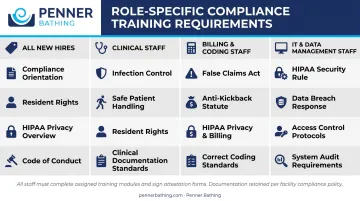
HIPAA requires documented training attestations. Some states mandate training within a specific window — Texas, for example, requires completion within 90 days of hire. Beyond initial training, conduct regular tabletop exercises: how to respond to a data breach, a resident complaint, or an unannounced survey visit.
Audits, Risk Assessments, and Technology Tools
Schedule internal compliance audits at minimum annually and after any significant regulatory change. Each audit should produce a corrective action plan with:
- Named owners for each remediation item
- Hard deadlines (not rolling timelines)
- Documented sign-off once resolved
Compliance management software can track regulatory changes across agencies, manage policy documentation, generate risk assessments, and identify conflicts between overlapping standards. For organizations managing multiple facilities, this is particularly valuable. Manual tracking across dozens of regulations and locations is where compliance gaps develop.
2026 Regulatory Trends and Updates to Watch
Minimum staffing: The April 2024 numerical staffing mandates have been repealed. However, retained requirements — including 8 consecutive hours of daily RN coverage — remain in force. Make sure your staffing documentation reflects the current rules, not the repealed version.
Healthcare cybersecurity: HHS published a proposed HIPAA Security Rule update on January 6, 2025. As of 2026, it remains a proposed rule — not yet finalized. The existing Security Rule is still in effect.
The proposed changes would introduce several new mandates:
- Mandatory encryption of all ePHI
- Multi-factor authentication across covered systems
- Annual risk analyses (moving from periodic to required annual cadence)
- Ability to restore critical systems within 72 hours of a contingency event
HHS's Cybersecurity Performance Goals remain voluntary, divided into Essential and Enhanced categories.
AI and technology oversight: FDA's January 2026 final Clinical Decision Support Software guidance clarifies which software functions fall under device regulation. Facilities adopting AI-assisted clinical tools should monitor FDA guidance updates and ONC's HTI-1 transparency requirements for predictive decision-support interventions. No AI rule specific to long-term care has been finalized yet, but regulatory scrutiny is increasing.
Frequently Asked Questions
What are some examples of regulatory compliance in healthcare?
A hospital following EMTALA to provide emergency care regardless of a patient's ability to pay, a nursing facility maintaining a written infection prevention program with a designated infection preventionist, and a billing department reviewing claims against the False Claims Act before submission are all concrete examples.
What happens if a healthcare facility fails to comply with regulations?
Consequences include civil monetary penalties, corrective action plans, payment denials, loss of licensure, and exclusion from Medicare and Medicaid. Survey deficiencies are also posted publicly on CMS Care Compare, adding reputational risk on top of regulatory penalties.
Who is responsible for healthcare compliance in a nursing home or assisted living facility?
Compliance is a shared responsibility, but designated compliance officers lead policy development, training, audits, and agency communication — a role that may fall to a trained department head in smaller facilities rather than dedicated staff.
How often do healthcare compliance requirements change?
Individual regulations may not change frequently, but facilities must comply with many simultaneously — meaning cumulative updates can amount to meaningful changes nearly every month. Ongoing monitoring of CMS, HHS, OSHA, and state agency communications is critical for staying ahead of those changes.
What is the role of CMS in long-term care facility compliance?
CMS sets and enforces the Conditions of Participation for Medicare- and Medicaid-funded nursing homes, conducts oversight through state survey agencies, and publishes ratings and deficiency citations on Care Compare. Enforcement tools range from civil monetary penalties to termination from federal programs.
How can long-term care facilities stay current with changing healthcare regulations?
Monitor official communications from CMS, HHS, OSHA, and your state health department. Engage with industry associations for early visibility into proposed rules. Provide ongoing staff training, and use compliance management software to track and implement regulatory changes before they show up as survey findings.
![Patient Care Assistant Duties & Responsibilities [2026]](https://file-host.link/website/pennerbathing-uj4awa/assets/blog-images/5c287aad-642d-4e45-a141-820e109015bd/1784185585478548_c4bfbe2b16c843369cd487bf4bb383d6/1080.webp)