Introduction
Picture this: it's Wednesday morning, and a nursing home administrator gets word that the facility's primary bathing system is down. The vendor is backordered. The backup supplier was never identified. Residents go without, staff scramble, and the care plan for three residents is disrupted — all because procurement was treated as a purchasing task rather than a care delivery function.
This scenario plays out more often than it should. According to a GAO report on nursing home preparedness, roughly 10% of nursing homes lacked a one-week supply of at least one critical supply category as recently as December 2020 — a figure that peaked at 22% just months earlier.
Supply gaps at that scale aren't just operational headaches. They carry direct consequences for resident safety and regulatory standing.
This guide breaks down healthcare procurement from the ground up — what it is, where it fails, and what best practices actually look like for long-term care and assisted living facilities.
Key Takeaways
- Reactive, decentralized purchasing drives most healthcare procurement failures — shortages, compliance gaps, and overspending included
- Supply chain resilience requires multiple vetted vendors per critical product category, not just a preferred supplier
- Long-term care facilities must evaluate equipment on total cost of ownership, not purchase price
- Centralized procurement and standardized vendor criteria reduce audit risk and protect patient safety
- Strong vendor relationships depend on accountability, certifications, and post-sale support — price is rarely the deciding factor
What Is Healthcare Procurement?
Healthcare procurement is the full process of identifying needs, vetting suppliers, negotiating contracts, and managing the acquisition of goods, equipment, and services required to deliver patient care.
It covers a wide range — from consumable medical supplies and pharmaceuticals to durable medical equipment, hygiene systems, facility maintenance products, and specialized patient care technology. Each category carries its own regulatory demands, vendor qualification hurdles, and vendor landscape.
The core goals of healthcare procurement are:
- Product quality and availability — ensuring the right items are on hand when care demands them
- Cost control — managing spend across hundreds of SKUs and vendor relationships
- Regulatory compliance — meeting CMS, FDA, OSHA, and state-specific requirements
- Patient outcomes — recognizing that supply decisions directly affect the quality of care delivered
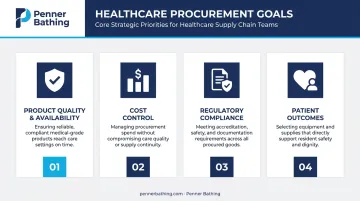
What separates healthcare procurement from general purchasing is that last point. In retail, a poor sourcing decision causes a stockout. In healthcare, it can disrupt a care plan — or put a patient at risk.
How It Differs From Other Industries
Healthcare procurement operates under regulatory constraints that most industries never encounter. 42 CFR Part 483 governs certified nursing facilities across physical environment, emergency preparedness, infection prevention, and resident safety. FDA rules apply to medical devices and, in some cases, extend liability to facilities that modify or label device software or data systems. OSHA governs worker PPE — meaning purchasing decisions for gloves, masks, and gowns aren't discretionary.
Procurement decisions also involve more stakeholders than in most industries — clinical staff, compliance officers, department heads, and finance teams all have legitimate input. That complexity slows cycles and demands cross-functional communication that typical purchasing departments rarely face.
Key Challenges in Healthcare Procurement
Regulatory Compliance Complexity
Staying current with compliance requirements is a constant operational burden, especially for smaller organizations without dedicated compliance staff. Product safety certifications, vendor credentialing, data privacy obligations, and facility-specific standards all shift over time. Manual tracking of these requirements — through spreadsheets or paper records — dramatically increases the risk of violations and audit exposure.
CMS conducts nursing home inspections on a 9-to-15-month cycle, with an average of 12 months. Deficiencies can trigger civil money penalties or payment denials. Procurement teams need systems that flag compliance changes proactively, well before the next inspection cycle.
Supply Chain Vulnerability
Over-reliance on a single supplier for any critical product category creates a dangerous single point of failure. The GAO's nursing home supply data illustrates this clearly: when supply chains tighten, facilities without backup sourcing strategies are the first to run short.
HHS research identifies manufacturing concentration, lack of redundancy, and limited supply chain visibility as the core drivers of medical product vulnerability. These are structural weaknesses embedded in how many facilities source — present long before the pandemic exposed them.
Decentralized and Siloed Purchasing
When individual departments or staff members make purchasing decisions in isolation, the results are predictable:
- Inconsistent pricing across vendors
- Off-contract spending that bypasses volume discounts
- Weak vendor accountability with no centralized record
- Duplicate orders and redundant supplier relationships
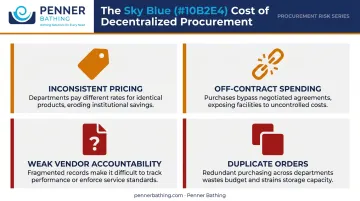
This is particularly common in nursing homes and assisted living facilities with lean administrative structures, where procurement responsibility often falls to someone whose primary role is clinical or operational.
Manual Processes and Poor Visibility
Paper-based tracking, manual purchase orders, and spreadsheet inventory management create delays and increase error rates. Facilities often don't see spending patterns until problems are already entrenched.
Without visibility into what's being ordered, by whom, and at what price, cost control is essentially impossible.
Vendor Evaluation and Product Quality Risks
When purchasing is reactive — driven by immediate need rather than strategic planning — vendor vetting gets skipped. Poorly vetted suppliers introduce risks that go beyond cost:
- Products that fail to meet certification requirements
- Inadequate after-sale support when equipment malfunctions
- Unreliable fulfillment on repeat orders
In a regulated care environment, any of those failures can affect both patient safety and facility accreditation.
Best Practices for Healthcare Procurement
Centralize Procurement with a Single Source of Truth
Establishing a centralized procurement system — whether a digital platform or a formalized policy framework — creates consistency in purchasing decisions and provides full visibility into organizational spending.
Centralization delivers several practical benefits:
- Consolidates orders to achieve volume pricing
- Enforces compliance guardrails across departments
- Creates an auditable record of purchase decisions
- Reduces duplicate or off-contract spending
For smaller facilities without dedicated procurement staff, even a structured policy with clear approval hierarchies is a meaningful step toward centralization.
Build a Resilient, Vetted Supplier Network
Maintaining relationships with both primary and secondary suppliers for each critical product category is the most direct defense against supply disruptions. When one vendor has a stock issue, operations continue without a crisis.
Supplier vetting should go beyond price to include:
- Product safety certifications (UL, FDA clearance where applicable)
- Financial stability and fulfillment track record
- Delivery reliability and lead times
- Post-sale support capabilities, including parts availability and training
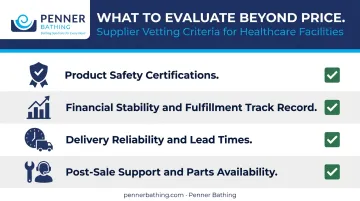
Competitive pricing means little if a vendor can't deliver consistently or support the product after installation.
Leverage Demand Forecasting and Inventory Planning
Analyzing historical purchasing data and usage patterns allows procurement teams to anticipate needs before stockouts occur. The goal is avoiding two failure modes simultaneously: critical shortages that disrupt care, and overstocking of supplies with expiration dates that drive waste.
Practical steps at any scale include:
- Tracking monthly usage by category to spot trends early
- Setting reorder thresholds before stockouts occur
- Using software-based forecasting where resources allow
Standardize Vendor Selection Criteria
A formal vendor evaluation framework ensures procurement decisions are defensible, repeatable, and aligned with both compliance and patient care standards. That framework should include:
- Product safety certifications relevant to the equipment class (such as UL/CUL Listed for electrical equipment)
- Warranty terms and what they actually cover
- Staff training support — whether the vendor provides it, and how
- Responsiveness and parts availability
- Domestic manufacturing or supply chain transparency where relevant
Standardized criteria also protect procurement teams during audits. If a vendor selection can be traced to documented, objective criteria, it's far harder to challenge.
Invest in Compliance Monitoring and Documentation
Compliance is not a one-time checkpoint — it's an ongoing process. According to CMS enforcement data, nursing homes face regular inspections with remedies ranging from directed plans of correction to civil money penalties. Procurement teams need systems to:
- Track vendor certifications and renewal dates
- Document purchase decisions and the criteria used
- Receive alerts when regulatory requirements change
- Maintain records that protect the facility during accreditation reviews
Whether this is software-based or procedural, the documentation habit itself is what matters. Gaps in purchasing records during an inspection are almost as problematic as the underlying compliance issue.
Procurement Considerations for Long-Term Care and Assisted Living Facilities
Long-term care and assisted living facilities face a distinct procurement profile. Tighter budgets, smaller procurement teams, and a resident population with specialized safety and comfort needs create a sourcing environment where vendor relationships matter more — and bad decisions compound faster.
AHCA/NCAL reports approximately 41,465 assisted living communities with nearly 1.4 million licensed beds nationwide. Yet Medicaid reimbursement has historically covered only 70–80% of nursing home care costs, leaving procurement teams constantly balancing quality against tight margins.
Equipment Categories That Demand Extra Diligence
Several equipment categories require particular procurement care in LTC settings:
- Therapeutic bathing systems touch resident dignity, safety, and daily staff workflow — vendor quality is non-negotiable
- Mobility aids and patient lifts carry direct fall prevention and injury risk, making selection criteria especially high-stakes
- Fall prevention equipment requires assessment against AHRQ's LTC guidelines, which direct facilities to evaluate whether furniture and equipment contribute to fall likelihood
- Hygiene and infection control supplies are compliance-relevant under CMS infection control obligations, not merely operational purchases
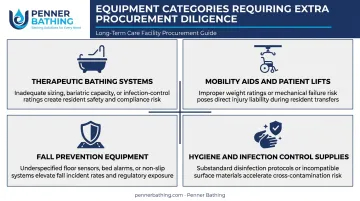
For each category, the vendor evaluation should include product safety certifications, ease of use for clinical staff, maintenance requirements, and parts availability. A two-week lead time on replacement parts creates care disruptions no price savings can offset.
Penner Bathing — a family-owned manufacturer based in Aurora, Nebraska, serving the long-term care market since 1980 — illustrates this in practice. Their healthcare bathing systems carry UL and CUL Listed certifications, are manufactured domestically, and include on-site staff training.
That combination of certification status, supply chain reliability, and post-sale support is exactly what a standardized vendor evaluation framework should surface.
Total Cost of Ownership Over Purchase Price
The most common procurement mistake in LTC settings is treating purchase price as the primary decision variable. A lower upfront equipment cost may be offset by:
- Higher maintenance costs over the product lifecycle
- More frequent replacements due to lower build quality
- Lack of staff training support, leading to increased errors and potential resident safety incidents
- Poor parts availability that extends downtime when equipment needs repair
WHO's procurement framework explicitly includes installation, training, maintenance, consumables, and eventual replacement as lifecycle cost drivers — not just acquisition cost. That framework applies directly to capital equipment decisions in long-term care.
Industry Specialization as a Vendor Criterion
Total cost of ownership is easier to control when your vendor already understands your operating environment. LTC facilities benefit from working with vendors who know infection control requirements, resident safety standards, state licensing rules, and staff workflow constraints firsthand — not vendors learning your context on the fly.
A vendor selling into hospitals and nursing homes interchangeably may not grasp why next-day parts availability is non-negotiable in a care facility. In a regulated environment with constrained budgets and high-stakes resident outcomes, that gap in understanding translates directly into procurement risk. Build industry specialization into your vendor evaluation criteria from the start.
Frequently Asked Questions
What is procurement in healthcare?
Healthcare procurement is the strategic process of sourcing and acquiring the medical supplies, equipment, and services needed to deliver patient care. It spans supplier selection, contract negotiation, compliance management, and inventory oversight — treating every purchasing decision as a care function, not just a cost center.
What are the 4 types of procurement?
The four main types are: direct procurement (goods used directly in patient care), indirect procurement (operational supplies not used in care delivery), services procurement (contracted labor or specialized services), and capital procurement (large equipment and infrastructure purchases). Each type carries different vendor management requirements in healthcare settings.
What are the 7 principles of procurement?
The seven core principles are value for money, transparency, accountability, integrity, proportionality, fair competition, and efficiency. Patient safety and regulatory compliance act as overriding constraints — no procurement decision in healthcare can optimize for cost alone.
What are the 5 P's of procurement?
The 5 P's — People, Process, Products, Price, and Performance — offer a practical framework for evaluating procurement decisions. In healthcare settings, care quality and compliance requirements shape how each element gets weighted, often putting safety above price.
How does procurement differ across nursing homes, hospitals, and private practices?
Hospitals typically have larger budgets and dedicated procurement teams with formal GPO relationships. Nursing homes focus on long-term consumables and specialized resident care equipment under tighter budget constraints. Private practices often rely on individuals managing procurement alongside clinical duties, making streamlined processes especially critical.
What should long-term care facilities look for when evaluating equipment vendors?
Look for product safety certifications (UL/CUL Listed for electrical equipment), domestic manufacturing, reliable parts availability, staff training support, and proven experience in the long-term care market. Total cost of ownership — not purchase price alone — should drive the final decision.