This guide covers the top hospital equipment manufacturers across key categories — imaging, surgical, patient support, and patient hygiene — and explains what actually sets each apart for procurement teams.
Key Takeaways
- No single manufacturer leads every hospital equipment category — specialist vendors often outperform generalists in specific departments
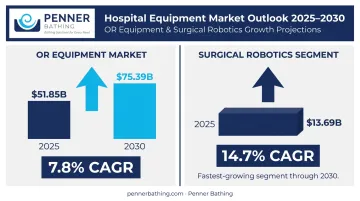
- Global operating-room equipment reached $51.85B in 2025, with surgical robotics growing at 14.7% CAGR
- Leading manufacturers in 2026 include Medtronic, GE HealthCare, Stryker, and Siemens for clinical tech — with category specialists like Penner Bathing leading patient hygiene
- Always verify FDA clearance at the product level, not the company level — approval is device-specific
- Match manufacturer to equipment category rather than defaulting to one large vendor
Hospital Equipment Manufacturing in 2026: What You're Actually Buying
"Hospital equipment" covers a broader range than most procurement checklists acknowledge. The category includes diagnostic imaging systems, surgical instruments, patient monitoring tools, hospital beds, patient transfer equipment, and hygiene systems — each representing a distinct supply chain, regulatory pathway, and manufacturer landscape.
The scale of this industry matches that complexity. Global operating-room equipment hit $51.85B in 2025 and is projected to reach $75.39B by 2030, a 7.8% CAGR. Surgical robotics is the fastest-growing verified segment at $13.69B in 2025, with a 14.7% CAGR forecast through 2030. Patient monitoring devices are also outpacing broader market averages.
This guide covers manufacturers across equipment categories — global technology leaders alongside category specialists — so procurement teams can evaluate the full supplier landscape, not just the largest players by revenue.
Top Hospital Equipment Manufacturers in 2026
These manufacturers were evaluated on product reliability, regulatory compliance, category depth, U.S. market presence, and customer support infrastructure.
Medtronic
Medtronic reported $36.364B in FY2026 revenue and $2.9B in R&D investment — numbers that reflect the scale of its hospital footprint. With an operational headquarters in Minneapolis and principal offices in Ireland, the company's hospital applications span cardiac monitoring, neuromodulation, surgical tools, diabetes management, and spinal surgery robotics. In early 2026, Medtronic received FDA clearance for its Stealth AXiS surgical system — the first integrated planning, navigation, and robotics platform for spine surgery.
| Category | Detail |
|---|---|
| Hospital Equipment | Cardiac, neuro, surgical, and diabetes management devices |
| Key Differentiator | $2.9B annual R&D investment; deep integration into OR and ICU workflows |
| Compliance | FDA clearance verified at the device level (e.g., Stealth AXiS, Hugo robotic system); ISO 13485 certification is site-specific — verify for the product in question |
GE HealthCare
GE HealthCare became an independent Nasdaq-listed company in January 2023 and reported $20.625B in 2025 revenue. It maintains more than 5 million installed equipment units globally, with hospital applications concentrated in diagnostic imaging (MRI, CT, ultrasound) and patient monitoring. FDA-cleared examples include the Venue Go ultrasound, Revolution Vibe CT, and the Portrait patient monitoring system.
For hospital IT and clinical teams, GE's Edison platform enables AI-enhanced imaging applications — though FDA clearance applies per application, not to the platform as a whole.
| Category | Detail |
|---|---|
| Hospital Equipment | Diagnostic imaging (MRI, CT, ultrasound), patient monitoring |
| Key Differentiator | AI-powered imaging tools and a large installed base across U.S. hospital radiology departments |
| Compliance | FDA clearance verified per device; check product-specific status before procurement |
Siemens Healthineers
Founded from roots dating to 1847 — with medical X-ray manufacturing beginning in 1896 — Siemens Healthineers reported approximately EUR 23.4B in FY2025 revenue from its Erlangen, Germany headquarters. U.S. hospital applications cover diagnostic imaging, laboratory diagnostics, and oncology systems (via its Varian acquisition). Recent FDA clearances include a Siemens MR diagnostic device under K252838 and the Biograph One PET/MR system.
Its enterprise-level approach — digitally connecting imaging, diagnostics, and clinical data across departments — makes it particularly relevant for large health systems standardizing across multiple sites.
| Category | Detail |
|---|---|
| Hospital Equipment | Imaging systems, laboratory diagnostics, radiation therapy |
| Key Differentiator | Enterprise digitalization and AI integration for multi-site hospital networks |
| Compliance | FDA clearance verified per device; CE marking is product-specific — confirm before procurement |
Stryker
Stryker ranked No. 195 on the 2025 Fortune 500 and No. 22 among healthcare companies, generating $25.116B in 2025 revenue. Based in Kalamazoo, Michigan, it covers both the OR and the ward floor: orthopedic implants, surgical navigation, the Mako SmartRobotics platform (which surpassed 1.5 million procedures globally by March 2025), hospital beds, stretchers, and neurovascular devices.
That cross-departmental reach is Stryker's clearest differentiator — few manufacturers serve a single hospital from the operating room through post-operative care and into general ward patient handling.
| Category | Detail |
|---|---|
| Hospital Equipment | Orthopedic implants, surgical tools, patient transport and handling equipment |
| Key Differentiator | OR-to-ward portfolio spanning surgical robotics, beds, and emergency equipment |
| Compliance | FDA clearance verified per device; EN ISO 13485:2016 certificate confirmed for Stryker Communications, Inc. — site-specific |
Philips Healthcare
Royal Philips reported EUR 17.834B in group sales for 2025, with hospital-relevant activity split across Diagnosis and Treatment and Connected Care segments. U.S. hospital applications include patient monitoring systems, diagnostic imaging, and health informatics. In 2026, Philips received FDA 510(k) clearance for Elevate Plus, an AI advancement in ultrasound imaging.
One important note for procurement teams: a federal court entered a permanent-injunction consent decree against Philips Respironics in April 2024 following recalled sleep-therapy and ventilator products. This risk is scoped to the Respironics product line — it does not affect Philips' broader imaging or monitoring portfolio, but warrants specific due diligence during evaluation.
| Category | Detail |
|---|---|
| Hospital Equipment | Patient monitoring, imaging, sleep and respiratory care, health informatics |
| Key Differentiator | Connected care ecosystem linking patient monitoring to clinical decision support |
| Compliance | FDA clearance verified per device; note Respironics consent decree for that specific product line |
Hill-Rom (Baxter)
Baxter completed its Hill-Rom acquisition in December 2021, and the brand now operates as "Hillrom: Now a Part of Baxter." The portfolio centers on hospital beds, patient support systems, wound care, and patient mobility solutions for general wards, ICUs, and long-term care units.
The Centrella Smart+ bed is the flagship product for hospitals focused on patient safety. It incorporates bed-exit alerts, SafeView visual status indicators, patient position and respiratory rate sensing, and ReadyConnect nurse-call connectivity — supporting fall prevention workflows and reducing nursing workload in high-acuity settings. A 2024 quasi-experimental study across 1,300 patients over 12 months found improved fall-prevention performance using an integrated IoT patient-care system, though this was technology-level evidence rather than Centrella-specific data.
| Category | Detail |
|---|---|
| Hospital Equipment | Hospital beds, patient support systems, wound care, patient mobility |
| Key Differentiator | Smart bed platform with nurse-call integration and patient safety monitoring |
| Compliance | FDA clearance verified per device; confirm current product-specific status |
Penner Bathing
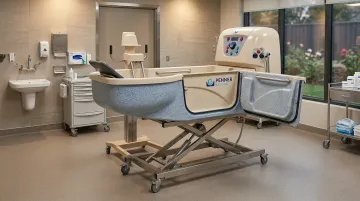
Patient hygiene is a category that procurement lists often overlook — a gap with real consequences for infection control compliance, staff efficiency, and patient dignity. Penner Bathing, a family-owned manufacturer based in Aurora, Nebraska, has specialized exclusively in therapeutic bathing systems for hospitals, nursing homes, and long-term care facilities since 1980.
All products are Made in America, manufactured in the company's own 22,000-square-foot facility since 2015.
The product line spans 38+ models — including the Premier, Premier Elite, Contour, Cascade, Pacific, and Superior systems. Configuration options include:
- Left/right/end-opening door layouts
- Mobile and post-transfer systems
- Bariatric sizing and integrated weight scales
- Fast-fill reservoirs and multiple finish options
Every model carries UL Listed and CUL Listed certifications, with automatic disinfection and round-the-clock BioCote antimicrobial protection built in as standard.
For hospital procurement teams, two operational details matter most:
- 24/7 live phone support — not a ticket queue, an actual person
- Next-day air shipping on parts for orders placed before 2PM CST, which minimizes facility downtime
| Model Line | Best Fit | Key Features |
|---|---|---|
| Pacific | Acute care / hospital | Motorized height-adjustable frame on casters, deep immersion, auto-disinfection, mobile stretcher compatibility |
| Premier / Contour | Long-term care / nursing homes | Resident comfort, staff ergonomics, routine hygiene workflows |
| Category | Detail |
|---|---|
| Hospital Equipment | Therapeutic and hydrotherapy bathing systems for hospitals and long-term care |
| Key Differentiator | 38+ models with automatic disinfection, BioCote antimicrobial protection, and 24/7 live support; Made in America |
| Compliance | UL Listed, CUL Listed; 40+ years serving U.S. and Canadian healthcare facilities |
How to Choose the Right Hospital Equipment Manufacturer
The most common procurement mistake isn't choosing the wrong brand — it's applying the wrong evaluation framework. Buying imaging equipment from a reputable generalist and applying that same logic to patient bathing systems often results in a poor match: oversized vendor, limited category expertise, weak post-sale support.
Key evaluation criteria to apply across every category:
- Verify regulatory compliance at the product level: FDA clearance, ISO 13485, and UL/CUL listing apply per product or manufacturing site, not company-wide
- Assess category-specific depth by counting models, configurations, and clinical use cases the manufacturer actually supports
- Confirm post-sale infrastructure covers training, parts availability, and documented response times
- Scrutinize software-dependent equipment against ECRI's 2025 health technology hazards list, which flags AI-enabled devices and cybersecurity vulnerabilities as top concerns
- Factor in supply chain resilience: U.S. hospital supply spending rose 9.9% through 2025, making domestic manufacturing and same-day parts availability more critical than ever
Applying these criteria consistently leads to one practical conclusion: match the right specialist to each equipment category. For imaging and surgical systems, large global manufacturers offer proven scale and clinical integration. For patient hygiene and therapeutic bathing, a dedicated specialist like Penner Bathing brings 40+ years of category-specific engineering, 38+ models with UL and CUL certifications, same-day parts shipping, and 24/7 live support — depth that a generalist vendor isn't structured to provide.
Frequently Asked Questions
What is considered hospital equipment?
Hospital equipment covers diagnostic imaging systems, surgical instruments, patient monitoring devices, hospital beds and support systems, and patient hygiene equipment. Different manufacturers specialize in different categories; no single product class qualifies as "hospital equipment" under FDA classification.
Which company is the largest hospital equipment manufacturer in the world?
By device revenue, Medtronic leads with approximately $33.5B, followed by Johnson & Johnson MedTech at $31.9B and Siemens Healthineers at $19B (per MassDevice's 2025 rankings). "Largest" depends on whether you measure by total revenue, specific product segment, or geographic market.
What certifications should a hospital equipment manufacturer have?
Key certifications include FDA clearance or approval (device-specific), ISO 13485 for quality management systems (site-specific), and UL or CUL listing for electrical safety. Required certifications vary by product type: bathing systems require different compliance standards than imaging systems, for instance.
How do hospitals decide which equipment manufacturers to work with?
Procurement decisions typically weigh regulatory compliance, product reliability, total cost of ownership, after-sales support quality, staff training provisions, and compatibility with existing clinical systems. Post-sale service (parts availability, response time, and training) often differentiates otherwise comparable vendors.
Are there hospital equipment manufacturers that specialize in specific departments?
Yes. Many strong manufacturers focus on specific niches: Penner Bathing for patient hygiene systems, Intuitive Surgical for robotic surgery platforms, and Hologic for women's health imaging. Specialist manufacturers typically provide deeper technical expertise and better ongoing support than generalists for those specific applications.
What is the difference between a medical device company and a hospital equipment manufacturer?
The terms overlap significantly. Hospital equipment manufacturers specifically design products for healthcare facility use, while medical device companies may also serve outpatient, home care, or consumer markets. This distinction affects regulatory compliance pathways: a product cleared for home DME use may not meet hospital facility standards.
Facilities evaluating bathing and hydrotherapy systems for hospital or long-term care units can reach Penner Bathing directly at 1-800-732-0717. With over 40 years of experience, Made in America manufacturing, UL/CUL Listed products, and 24/7 live phone support, Penner Bathing delivers dependable healthcare bathing solutions across the United States and Canada.