
Introduction
Nurses routinely manage five patients at once while fielding lab calls, physician orders, and call lights — all before noon. Without a structured approach to deciding who needs attention first, critical interventions get delayed and patients get hurt.
AHRQ's review of missed nursing care found that 55%–98% of nurses across reviewed studies reported omitting at least one required care item on their previous shift. Staffing pressure and disorganized prioritization were consistent contributing factors.
Priority-setting frameworks give nurses a repeatable, defensible method for making those decisions. This guide covers six core frameworks and explains when each one applies:
- Maslow's Hierarchy
- ABCs (Airway, Breathing, Circulation)
- CURE Priority System
- Levels of Priority
- The Nursing Process
- Data Cues
Whether you're a nursing student preparing for the Next Generation NCLEX or an experienced nurse managing a full patient load, this guide shows you how to layer these frameworks so you can make faster, more defensible triage decisions under pressure.
Key Takeaways
- Life-threatening physiological needs always come first: ABCs and Maslow's base tier are non-negotiable starting points
- The CURE hierarchy helps sort competing needs across multiple patients when ABCs alone don't resolve the decision
- Actual problems take priority over potential ones in most circumstances
- Real-time data cues — vital trends, handoff details, chart review — sharpen framework-based decisions
- Priority-setting is a skill built through repetition — consistent framework application develops automatic clinical judgment
Why Priority-Setting Is a Core Nursing Skill
The Bureau of Labor Statistics projects 189,100 RN job openings annually from 2024–2034 — driven largely by exits and transfers, not new positions. That sustained replacement demand signals a workforce under persistent pressure, where individual nurses routinely carry heavier workloads than staffing models anticipate.
The clinical risk is measurable. A nine-country European study found that each additional patient in a nurse's workload was associated with 7% higher odds of 30-day mortality. Each 10-percentage-point rise in missed care correlated with 16% higher mortality odds. Observational data, yes — but the pattern is consistent: workload without structure creates gaps in care.
Priority-Setting Is Not a Task Checklist
Prioritization means identifying which patient problems require action first (urgency) and which require action most (importance) — then organizing care accordingly. That's different from working through a to-do list in the order tasks appear.
A nurse who completes all scheduled medication passes before assessing the patient whose condition changed during handoff has completed tasks while failing to prioritize. The distinction matters clinically.
The NGN Connection
Since the Next Generation NCLEX launched on April 1, 2023, clinical judgment has been formally embedded in licensure evaluation. The NCSBN Clinical Judgment Measurement Model defines six core functions:
Since the Next Generation NCLEX launched on April 1, 2023, clinical judgment has been formally embedded in licensure evaluation. The NCSBN Clinical Judgment Measurement Model defines six core functions:
- Recognize cues
- Analyze cues
- Prioritize hypotheses
- Generate solutions
- Take action
- Evaluate outcomes
Priority-setting frameworks map directly onto that structure, making them essential for both practice and exam preparation.
Foundation Frameworks: Maslow's Hierarchy and the ABCs
Maslow's Hierarchy of Needs
Maslow's five-level pyramid moves from base to peak: Physiological → Safety → Love/Belonging → Esteem → Self-Actualization. In clinical application, nurses work upward — survival needs must be met before higher-order concerns can be addressed meaningfully.
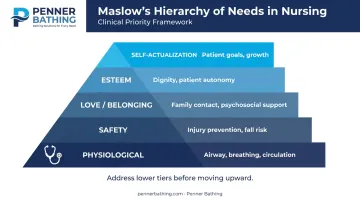
The logic is clear in emergencies. A patient who is actively hemorrhaging and emotionally distressed needs bleeding controlled before family is contacted. Addressing the emotional need first doesn't resolve the physiological crisis — it delays treatment.
Cultural context matters here. Maslow developed this framework within an individualistic Western context. A 2022 First Nations analysis noted that Indigenous and collectivist communities may experience belonging and community as inseparable from physiological wellbeing — not as a separate tier above it.
Nurses should treat the framework as a clinical guide, not a universal truth, and remain attentive to what the patient identifies as their own priorities.
ABCs: Airway, Breathing, Circulation
The ABCs function as the most immediate filter within Maslow's physiological tier. If a patient has no patent airway, cannot breathe, or lacks circulation, nothing else takes precedence.
Example scenario:
| Patient | Complaint | Priority |
|---|---|---|
| Patient A | Needs help getting to the bathroom | Lower — elimination need |
| Patient B | Chest pain, shortness of breath, pale and diaphoretic | Immediate — ABC threat |
Both patients have physiological concerns, but the ABCs resolve the order instantly. The nurse responds to Patient B first, notifies the team, and arranges bathroom assistance for Patient A.
A common point of confusion: ABC describes the order of assessment priority, not CPR action sequence. Current AHA adult BLS guidelines recommend compressions before breaths in cardiac arrest — the clinical prioritization framework and the resuscitation protocol serve different purposes.
Expanding the Toolkit: CURE, Levels of Priority, and the Nursing Process
The CURE Hierarchy
CURE was documented in peer-reviewed nursing literature by Kohtz, Gowda, and Guede in their 2017 article on cognitive stacking and has since appeared in nursing management curricula as a framework specifically designed to help novice nurses sort competing demands across a full shift.
| Category | Definition | Examples |
|---|---|---|
| Critical | Immediate life-threatening need | New-onset respiratory distress, absent pulse |
| Urgent | Significant discomfort or safety risk | Fall risk at bedside, bathroom urgency with mobility concerns |
| Routine | Scheduled assessments and daily care | Morning vitals, scheduled medications |
| Extras | Comfort measures after higher needs are met | Hair wash, massage |
Applied example: Patient A has been requesting help to the bathroom for 20 minutes. Patient B just developed new-onset shortness of breath. Under CURE, Patient B is Critical; Patient A is Urgent. The nurse assesses Patient B immediately, alerts the care team, and then addresses Patient A — or arranges for a colleague to assist while the Critical situation is being managed.
For nurses still building clinical instinct, CURE provides a clear decision rule when competing needs arrive simultaneously.
Levels of Priority: First, Second, Third
Where CURE organizes shift-wide task management, the Levels of Priority framework classifies patient deterioration specifically by urgency and required response time:
- First-level: Life-threatening — requires immediate intervention (respiratory distress, hemodynamic instability, absent pulse)
- Second-level: May become life-threatening without prompt action — confusion, rapidly rising temperature, declining consciousness
- Third-level: Non-urgent — functional health support, patient education, hygiene routines, daily living assistance
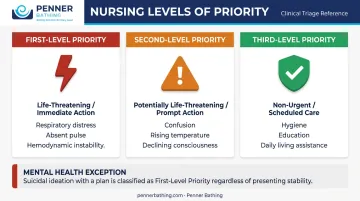
Mental health exception: Suicidal ideation with a specific plan identifying when and how constitutes a first-level priority regardless of stable physical presentation. A calm affect does not reduce urgency. The standard three-tier model can underestimate mental health emergencies — nurses should apply the same immediacy they would to a hemodynamic threat. Formal risk stratification also considers intent, means, preparatory behavior, and the patient's ability to maintain safety.
The Nursing Process and Supporting Frameworks
The Nursing Process (Assess → Diagnose → Plan → Implement → Evaluate) functions as a check against premature action. Assessment always precedes intervention — a nurse who acts on assumption before gathering data risks treating the wrong problem entirely.
Two principles reinforce this sequence in practice:
- Least Restrictive/Least Invasive: Attempt the safest, most conservative intervention before escalating. ANA's position on restraint use requires alternatives to be considered and exhausted when feasible.
- Acute vs. Chronic / Unstable vs. Stable: When core frameworks don't clearly differentiate priority, always address the acute, unstable, and urgent presentation over the chronic, stable, and expected one.
Reading Clinical Signals: Data Cues and Acuity
Frameworks provide structure. Data cues provide the clinical content those frameworks act on.
What Data Cues Are
A data cue is any piece of significant clinical information that directs a nurse toward a concern or change in condition: a trending vital sign, a new lab value, a change in responsiveness or behavior. Data cues aren't interpreted in isolation — they're fed into the prioritization framework to establish clinical priorities.
From there, the distinction between actual and potential problems matters. Actual vs. Potential Problems: An active nursing diagnosis (ineffective airway clearance that is currently occurring) takes priority over a risk diagnosis (risk for skin breakdown with no present symptoms) in most cases. A high-risk potential problem may outrank a mild actual problem when vulnerability and consequences are severe — but the default is to address what is already happening.
Handoff and Chart Review as Proactive Sources
Reviewing a patient's baseline at shift start — their typical heart rate, oxygen saturation, mental status — allows a nurse to recognize deviations quickly rather than reacting to a crisis that could have been caught earlier.
Example: A chart review at shift change shows a patient's oxygen saturation trending from 97% to 91% over four hours, documented across three vitals sets. No alarm has triggered. But the trend is a cue. The nurse assesses that patient first, before the saturation crosses a threshold that requires emergent response.
Acuity Ratings
Patient acuity systems (typically scored on a 1–4 scale, though no universal standard applies across all organizations) help distribute workload based on care complexity. A patient rated 4 requires frequent assessment and complex interventions — they should be seen first when clinical cues are otherwise equal.
Key rule: Acuity alone is never sufficient. A lower-acuity patient with a sudden change in condition may outrank a high-acuity patient who is currently stable — real-time assessment always takes precedence over a rating.
Applying Frameworks in Long-Term Care and Complex Settings
Long-term care environments — nursing homes, assisted living, and rehabilitation centers — present a distinct prioritization challenge. Most residents have multiple chronic conditions, and the central clinical judgment task on every shift is distinguishing between an expected chronic symptom and a new acute deterioration.
Where Third-Level Priorities Dominate
Third-level priorities make up a larger share of daily care in long-term care than in acute settings. Hygiene routines, functional health support, patient education, and comfort care aren't emergencies — but they directly affect residents' dignity, quality of life, and psychological wellbeing. They can't be consistently deferred without consequence.
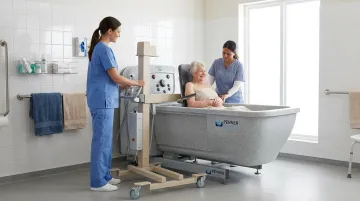
Equipment purpose-built for long-term care can meaningfully reduce the time burden of routine hygiene tasks. Penner Bathing's healthcare bathing systems, used in nursing homes and assisted living facilities across the US and Canada, include features like fast-fill reservoirs and automatic disinfection that move staff through third-level tasks without crowding out second-level assessment work.
Recognizing Subtle Baseline Shifts
AHRQ instructs long-term care staff to know what is normal for each resident, because deterioration in this population often presents first as the resident "not being their usual self." Relevant early signals include:
- Changes in alertness or behavior
- Reduced appetite or fluid intake
- Decline in physical function or participation
- Subtle changes in breathing pattern or skin condition
- New or worsening pain
These subtle shifts may not register as obvious acute events — but each one warrants reclassification from third-level to second-level priority. A resident who is "just a little quiet today" may be showing the first sign of a urinary tract infection, aspiration event, or cardiac change. In long-term care, acting on those soft signals before they escalate is the practical expression of strong clinical judgment.
Frequently Asked Questions
What are the priority-setting frameworks in nursing?
The six core frameworks are: Maslow's Hierarchy of Needs, the ABCs (Airway, Breathing, Circulation), the CURE Hierarchy (Critical, Urgent, Routine, Extras), Levels of Priority (First, Second, Third), the Nursing Process, and Acute vs. Chronic/Unstable vs. Stable comparisons. Nurses use these in combination — ABCs for immediate life threats, CURE and the nursing process for shift-level organization.
What are the 4 P's of prioritization in nursing?
The 4 P's (Patient, Problem, Plan, and Priority) prompt nurses to identify the patient and their condition, define the clinical problem, and outline a care plan. The final step — determining what must be addressed first based on urgency and potential for harm — makes it a structured thinking sequence, not a standalone framework.
What are the 5 nursing priorities?
The five nursing priorities map directly to Maslow's hierarchy: physiological survival, safety and injury prevention, psychosocial connection, esteem and dignity, and self-actualization. Physiological needs come first; higher-order needs are addressed once the patient is stabilized.
How do the ABCs relate to Maslow's Hierarchy of Needs?
The ABCs are a subset of Maslow's foundational physiological tier. They represent the most acutely life-threatening physiological needs and serve as the first filter a nurse applies when a patient's life may be at immediate risk. Maslow's hierarchy organizes all human needs; the ABCs zoom in on the most critical corner of the base level.
When should a nurse use the CURE framework instead of the ABCs?
CURE is most useful when multiple patients simultaneously have physiological needs and the ABCs alone don't differentiate urgency clearly enough. ABCs handle true emergencies; CURE organizes the full range of competing demands across a shift — Critical through Extras — giving nurses a structured way to sequence care when several patients need attention at once.