
This glossary organizes terms into six functional categories: structural, drainage, water supply, therapeutic features, tub types, and accessibility. Skip directly to the section relevant to your situation, or read through for a complete reference.
Who this is for: facility administrators, caregivers, homeowners, and anyone comparing bathing systems who needs plain-language definitions they can actually use.
Key Takeaways
- Terms are grouped by function—structural, drainage, supply, therapeutic, installation, and accessibility—for faster navigation.
- Knowing the difference between terms like "overflow" and "drain flange" helps you pinpoint problems and communicate accurately with plumbers or technicians.
- Therapeutic terms like whirlpool, air bath, and inline heater determine which bathing system fits your clinical or residential needs.
- Accessibility terms—walk-in tub, transfer seat, ADA compliance—are essential for long-term care and aging-in-place decisions.
Bathtub Body and Structural Terms
These are the parts you see and touch before any water flows: the physical shell and surfaces that define the tub's form, fit, and material performance.
Tub Shell / Tub Body
The tub shell is the main basin structure that holds water. Material choice has real consequences:
- Acrylic – Lightweight, smooth, and resistant to chipping. Easy to clean, but surface can scratch over time.
- Fiberglass (gelcoat) – Similar to acrylic but typically less durable; abrasive cleaners can dull the finish.
- Enameled cast iron – Highly durable and heat-retaining. Kohler's Villager model, for example, weighs 316 lbs and requires a 49 lb/ft² minimum floor load—a structural consideration for any installation.
- Porcelain-enameled steel – Lighter than cast iron (a Bootz 60×30 model weighs 67 lbs) with good durability; some manufacturers add full-wrap insulation for heat retention.
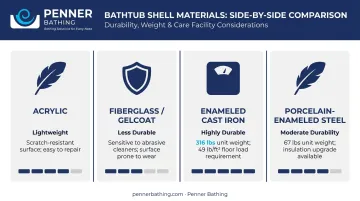
Material selection matters differently in residential versus commercial settings. Weight affects floor load requirements, and surface hardness affects long-term cleaning ease in high-use environments.
Rim / Ledge / Deck
The rim is the upper perimeter edge of the tub, the structural border where the basin ends. Ledge refers to the support surface immediately around the basin opening, while deck typically describes the wider finished surface surrounding the tub in platform or drop-in installations.
These terms are used interchangeably by many manufacturers, but the distinction matters when specifying faucet placement or planning grab bar installation.
Apron / Skirt
The apron (also called the skirt) is the vertical front-facing panel that provides a finished exterior appearance and conceals plumbing underneath. On alcove tubs, this is the one visible side. Some models feature removable aprons for service access to the drain assembly and pump components—worth confirming before purchase if maintenance access is a priority.
Flange
The flange is the lip or edge of the tub that creates a watertight seal against the surrounding wall or deck structure. Two common types:
- Tile flange – Bends upward along wall-facing edges so tile installs over it, directing water back toward the tub. American Standard specifies a tile flange on every side adjoining a wall.
- Undermount flange – The tub rim sits below the finished deck surface, hiding the edge from view.
Selecting the wrong flange type—or sealing it improperly—is one of the most common sources of water damage behind walls.
Tub Surround / Enclosure
The tub surround is the wall paneling or tile system that encloses the bathing area above the tub. It protects drywall from moisture and comes in acrylic panels, ceramic tile, or solid surface materials. In both residential remodels and facility installations, a properly sealed surround is as important as the tub itself for preventing water damage behind walls.
Drainage and Overflow Terms
Most bathtub problems—slow drains, odors, leaks under the floor—trace back to one specific component in the drainage system. These definitions help you identify which component is actually at fault.
Drain / Drain Flange
The drain is the opening at the lowest point of the tub that allows water to exit. The drain flange is the metal ring visible from above that seals the connection between the tub surface and the drain pipe. Per IPC 407.2, the waste outlet must be at least 1½ inches (38 mm) in diameter. Oatey specifies putty or silicone beneath the flange to form a watertight joint—a failed seal here is a common and easily missed source of slow leaks.
Drain Stopper Types
The drain stopper is the mechanism that seals the drain to hold water. Four common types, with meaningful differences for elderly or mobility-limited users:
| Type | Mechanism | Accessibility Note |
|---|---|---|
| Lift-and-turn | Lift and twist to open; push and twist to close | Requires grip and wrist rotation |
| Toe-touch | Press center to close; press off-center to open | Hands-free operation |
| Trip lever | Overflow-plate lever operates internal linkage | No contact with drain needed |
| Pop-up | Rises above drain; linkage varies by model | Linkage mechanism varies by model; confirm specifics with your supplier |
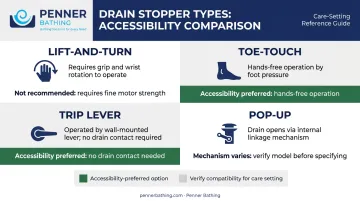
Stopper type can make a real difference in care environments where residents have limited hand dexterity—trip lever and toe-touch options are often preferred for this reason.
Overflow / Overflow Plate
The overflow is the secondary opening positioned a few inches below the tub rim that drains excess water before it floods the bathroom. The overflow plate (faceplate) is the visible cover secured by screws. Behind that plate sits a rubber gasket—the most commonly missed leak point during routine maintenance. If you have a drip under the tub with no obvious source, this gasket is a logical first place to check.
P-Trap
The P-trap is the U-shaped pipe section beneath the tub that holds a small amount of standing water, creating a seal that blocks sewer gases from entering the bathroom. In the International Plumbing Code, it's defined as a trap that retains a liquid seal without obstructing wastewater flow. Tubs that go unused for extended periods can develop sewer odors when the P-trap dries out. In care facilities with infrequently used bathrooms, running an inch or two of water down the drain weekly prevents this.
Waste-and-Overflow Assembly
The waste-and-overflow (W&O) assembly is the complete connected system linking the drain, the overflow tube, and the tee fitting that joins them before connecting to the building's main drain line. When multiple components are aging or corroded at the same rate, replacing the full assembly reduces the risk of re-failure from mismatched parts—one new component in a corroded system rarely holds long.
Water Supply, Faucet, and Control Terms
These terms cover how water enters the tub, how temperature is controlled, and how flow is directed between tub and shower—areas where terminology confusion often leads to ordering the wrong parts or specifying the wrong valve type.
Tub Filler / Faucet / Valve Body
- Tub filler – The spout and handle assembly that delivers mixed water into the tub
- Valve body – The concealed assembly behind the wall containing the cartridge that regulates flow and temperature
- Faucet – A general term covering handles, trim, and spout together
When describing a problem to a plumber or ordering replacement parts, specifying which component is affected prevents costly mistakes. A dripping spout is a filler issue; temperature inconsistency usually points to the valve body.
Two critical valve types for care settings:
- Pressure-balancing valve – Compensates for hot/cold pressure changes. ASSE 1016 Type P testing requires the outlet temperature remain within ±3.6°F during specified pressure changes. It does not compensate for supply temperature changes.
- Thermostatic valve – Senses and compensates for temperature changes. CMS Appendix PP F689 guidance identifies 100°F (37°C) as a safe bathing temperature for residents. Thermostatic valves are the safer choice in healthcare and senior bathing environments, particularly for residents with reduced heat sensitivity.
Shower Diverter / Diverter Valve
The diverter redirects water flow from the tub spout to the showerhead. It can be a pull-up lever on the spout itself or integrated into the handle assembly. A worn diverter typically causes the showerhead to drip while the tub is in use—it does not regulate supply temperature.
Supply Lines / Shut-Off Valves
Supply lines are the hot and cold water pipes feeding the control valve. Upstream from those lines, shut-off valves (service stops) are isolation valves that allow water to be cut off for repairs without shutting down the building's main supply. Dedicated shut-off valves are not always present. Confirm their location during any facility evaluation; their absence complicates maintenance in both residential and institutional settings.
Therapeutic and Hydrotherapy Feature Terms
This category is particularly relevant for anyone selecting bathing systems for long-term care, assisted living, or rehabilitation. Therapeutic feature terminology directly affects purchasing decisions, staff workflow, and resident health outcomes.
Hydrotherapy
Hydrotherapy is the therapeutic use of water—its temperature, pressure, and movement—to relieve pain, support circulation, and promote relaxation. Research supports measurable benefits: a randomized trial of 140 knee osteoarthritis patients using thermal-water baths showed improved pain scores and functional outcomes compared to controls. It is the foundational principle behind whirlpool tubs, air baths, and specialty therapeutic bathing systems used in healthcare facilities.
Whirlpool Tubs / Jets
A whirlpool tub uses a pump to recirculate bathwater through jets positioned along the tub walls, creating pressurized streams that massage targeted areas of the body. Jets are the individual nozzles through which water exits—jet count, placement, and adjustability vary significantly by model and affect massage intensity and coverage.
Whirlpool systems require rigorous cleaning between uses. CDC guidelines for environmental infection control direct facilities to drain, clean, and disinfect hydrotherapy equipment after each use—jet plumbing included.
Air Bath / Air Jets / Blower
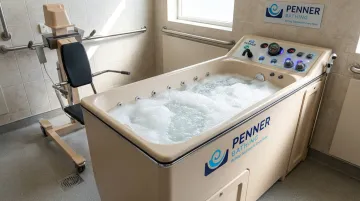
An air bath releases thousands of tiny air bubbles through openings in the tub floor or walls, producing a gentler, enveloping sensation compared to whirlpool water jets. The blower is the motor that pumps warm or ambient air into the system—water is not recirculated through this mechanism.
Penner Bathing's PennAire Microbubble Technology is an example of advanced air-bath engineering designed for long-term care. The system delivers billions of oxygenated microbubbles carrying a negative electrical charge, which actively attract and remove impurities from skin.
Penner's Aqua-Aire Jet System incorporates a check valve that prevents water from sitting in the jet lines between uses, a meaningful sanitation advantage in multi-patient environments. Automatic disinfection is standard on all Penner models.
Chromatherapy / Aromatherapy / Audiotherapy
These comfort and wellness features appear across both residential and facility bathing systems:
- Chromatherapy – Colored LED lighting within the tub to promote relaxation and mood support
- Aromatherapy – Warm air passed through an essential oil canister and released through the bath system
- Audiotherapy – Integrated sound systems that use the tub shell as a sounding board, so sound is both heard and felt through the bath
Inline Heater / Thermostatic Control
An inline heater maintains water temperature during a bath by recirculating and reheating already-warm water—it is not a replacement for the building's water heater. Jacuzzi specifies a maintained operating range of 77–104°F for applicable systems.
Thermostatic controls allow precise temperature setting and hold it consistently throughout the bath. In care facilities, this is a critical safety feature for residents with reduced heat sensation, where even brief exposure to water above safe temperatures carries serious burn risk.
Bathtub Types and Installation Terms
Quick-reference definitions for the most common tub styles and installation classifications encountered when purchasing, specifying, or renovating.
Alcove, Drop-In, Freestanding, and Undermount
| Type | Definition |
|---|---|
| Alcove | Fitted between three surrounding walls; one finished apron side. The most common residential installation. |
| Drop-In | Dropped into a pre-built deck surround; unfinished exterior, finished top edge. |
| Freestanding | Self-supporting, finished on all sides; does not attach to walls. |
| Undermount | Installed below a finished deck surface; rim is hidden from view. |
Clawfoot, Pedestal, Slipper, and Soaking
| Type | Definition |
|---|---|
| Clawfoot | Freestanding tub supported by decorative claw-shaped feet; typically antique-inspired. |
| Pedestal | Freestanding tub resting on a continuous solid base rather than separate feet. |
| Slipper | Freestanding form with one raised end (single slipper) or two raised ends (double slipper) for a reclined bathing position. |
| Soaking tub | Deeper basin designed for full-body immersion; no jet or air features. |
Apron Front, Corner Tub, and Japanese Soaking Tub
| Type | Definition |
|---|---|
| Apron front | A finished decorative panel on one or more sides; common in alcove or built-in installations. |
| Corner tub | Designed to fit into a room corner, often fan-shaped or five-sided with a broader bathing well. |
| Japanese soaking tub (ofuro) | Compact footprint with greater depth for shoulder-level immersion; often includes a built-in bench seat for upright bathing. |
Accessibility and Walk-In Tub Terms
This is critical vocabulary for anyone selecting bathing solutions for elderly individuals, people with disabilities, or long-term care and assisted living environments—areas where Penner Bathing has specialized for over 40 years.
Walk-In Tub / Low Threshold / Watertight Door
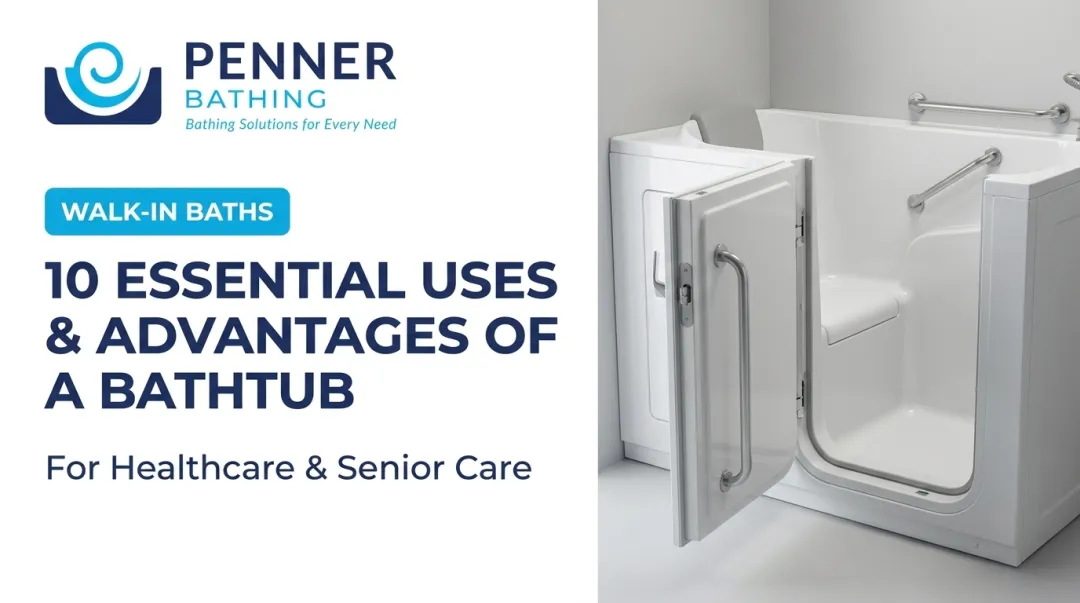
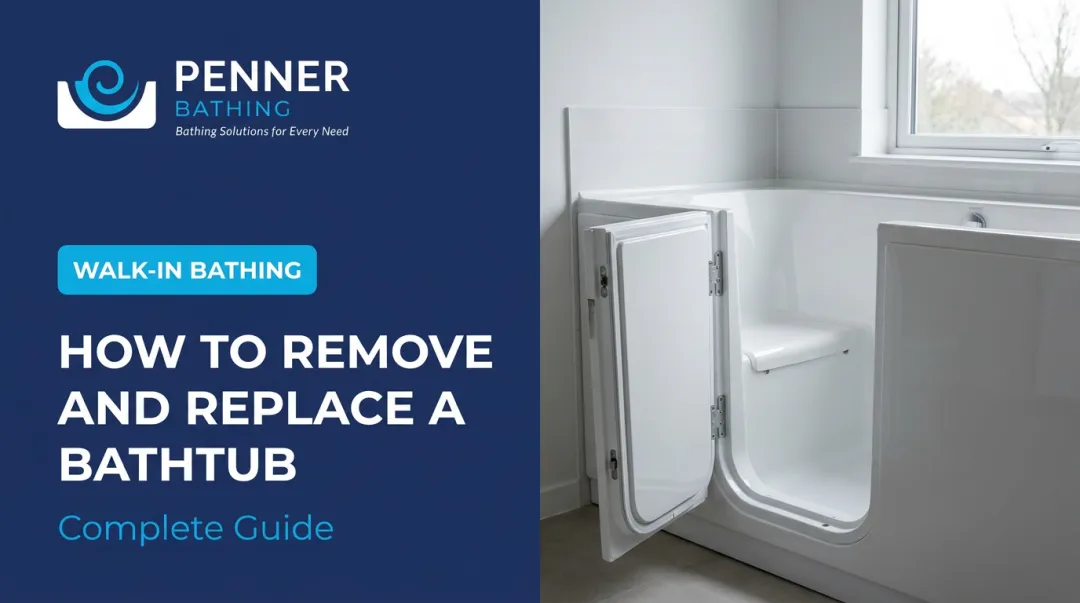
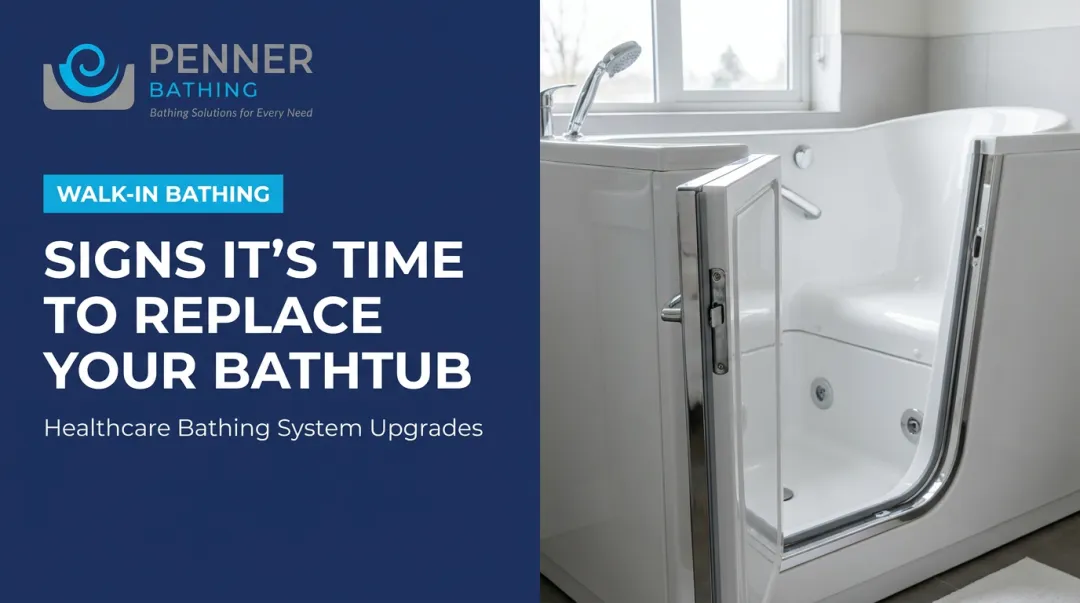
A walk-in tub is a bathtub with a side-entry door that allows the bather to step in without swinging a leg over a high tub wall—essential for users with limited mobility, balance challenges, or fall risk. Key related terms:
- Low threshold – The minimal step height required at the door entry point
- Watertight door – The sealed inward- or outward-swinging door that prevents leaks while the tub is in use
Penner Bathing's Dream Spa Walk-In Bath incorporates these features for residential use, with a wide swing-out door designed so users sit first and then bring their legs in—a meaningful distinction from inward-swinging designs, which require the user to step inside before sitting.
Transfer Seat / Bench Seat / Grab Bars
- Transfer seat – A built-in or fold-down seat that allows a person to slide laterally into the tub rather than stepping over a wall; designed for wheelchair-to-tub transfers
- Bench seat – A fixed interior seat that lets the bather sit at or near water level during bathing
- Grab bars – Fixed structural support rails inside or adjacent to the tub that assist with entry, exit, and stability
Research published in PubMed found that participants using a vertical grab bar during bathtub exit were 75.8% more likely to recover balance during a perturbation event. Grab bars are an ADA and safety standard in healthcare bathing.
ADA Compliance / Antimicrobial Surface / Automatic Disinfection
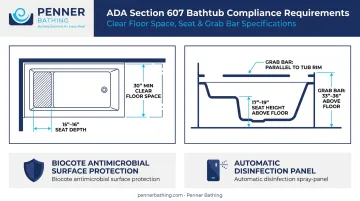
- ADA compliance – Meeting Americans with Disabilities Act standards for accessible bathing design. ADA Section 607 specifies:
- Clear floor space: at least 30 inches wide beside the full tub length
- Seat dimensions: 15–16 inches deep, 17–19 inches above the floor
- Grab bar placement: precise positioning relative to the rim and floor
- Antimicrobial surface – A material or coating that inhibits bacterial growth on tub surfaces between cleanings. Penner Bathing integrates BioCote® antimicrobial protection directly into tub materials, providing continuous surface protection for the life of the product—though this complements rather than replaces standard disinfection protocols.
- Automatic disinfection – A built-in system that sanitizes the tub between uses without requiring full manual intervention. On Penner Bathing's systems, a panel-activated jet cycle handles sanitization between uses, reducing staff workload and eliminating inconsistencies from manual cleaning.
Frequently Asked Questions
What are the parts of a bathtub called?
The main structural parts are the tub shell, rim, and apron. Drainage components include the drain flange, stopper, overflow plate, P-trap, and waste-and-overflow assembly. Water supply components include the faucet, valve body, tub spout, and diverter. Knowing which category a part belongs to speeds up diagnosis and ordering.
What is the ledge of a bathtub called?
The horizontal top edge is the rim or ledge. When it's wide enough to mount a faucet, it's often called the deck. The vertical front panel—sometimes confused with the ledge—is the apron or skirt. These are distinct components with different installation and replacement considerations.
What is the metal ring around the bathtub drain called?
That's the drain flange—the fitting that seals the connection between the tub basin and the drain pipe below. A rubber gasket or plumber's putty beneath the flange creates the watertight seal. When that seal fails, water leaks through the tub floor rather than through the drain pipe itself.
What is the difference between a whirlpool tub and an air bath?
Whirlpool tubs use a pump to recirculate water through targeted jets for deep, concentrated massage. Air baths use a blower to push air through floor or wall openings, creating thousands of small bubbles for a gentler, full-body sensation. Because air baths don't recirculate water through internal plumbing, sanitation is simpler—a practical advantage in care settings with multiple daily users.
What does "walk-in tub" mean?
A walk-in tub has a sealed side-entry door that eliminates the need to step over a conventional tub wall. The bather enters through the door, sits down, and then closes the watertight seal before filling. This design reduces fall risk for elderly users, people with mobility limitations, and residents in long-term care and assisted living settings.
What is hydrotherapy in a bathtub?
Hydrotherapy is the therapeutic use of water's temperature, pressure, and movement to relieve muscle and joint pain, reduce tension, and support circulation. In a bathtub context, it's the principle behind whirlpool jets, air bath systems, and specialty therapeutic bathing equipment used in healthcare and rehabilitation settings, where precise water control supports both resident safety and treatment outcomes.