Introduction
Picture a single nurse responsible for a dozen residents on a late-shift in a long-term care facility. Medications to administer, a fall to respond to, a resident who hasn't been repositioned in hours. This isn't a worst-case scenario — it's Tuesday.
The U.S. nursing workforce is in a genuine crisis. NCSBN research estimates roughly 100,000 RNs left the profession during the COVID-19 pandemic, with over 600,000 more reporting intent to leave by 2027. That's not a staffing blip — it's a structural collapse playing out in slow motion across every care setting in the country.
What follows is a direct look at how these shortages affect resident outcomes, why long-term care facilities absorb a disproportionate share of the damage, and what administrators can do to protect residents when teams are stretched thin.
Key Takeaways
- Understaffing directly increases patient mortality, medication errors, and hospital-acquired complications
- "Missed nursing care" — necessary tasks left undone — is one of the most consequential and least visible effects of short staffing
- Long-term care facilities face unique risks because their residents cannot self-advocate or compensate for gaps in care
- Burnout and turnover form a self-reinforcing cycle that deepens the shortage over time
- Workflow-efficient equipment and standardized care protocols can protect care quality even when teams are understaffed
The Scale of the Nursing Shortage Crisis
The numbers are stark. HRSA projects a shortage of nearly 109,000 RN full-time equivalents by 2038, with nonmetropolitan areas facing an 11% gap versus 2% in urban centers. Rural and underserved facilities — already struggling to recruit — face the steepest climb.
Why This Is Happening Now
The shortage isn't traceable to a single cause. Multiple pressures have converged simultaneously:
- An aging workforce: Nearly 40% of active RNs are now 55 or older, with significant retirement waves expected over the next decade
- Post-pandemic exits: The 2021 RN workforce decline was most pronounced among nurses aged 35–49 — mid-career professionals, not those near retirement
- Education bottlenecks: AACN reports that over 80,000 qualified nursing school applicants were turned away in 2024 due to insufficient faculty, clinical sites, and classroom capacity
- Demand acceleration: An aging U.S. population is generating more care needs faster than the workforce can absorb them
- Geographic and pay disparities: Rural facilities, long-term care settings, and underserved areas consistently struggle to compete on compensation with urban acute care hospitals
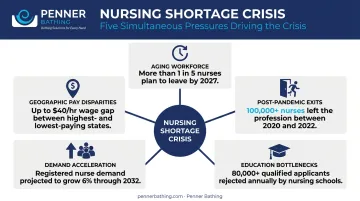
Each of these pressures reinforces the others. Expanding nursing school enrollment doesn't address burnout-driven mid-career exits. Raising pay doesn't resolve faculty or clinical site shortages. Because every fix addresses only one piece, the effects fall hardest on the facilities — long-term care, rural hospitals, assisted living — that were already operating with the thinnest margins.
How Nursing Shortages Directly Compromise Patient Care Quality
The consequences of understaffing aren't theoretical. They show up in mortality data, complication rates, and incident reports — consistently, across care settings.
The Mortality Link
The foundational study here is hard to argue with. Aiken et al., published in JAMA, analyzed over 232,000 surgical patients across 168 Pennsylvania hospitals and found that each additional patient added to a nurse's workload was associated with 7% higher odds of patient death within 30 days. Each additional patient also raised the odds of failure-to-rescue by 7%. That pattern holds at every staffing level — the risk doesn't plateau.
Missed Nursing Care: The Silent Metric
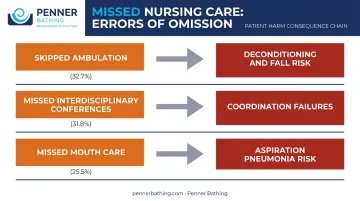
Researcher Beatrice Kalisch defines missed nursing care as an error of omission — required care that is partially or entirely skipped, or significantly delayed. In a 10-hospital U.S. study, the most frequently missed care items were:
- Ambulation three times daily or as ordered: 32.7% of cases
- Interdisciplinary care conferences: 31.8%
- Mouth care: 25.5%
These aren't administrative failures. Skipped ambulation leads to deconditioning and fall risk. Missed mouth care elevates aspiration pneumonia risk. Delayed monitoring misses deterioration before it becomes a crisis. Missed care is invisible in most quality reports — which is precisely what makes it dangerous.
Medication Errors and Shift Length
AHRQ research shows medication errors are three times more likely when nurses work shifts longer than 12.5 hours. Understaffing drives extended shifts, which drives error rates — and that sequence runs directly back to staffing decisions made at the facility level.
Hospital-Acquired Complications
When nurses are spread too thin, the consequences compound:
- Pressure injuries: Higher RN staffing consistently correlates with fewer pressure ulcers, supported by multiple systematic reviews
- Patient falls: Monitoring gaps under heavy workloads increase fall frequency and severity
- Healthcare-associated infections: Delayed hygiene care and missed protocol adherence elevate infection risk
- Readmissions: Inadequate discharge preparation and follow-through drive preventable returns
The impact extends beyond clinical outcomes. One additional licensed nurse per 1,000 inpatient days was associated with measurable improvements in HCAHPS staff responsiveness scores and patient willingness to recommend the facility. Staffing levels show up in satisfaction data just as clearly as they do in complication rates.
The Ripple Effect: Burnout, Turnover, and the Cycle of Decline
Understaffing doesn't just affect patients. It destroys the workforce it depends on.
The Burnout Pipeline
A 2023 American Nurses Foundation survey of more than 7,400 nurses found 56% experiencing burnout and 39% likely to leave their position within six months. McKinsey reported similar figures: 45% of surveyed inpatient nurses intended to leave within six months as of early 2023. When nurses leave, remaining staff absorb their workload, accelerating the burnout of those who stay.
The exits aren't concentrated among nurses approaching retirement. National workforce analysis found the sharpest 2021 RN decline among nurses aged 35–49. These are experienced professionals with decades of contribution ahead of them, and their departure strips institutional knowledge from teams already running lean.
The Cost of Constant Turnover
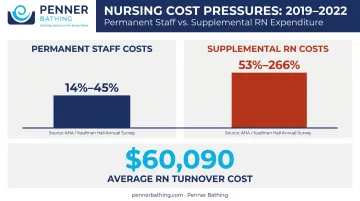
That loss of experienced staff carries a price that hits budgets directly. The 2026 NSI National Health Care Retention Report estimates the average cost of a single staff RN turnover event at $60,090, with annual hospital losses ranging from $4.2M to $6.2M. Each percentage-point change in RN turnover corresponds to roughly $295,000 saved or lost.
The supplemental staffing costs that fill those gaps aren't cheap. GAO data shows supplemental RN costs rose 53–266% between January 2019 and January 2022 across 11 studied hospitals, far outpacing the 14–45% increase in permanent staff costs over the same period.
Team Cohesion and Continuity
Rotating agency nurses face a concrete safety challenge: unfamiliar EHR systems, unit layouts, and care protocols require orientation time that permanent staff don't need. AHRQ notes that while researchers have not yet established a consistent statistical relationship between agency use and specific safety variables, the orientation gap remains a legitimate operational concern. Meanwhile, permanent staff bear a supervisory burden — answering questions, covering gaps in protocol knowledge — on top of their patient care load.
Long-Term Care and Assisted Living: The Hardest-Hit Settings
Long-term care facilities occupy a uniquely precarious position in this crisis. Their residents have complex, multi-system conditions. They depend entirely on staff for mobility, hygiene, nutrition, and safety monitoring. And their facilities typically cannot match the compensation offered by acute care hospitals competing for the same nursing candidates.
What Staffing Gaps Mean for Residents
Payroll-Based Journal data from March 2025 shows total nursing turnover in nursing homes at 48.7%, with RN turnover at 43.6%. In a March 2024 AHCA survey, 46% of nursing home providers reported limiting admissions because of labor shortages — turning away residents who need care because there isn't enough staff to safely serve them.
When staffing falls short in these settings, the first areas to suffer are basic daily living care:
- Bathing and hygiene routines are delayed or abbreviated
- Repositioning schedules slip, increasing pressure injury risk
- Mobility assistance decreases, accelerating deconditioning
- Monitoring gaps leave early signs of deterioration undetected
A 2025 U.S. nursing home study found agency and overtime use beyond identified breakpoints associated with a 6.44% increase in pressure ulcer rates, a measurable resident harm outcome tied directly to staffing strain.

Regulatory Consequences
That patient safety risk doesn't stay internal — it invites regulatory scrutiny. Long-term care facilities face compounding exposure through CMS quality rating systems that make staffing levels publicly visible. CMS's Five-Star Quality Rating System scores six staffing measures, including case-mix-adjusted nursing hours and RN and administrator turnover rates. A one-star staffing rating subtracts one star from a facility's overall rating, which affects reputation, census, and competitive positioning.
Where Equipment Makes a Measurable Difference
When staffing is constrained, operational efficiency becomes a form of patient protection. Equipment designed to reduce manual steps per care task lets nurses redirect limited time toward direct resident interaction.
Penner Bathing's healthcare bathing systems are built with this reality in mind. Features like the fast-fill reservoir, automatic disinfection, and integrated bath oil and shampoo dispensers reduce the manual steps per bathing session, which matters when a single aide is managing multiple residents per shift.
The Cascade Bariatric model and 13 available transfer configurations let facilities match equipment to resident mobility needs and room layout, reducing both staff physical strain and resident discomfort. The Pacific model's height-adjustable design specifically addresses the extended bending postures that rank among the leading causes of back injury in long-term care.
CDC/NIOSH data shows that safe-resident-handling programs using mechanical equipment reduced workers' compensation injuries in nursing homes by 61%. That figure reflects both staff protection and operational continuity, two outcomes that matter most when a facility is already stretched thin.
What Healthcare Facilities Can Do Right Now
Waiting for the nursing shortage to resolve isn't a strategy. Facilities that protect care quality during workforce constraints do so through deliberate operational decisions.
Retention Over Recruitment
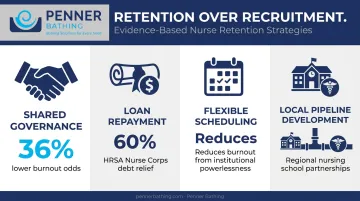
Replacing nurses costs more than keeping them. Evidence-based retention approaches include:
- Shared governance: Nurses in high-engagement shared governance environments showed 36% lower odds of burnout and 34% lower odds of intent to leave in a study of 425 U.S. hospitals
- Loan repayment: HRSA's Nurse Corps program repays 60% of qualifying nursing education debt for two years of service, with 25% available for a third year — a concrete recruitment and retention tool for facilities in underserved areas
- Flexible scheduling: Giving nurses real input into their schedules reduces the sense of institutional powerlessness that accelerates burnout
- Local pipeline development: Partnerships with regional nursing schools provide a more sustainable staffing pipeline than reactive agency reliance
Workflow and Operational Efficiency
Standardized care protocols, reduced manual task burdens, and time-saving equipment allow nurses to accomplish more within a shift without working longer or cutting corners. AHRQ's On-Time standardized nursing home workflow program reduced pressure ulcers by 33–59% in evaluation studies.
Equipment that handles routine tasks automatically recaptures minutes per care event that multiply across an entire shift. Examples include:
- Automated disinfection cycles between patient uses
- Fast-fill reservoir systems that reduce bathing prep time
- Integrated weight monitoring during resident transfers
Policy and Advocacy Engagement
Staffing legislation is evolving at the state level. Oregon's HB 2697 established hospital staffing ratios with ICU provisions effective June 2024. New York's Safe Staffing for Hospital Care Act remains active in the 2025–2026 session. CMS repealed its 2024 federal numeric nursing home staffing minimums effective February 2026, but the regulatory environment continues to shift.
Facility administrators who stay engaged with state-level legislative developments can prepare for future requirements rather than react to them and position themselves to shape — not just respond to — the staffing obligations ahead.
Frequently Asked Questions
How does the nursing shortage affect patient safety?
Understaffing is directly linked to higher patient mortality, more medication errors, increased fall rates, and higher rates of hospital-acquired infections — making nurse-to-patient ratios one of the most measurable patient safety variables in healthcare.
What is "missed nursing care" and why does it matter?
Missed nursing care refers to necessary tasks — repositioning, ambulation, mouth care, medication administration — that are left undone or significantly delayed due to insufficient staffing time. It is consistently linked to worse patient outcomes, including increased mortality risk, infections, and pressure injuries.
How are long-term care facilities specifically impacted by nursing shortages?
Nursing homes and assisted living facilities serve high-acuity, dependent residents whose daily care — hygiene, mobility assistance, monitoring — is directly at risk when staffing falls short. Nearly half of nursing home providers reported limiting admissions in 2024 due to labor shortages, and pressure ulcer rates rise in direct proportion to staffing strain.
What is causing the nursing shortage in the United States?
Key drivers include an aging nursing workforce nearing retirement, accelerated post-pandemic exits among mid-career nurses, burnout from poor working conditions, nursing faculty shortages limiting training capacity, and growing care demand from an aging population.
How does nurse-to-patient ratio affect outcomes?
Research shows each additional patient added to a nurse's workload increases the odds of patient death within 30 days by 7%. Lower ratios are also linked to fewer pressure injuries, shorter hospital stays, lower readmission rates, and higher patient satisfaction scores.
What can facilities do to maintain care quality during a nursing shortage?
Effective approaches include shared governance programs, loan repayment incentives, flexible scheduling, partnerships with local nursing schools, standardized care protocols, and time-saving equipment that reduces manual task burden — so nurses can spend more time on direct resident care even when teams are short-staffed.