Entrepreneurs, healthcare professionals, and business owners are taking notice. The appeal is clear: predictable demand, multiple viable entry models (manufacturing, distribution, niche supply), and a customer base — hospitals, nursing homes, assisted living facilities, home healthcare providers — that buys on a recurring, budgeted basis rather than impulsively.
This guide walks through exactly what starting a medical equipment business involves: understanding the landscape, choosing the right model, navigating compliance, and executing a launch that holds up when reality hits.
Key Takeaways
- Medical equipment businesses span manufacturing, distribution, and specialty supply — each with different costs, timelines, and compliance burdens.
- Regulatory requirements (state DME licensing, CMS enrollment, FDA registration) must be addressed before revenue begins.
- Reimbursement delays from Medicare and Medicaid create real cash flow pressure even when sales are strong.
- Relationships with referral sources like discharge planners, administrators, and therapists drive more revenue than advertising.
- Deep specialization in one product category consistently outperforms trying to carry everything.
What Is a Medical Equipment Business?
A medical equipment business provides physical products used in diagnosing, treating, monitoring, or supporting patient care. That includes hospital beds, mobility aids, respiratory devices, bathing systems, diagnostic tools, and everything in between.
The core value is access and reliability. Facilities and patients need the right equipment, in working condition, when they need it. Businesses that earn long-term customers do so by consistently delivering on that — not by offering the lowest price.
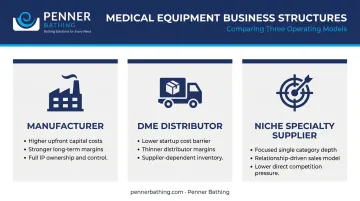
Three common business structures:
- Manufacturers design and produce their own equipment. Upfront costs run higher, but margins and IP protection are stronger over time.
- DME distributors source from manufacturers and sell or rent to facilities and patients — lower startup costs, but margins are thinner and competition is stiff.
- Niche specialty suppliers focus on one product category or customer segment, such as bathing systems for long-term care or respiratory equipment for home healthcare.
Your choice of structure shapes everything from your regulatory path to how quickly you reach first revenue.
What to Know Before You Start
Many first-time entrants underestimate how compliance-heavy this industry is. Before a single product ships, the business may need state licensing, federal supplier enrollment, product liability insurance, and FDA registration depending on product classification. These steps take time and money before any revenue appears.
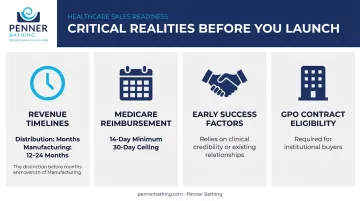
Critical realities to understand upfront:
- Revenue timelines vary sharply — a lean distribution business may see early sales within months, while a manufacturer building proprietary equipment can spend 12–24 months in development and certification before market entry.
- Medicare's clean-claim rules allow payment no earlier than 14 days after electronic claim receipt, with a 30-day ceiling. Build this lag into your working capital plan from day one.
- Early-stage success relies on either clinical credibility or existing relationships with healthcare procurement staff. Know which you bring and where you'll need outside support.
- Many hospitals and nursing homes purchase through Group Purchasing Organizations (GPOs). New suppliers must understand contract eligibility, pricing alignment, and distributor setup before approaching institutional buyers.
Why Start a Medical Equipment Business?
The case for entering this sector comes down to structural demand. The US Census Bureau counted 61.2 million Americans age 65 or older in 2024 — 18% of the total population, up 3.1% from the prior year. The CDC reports 32,200 residential care communities with over 1.3 million licensed beds operating as of 2022. These are your institutional customers, and they buy equipment on a recurring, budgeted basis.
The opportunity for differentiation is also real. Businesses that win in this space typically do so on:
- Showing up, delivering correctly, and following through on every order
- Product depth — knowing their category better than generalist distributors
- Responsive after-sales support: training staff, troubleshooting issues, and being reachable when something goes wrong
- Specialization — building a reputation as the go-to supplier for a specific product type or care setting
Price matters, but it's rarely the deciding factor for institutional buyers. A nursing home administrator choosing a bathing system supplier isn't optimizing for the cheapest option — they're managing risk. That dynamic favors well-structured independent businesses over volume-focused national suppliers, and it's exactly the kind of market this guide is built to help you navigate.
How to Start a Medical Equipment Business – Step by Step
Skipping steps here creates predictable problems: entering without proper licenses, underpricing to win early customers, or launching without enough working capital to survive the first reimbursement cycle. Each stage below builds on the previous one.
Step 1 – Identify Your Niche, Customer, and Problem
Define who you're serving and what specific problem you solve. Be concrete: are you supplying durable medical equipment to home healthcare patients, bathing systems to nursing homes, mobility aids to post-surgical patients, or respiratory devices to assisted living facilities?
Also clarify whether your primary customer is an institutional buyer (a facility's procurement or clinical team) or an individual patient and their family. Each has a different buying process, timeline, and decision criteria.
Common miss: Choosing a product category because it sounds promising without confirming that facilities in your target geography actually purchase it regularly and have budget for it.
Step 2 – Validate Demand, Pricing, and Viability
Speak directly with procurement managers at nursing homes, hospital discharge planners, physical therapists, or home healthcare agencies. Ask what they currently buy, who they buy from, what frustrates them about existing suppliers, and whether they'd consider switching.
Then test pricing against real costs: find what comparable products sell for, work backwards from your cost of goods and operating expenses, and confirm whether the business can be profitable at those price points before committing.
Common miss: Validating interest from healthcare contacts only to discover too late that facilities are locked into GPO contracts or long-term supplier agreements that make switching difficult for new entrants.
Step 3 – Define Your Business Model and Pricing Structure
Decide how the business generates revenue:
- Direct equipment sales — straightforward but requires inventory investment
- Rental programs — common for home healthcare, with different cash flow dynamics
- Service contracts — recurring revenue but requires support capacity
- Combination models — more complex to manage early on
If your customers will be billing insurance or federal programs, understand what Medicare or Medicaid will actually reimburse for specific product categories. Build pricing around what the end payer covers — not just what the facility says they're willing to pay.
Common miss: Setting pricing that works for private-pay customers but fails to account for lower reimbursement rates and longer payment cycles when Medicare or Medicaid is the primary payer.
Step 4 – Set Up Legal Structure, Licensing, and Compliance
This step has more components than most new entrants expect.
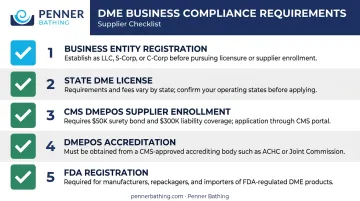
Required in most cases:
- Register your business entity (LLC, S-Corp, or C-Corp based on your tax situation)
- Obtain a state-issued DME license — requirements and fees vary by state; California, Florida, Tennessee, and New York each have distinct licensing requirements and processes
- If billing Medicare or Medicaid: enroll as a CMS-approved DMEPOS supplier, meet 42 CFR 424.57 supplier standards, carry a $50,000 surety bond per NPI, and maintain at least $300,000 per-incident liability coverage
- Obtain DMEPOS accreditation from one of eight CMS-approved organizations — including ACHC and The Joint Commission, both of which now conduct annual in-person surveys as of 2026
- Research FDA registration requirements: domestic distributors who don't import, repackage, or relabel devices generally don't need FDA registration solely for distribution — but manufacturers, repackagers, and initial importers do
Common miss: Assuming forming an LLC is sufficient to begin operations. In most states, you cannot legally sell or rent medical equipment to patients or bill insurance without the corresponding DME license and, where applicable, Medicare supplier enrollment.
Step 5 – Build Your Product Offering, Sourcing, and Operations
Define your product catalog clearly — what you'll carry, what's excluded, and what minimum service standards you'll guarantee. Clarity here prevents expanding beyond your original product focus and sets expectations that either build or erode trust with institutional buyers.
For distributors, establish relationships with at least two or three reliable manufacturers so a supply chain disruption with one partner doesn't halt your ability to serve customers. Evaluate vendors on product quality, delivery reliability, credit terms, and whether they provide training materials or sales support.
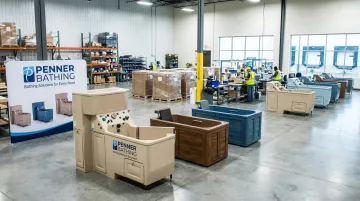
What deep specialization looks like in practice: Penner Bathing, a family-owned manufacturer based in Aurora, Nebraska, has spent over 40 years developing bathing systems exclusively for long-term care facilities, hospitals, and assisted living communities. Their 22,000-square-foot facility handles manufacturing, assembly, a national showroom, and parts fulfillment under one roof.
Products carry UL and CUL listings, same-day parts shipping is available for orders placed before 2 PM CST, and 24/7 live phone support means facility customers always reach a person when something goes wrong. That operational depth is what converts a first-time nursing home buyer into a 20-year customer.
Common miss: Launching with too broad a catalog before proving any single product category. Businesses that try to carry everything typically execute nothing well.
Step 6 – Plan Capacity, Staffing, and Delivery
Map out what the founder can handle alone in the early months versus what requires additional people. Common early hires include:
- Delivery and installation technicians
- A billing and reimbursement specialist (especially if billing Medicare)
- A sales or account management role focused on facility relationships
Also plan your physical infrastructure: warehouse space, delivery vehicles, inventory management software, and a compliant physical location (required for Medicare enrollment). Map these costs against revenue projections so you're not funding overhead before income materializes.
Common miss: Underestimating the cost and complexity of last-mile delivery and equipment setup. Facilities expect equipment to arrive correctly configured with staff capable of explaining its use. Cutting corners here damages the referral relationships that drive repeat business.
Step 7 – Go to Market and Build Referral Relationships
The most effective customer acquisition channel in this space is direct relationship-building with referral sources. Hospital discharge planners, physical therapists, nursing home administrators, and home healthcare agencies are the gatekeepers who recommend or specify equipment.
Federal discharge planning regulations require hospitals to discuss equipment needs with patients before discharge — meaning these referral pathways are structurally embedded in how care transitions work.
Build credibility early:
- Pursue accreditation from ACHC or The Joint Commission — it signals to institutional buyers that your processes meet the standards they require
- Ensure product-level certifications (such as UL Listing for electrical equipment) are in place before approaching clinical buyers
- Track which referral sources drive inquiries, your conversion rate from first contact to sale, and which product categories generate repeat business
Step 8 – Monitor Performance, Manage Cash Flow, and Stabilize
Track financial health weekly in the early months — not monthly. The gap between delivering equipment and receiving Medicare reimbursement creates real liquidity pressure, and waiting until month-end to notice a problem is waiting too long.
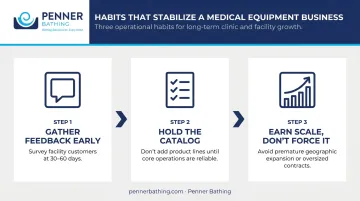
Beyond cash flow, three habits separate businesses that stabilize from those that stall:
- Gather feedback early — survey new facility customers at 30–60 days and fix service gaps before they damage the relationship
- Hold the catalog — resist adding product lines until delivery, billing, and support are executing reliably
- Earn scale, don't force it — expanding geographically or taking on large institutional contracts too soon accelerates problems, not growth
Conclusion
Starting a medical equipment business rewards those who enter with clarity about their niche, respect for the regulatory environment, and a genuine commitment to building trust with healthcare buyers over time. The basics matter more than speed: choosing the right model, getting licensed correctly, building reliable supplier relationships, and following through on every order and service commitment.
Revisit your business model, pricing, and operations quarterly through the first two years. Regulatory changes, reimbursement shifts, and technology updates move fast in this industry. The businesses that track those shifts and adjust accordingly tend to outlast those that treat their launch-day decisions as permanent. Build the review habit early — it compounds over time.
Frequently Asked Questions
What are the main sections of a business plan for a medical equipment business?
Core sections include executive summary, company overview, market analysis, competitive analysis, marketing and sales plan, operations plan, regulatory and compliance plan, management team, and financial projections. The financial plan and compliance sections carry extra weight here — lenders and investors need to see that regulatory risks are understood and funded before they'll commit.
What are typical profit margins, and is a DME business profitable?
Margin ranges vary by business model, and the sector can be profitable — but early-stage businesses often operate at a loss for 12–24 months due to startup costs, licensing investment, and slow reimbursement cycles. Manufacturers typically see stronger margins than distributors, but carry higher upfront investment and longer paths to revenue.
What licenses and certifications do I need?
Requirements depend on your state and business model, but typically cover a state-issued DME license, CMS Medicare/Medicaid supplier enrollment, DMEPOS accreditation from a CMS-approved body, and FDA registration for manufacturers or importers. Product-level certifications such as UL Listing apply to certain electrical equipment categories.
How much does it cost to start a medical equipment business?
Startup costs vary widely by model. A lean DME distribution business might launch for $15,000–$50,000, while a full-service distributor with warehouse space, inventory, and delivery vehicles typically requires $200,000–$900,000. Working capital to cover reimbursement delays adds substantially to those figures and catches many first-time operators off guard.
What is the difference between manufacturing and distributing medical equipment?
Manufacturers design and produce their own equipment, which means higher R&D and regulatory costs upfront but stronger margins and IP ownership. Distributors source from manufacturers and resell or rent to end customers — lower entry costs, but thinner margins and heavier reliance on supplier relationships. Your choice should reflect your available capital, technical expertise, and long-term growth goals.