Introduction
A patient care unit is more than a room with a bed — it's a temporary home where someone heals, rests, and depends on others for basic needs. How that space is prepared, cleaned, and maintained has a direct impact on recovery outcomes, fall rates, infection risk, and patient dignity.
This guide covers unit structure and equipment, environmental comfort requirements, infection control protocols, admission and discharge preparation, and the role of bathing in long-term care. Whether you're a nursing assistant, facility administrator, or assisted living caregiver, the guidance here is practical, actionable, and grounded in current regulations.
Key Takeaways
- Patient care units encompass the bed, furniture, storage, and immediate medical equipment — all requiring safety and hygiene upkeep
- Concurrent (daily) and terminal (post-discharge) cleaning serve different purposes and follow distinct protocols
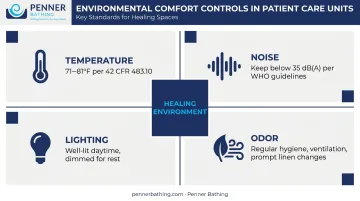
- 42 CFR 483.10 mandates room temperatures of 71–81°F with patient input on thermostat settings
- Structured admission, transfer, and discharge processes reduce anxiety, medication errors, and care gaps
- Purpose-built bathing systems help staff deliver consistent hygiene, safety, and efficiency between patients
What Is a Patient Care Unit?
A patient care unit (PCU) is the designated area within a healthcare facility where a patient receives ongoing care. At the individual level, it includes the patient's bed, bedside table, chair, personal storage, and immediate medical equipment. At the organizational level, the term refers to an entire floor or wing of a facility structured to deliver a specific type of care.
Types of Patient Care Units
Healthcare settings support a wide range of unit types. AHRQ's 2024 Hospital Survey on Patient Safety Culture lists common unit categories including:
- Medical/surgical (combined or separate)
- Cardiology and telemetry
- Oncology and hematology
- Psychiatry and behavioral health
- Rehabilitation
- Obstetrics/gynecology and pediatrics
- Observation/short stay
In smaller facilities — nursing homes, assisted living communities — these are typically consolidated into general care wings. Unit layout is intentional: a centrally located nursing station surrounded by patient rooms minimizes staff walking distances and shortens response times.
PCU vs. ICU: What's the Difference?
AACN's 2025 scope for progressive care nursing defines PCU patients as acutely ill, moderately stable, and at elevated risk of instability. These patients need closer monitoring than a standard medical/surgical floor but don't require the continuous intervention of an intensive care unit.
PCUs serve a wide range of patients:
- Post-surgical patients transitioning out of the ICU
- Individuals with cardiac conditions requiring telemetry
- Elderly residents in long-term care
- Patients recovering from acute illness or managing chronic conditions
ICUs, by contrast, require specially trained personnel, lifesaving equipment, and continuous nursing and physician attention. For facility administrators and care planners, knowing where a patient sits on this spectrum directly shapes staffing ratios, equipment selection, and the daily routines covered throughout this guide.
Essential Equipment Found in Every Patient Unit
Bed and Linens
The bed is the single most important piece of equipment in any patient unit. Adjustable-height beds reduce caregiver injury risk during bed-making and patient transfers. The FDA recommends height-adjustable electric beds as the best choice for staff working with high-risk patients.
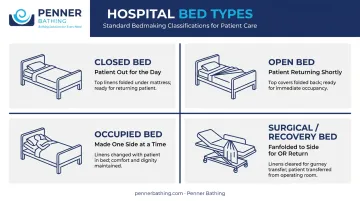
Staff must know how to make four types of beds:
- Closed bed — for patients out of bed for the day; top linens are folded down
- Open bed — for patients returning shortly; top linens are fanfolded back
- Occupied bed — made one side at a time for patients on absolute bedrest
- Surgical/recovery bed — fanfolded to the side for patients returning from the OR on a stretcher
Always raise the bed to waist height when making it. This protects staff body mechanics and reduces musculoskeletal strain — OSHA reports 18,090 days-away-from-work musculoskeletal injury cases among nursing assistants annually.
Linen basics:
- Fitted sheet, flat sheet, draw sheet, top sheet, pillowcases, blanket
- Draw sheets serve double duty: hygiene and patient repositioning
- Incontinence pads or waterproof protectors are used as needed
- Wet, soiled, or wrinkled linens must be changed immediately: they increase moisture at the skin surface and contribute to friction and pressure injury risk
Bedside Furniture and Accessories
The bed and its linens are just the start. Beyond the mattress, every patient unit includes standard furniture, each piece serving a specific hygiene or safety function:
| Item | Purpose |
|---|---|
| Bedside stand | Top drawer: personal care items. Lower compartment: elimination devices. These must always stay separate. |
| Overbed table | Clean surface for meals and activities — never place bedpans or soiled items on it |
| Chair | For patient mobility and visitors |
| Privacy curtain | Dignity during care procedures |
| Dresser/closet | Personal belongings storage |
Call lights require particular attention. Federal regulations under 42 CFR 483.90 require that call systems originate from every bedside and toilet or bathing facility, reaching staff directly or through a centralized area.
The call light must be within reach at all times — including after repositioning. Bathroom call lights require immediate response, as they may indicate a fall. Patients with limited hand mobility may need specialized signal devices; always check each patient's care plan.
Creating a Safe, Comfortable, and Healing Environment
Physical Safety Measures
Falls are one of the most serious patient unit risks. AHRQ reports 700,000 to 1 million hospitalized patients fall annually, with approximately 3–5 falls per 1,000 bed-days. In nursing homes, about half of all 1.6 million residents fall each year. Contributing factors include improper bed height, slippery surfaces, and poor caregiver sightlines.
Core fall prevention practices:
- Keep floors clear of clutter, cords, and equipment
- Address spills immediately
- Provide non-slip footwear for ambulatory patients
- Position bed rails appropriately, assessing entrapment risk per 42 CFR 483.25(n)
- Ensure the call light is always accessible
Pressure injuries develop faster than most staff expect. Patients should be repositioned regularly — in bed and in chairs — to prevent skin breakdown, maintain circulation, and preserve muscle health. Clinical guidelines support individualized schedules based on patient risk, surface type, and mobility rather than a single universal interval.
The seven standard positions are Fowler's, supine, prone, lateral, Sims', Trendelenburg, and reverse Trendelenburg. Note: Trendelenburg and reverse Trendelenburg require a physician's order.
Sensory and Environmental Comfort
Temperature
42 CFR 483.10(i)(6) requires patient rooms in facilities certified after October 1, 1990 to maintain 71–81°F, with patients having input over their thermostat setting within that range. For patients still uncomfortable at the range limits, fans, extra blankets, or layered clothing help. Elderly, sick, and infant patients are particularly susceptible to drafts.
Noise
A 2021 systematic review of hospital noise levels found daytime readings of 37–88.6 dB(A) — well above WHO's recommended hospital benchmark of 35 dB(A). Effects include sleep disruption, slower recovery, cardiovascular stress, and increased staff error risk. Staff should keep voices low, handle equipment quietly, and respond to call lights promptly.
Lighting and Odor
Rooms should be well-lit and cheerful during the day — particularly for patients with poor vision — and dimmed during rest periods. Federal regulations require adequate and comfortable lighting under 42 CFR 483.10(i)(5), with patient control over intensity and direction.
For odors, attentive personal care is the most effective solution: regular incontinence brief changes, prompt linen replacement, good ventilation, and open windows when possible. Staff grooming — hair, clothing, breath — is also part of the patient's environment. Together, these sensory controls support faster recovery and a more dignified care experience.
Infection Control and Unit Cleaning Protocols
CDC data shows approximately 1 in 43 nursing home residents has at least one healthcare-associated infection on any given day. Cleaning protocols are one of the most direct ways staff reduce that risk. This section covers two distinct approaches: concurrent cleaning for occupied units and terminal cleaning after discharge.
Concurrent (Daily) Cleaning
Concurrent cleaning is the routine daily cleaning of an occupied patient unit. Per CDC implementation guidance, inpatient units should receive routine cleaning at least every 24 hours, with focused attention on the patient zone and high-touch surfaces.
Daily cleaning priorities:
- Wipe down high-touch surfaces: bed rails, doorknobs, call buttons, overbed table
- Ensure hand hygiene for all staff, visitors, and patients
- Change soiled linens promptly
- Clean equipment between each patient use
- Segregate and dispose of biohazardous waste per agency protocols
In facilities without dedicated custodial staff, nursing personnel may also handle floors and windowsills within the patient unit area. Once daily cleaning is maintained, the next critical step is thorough disinfection when a patient leaves the unit entirely.
Terminal (Post-Discharge) Cleaning
Terminal cleaning is the thorough disinfection of a patient unit after discharge, transfer, or death. The CDC defines it as covering the entire patient zone — including surfaces hard to reach while the unit is occupied — working top to bottom, cleaner to dirtier.
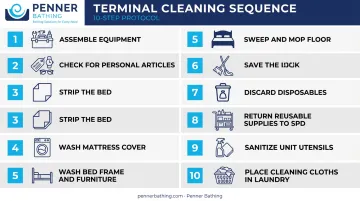
Terminal cleaning sequence:
- Assemble equipment in the utility room
- Check bedside cabinet for personal articles left by the patient
- Strip the bed and place all linens in the laundry hamper
- Wash the mattress cover and inspect for tears
- Wash the bed frame, cabinet (inside and out), chair, lamp, overbed table, and signal cord
- Sweep and mop the floor; wash windowsills if applicable
- Discard disposable supplies per agency guidelines
- Return reusable supplies (bedpans, metal trays) to the CSR/SPD department for sterilization
- Sanitize unit-level utensils (those not sent to SPD) in the utensil boiler for 30 minutes before returning to storage
- Place reusable cleaning cloths in the laundry hamper
Research supports rigorous terminal cleaning standards. A nine-hospital controlled trial (the BETR study) found that adding UV-C disinfection to standard terminal cleaning reduced acquisition of target pathogens — MRSA, VRE, C. difficile, and MDR Acinetobacter — with a relative risk of 0.70 compared to standard cleaning alone.
Preparing the Unit for New Patients
Each patient encounter — admission, transfer, or discharge — requires a different set of preparations. Getting these transitions right protects patient safety, reduces anxiety, and keeps documentation clean.
Admission
The patient room should be fully ready before the patient arrives — bed made, equipment stocked, call light accessible. The admission interaction sets the tone for the entire care relationship.
Admission essentials:
- Greet the patient by name and title
- Orient them to the room: call light, bathroom, adjustable bed controls
- Introduce roommates and staff
- Obtain baseline measurements (weight, height, vital signs) with dignity and privacy
- Review the care plan and any specialized equipment needs
Transfer
Transfers — whether to a different room or a different facility — are particularly disorienting for patients prone to confusion or anxiety.
A 2019 study of 568 long-term care residents found higher mean anxiety among residents who had been relocated within the prior year. Federal regulations under 42 CFR 483.15 require documented preparation and orientation to ensure a safe, orderly transfer.
Transfer protocol priorities:
- Communicate throughout the move to reduce anxiety
- Orient the patient to their new space immediately upon arrival
- Introduce new roommates and staff by name
- Ensure all personal belongings transfer with the patient
- Physician authorization is required for any transfer out of the facility; notify the charge nurse immediately if a patient requests to leave
Discharge
Once a patient is officially released, the nursing assistant's role includes:
- Collecting and packing all personal belongings
- Coordinating with nurses and social workers on home care arrangements
- Removing all linens and care items before housekeeping begins terminal cleaning
- Maintaining meticulous documentation and respectful communication with patient and family throughout
Privacy and documentation accuracy matter at every stage. Joint Commission data indicates medication discrepancies occur in 25–80% of discharge transitions — which means a structured, documented handoff process is one of the most direct ways staff can prevent post-discharge harm.
The Role of Bathing and Hygiene in Patient Unit Care
Bathing is a scheduled, clinical component of patient care in long-term care settings — not just a comfort routine. Under 42 CFR 483.24(a), residents who cannot perform ADLs independently must receive necessary services consistent with their needs and preferences. While federal regulations don't mandate a fixed bathing frequency, most facilities schedule baths on the same day as linen changes so a clean bath is immediately followed by clean linens.
Proper bathing supports:
- Skin health and infection prevention
- Pressure injury risk reduction through skin assessment opportunities
- Odor management and patient dignity
- Emotional wellbeing and sense of normalcy
The Real Challenges for Staff
Bathing multiple residents per shift in a long-term care environment is physically and logistically demanding. Staff face:
- Time pressure — bathing must be completed within shift schedules for multiple residents
- Infection control between patients — equipment must be thoroughly disinfected between uses
- Physical safety risks — OSHA reports nursing assistants sustain musculoskeletal injuries at over five times the all-industry rate due to patient handling demands
- Dignity preservation — every patient deserves privacy and respectful care, regardless of how busy the shift is
Purpose-Built Bathing Systems
Addressing those challenges — compressed shift windows, infection control gaps, and caregiver injury risk — requires equipment designed specifically for the clinical environment. Penner Bathing, a family-owned manufacturer based in Aurora, Nebraska, has built healthcare bathing systems for nursing homes, assisted living facilities, and hospitals since 1980.
Their systems are built around the practical realities of long-term care:
- Automatic disinfection cycles run through dedicated disinfect jets between patient uses, reducing reliance on manual cleaning and eliminating shift-to-shift variability
- BioCote 24/7 antimicrobial protection is integrated into equipment surfaces, offering round-the-clock surface protection between cleaning cycles
- Fast-fill reservoirs reduce wait times between resident baths, improving staff workflow across a full shift
- Height-adjustable designs protect caregiver ergonomics during transfers and bathing assistance
- 38+ models with multiple door configurations (left, right, and end-opening) adapt to the room's layout rather than forcing layout workarounds
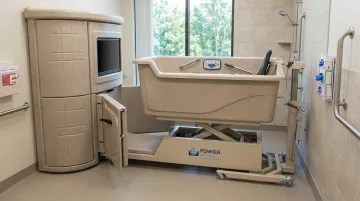
Penner also offers the Cascade Bariatric system for facilities serving residents with higher weight requirements, with a 600 lb bariatric transfer chair and flexible entry configurations.
Hydrotherapy also delivers documented therapeutic value beyond basic hygiene. A 2025 systematic review found aquatic exercise improved balance, stiffness, pain, and walking ability in older adults with osteoarthritis. For long-term care residents, that means a well-designed bathing session can contribute to mobility outcomes — not just cleanliness.
Frequently Asked Questions
What does patient care unit mean?
A patient care unit is the designated area within a hospital or long-term care facility where a patient receives care — encompassing their bed, bedside furniture, personal storage, and medical equipment. The term also refers to an entire floor or wing organized to deliver a specific type of care, such as skilled nursing or progressive care.
What kind of patients go to a PCU?
A Progressive Care Unit serves patients who are acutely ill but moderately stable, requiring closer monitoring than a general floor without the continuous intervention of an ICU. Typical patients include post-surgical cases, cardiac patients, and those recovering from acute illness. In long-term care, PCUs serve elderly residents, people with chronic conditions, and those in rehabilitative or end-of-life care.
What is the difference between concurrent and terminal cleaning?
Concurrent cleaning is daily maintenance performed while a patient occupies the unit, targeting high-touch surfaces and soiled linens. Terminal cleaning happens after discharge or death: a full disinfection covering all surfaces, equipment, and bedding to prepare the unit for the next patient.
How often should bed linens be changed in a patient care unit?
Most facilities complete a full linen change one to two times per week, typically coordinated with bath day. Regardless of schedule, wet, soiled, or wrinkled linens must be changed immediately since damp linens harbor pathogens and accelerate skin breakdown.
What equipment is standard in every patient unit room?
Standard items include an adjustable bed, bedside stand, overbed table, chair, privacy curtain, and call light system. Personal care supplies — wash basin, bedpan, urinal, and emesis basin — are also stocked in every unit.
What role does bathing play in patient unit care?
Bathing supports hygiene, infection prevention, skin health, and patient dignity — making it a core element of unit care. In long-term care settings, bathing is coordinated with linen changes and supported by purpose-built systems that maintain safety and consistent disinfection standards between patients.
![Patient Care Assistant Duties & Responsibilities [2026]](https://file-host.link/website/pennerbathing-uj4awa/assets/blog-images/5c287aad-642d-4e45-a141-820e109015bd/1784185585478548_c4bfbe2b16c843369cd487bf4bb383d6/1080.webp)