One fact that catches many families off guard: Medicare does not pay for long-term custodial care. Personal assistance with bathing, dressing, and mobility — the help most aging veterans actually need — falls almost entirely outside Medicare's coverage. That gap has to be filled by something else.
This guide covers every major VA long-term care option available to wartime veterans and their spouses: what each option is, who qualifies, what it costs, and which VA benefits can help pay for it.
Key Takeaways
- VA long-term care has two tracks: private settings (funded by Aid & Attendance) and VA-operated facilities (reserved primarily for service-connected veterans)
- Aid & Attendance is the most accessible financial tool, with no service-connected disability required
- Private options include in-home care, assisted living, memory care, and skilled nursing facilities
- VA Community Living Centers and State Veterans Homes have strict eligibility requirements; most wartime veterans won't qualify
- Surviving spouses can claim Aid & Attendance independently, even after the veteran's death
What Is VA Long-Term Care?
Long-term care refers to ongoing support with activities of daily living (ADLs) — bathing, dressing, eating, mobility, and toileting — typically for individuals managing chronic illness, disability, or age-related decline. Unlike acute hospital care, the goal isn't treating a condition — it's sustaining daily function over months or years.
The VA organizes long-term care into two broad tracks:
- Private care options — facilities and services the veteran or spouse selects independently, often funded in part through VA pension benefits like Aid & Attendance
- VA-operated or VA-subsidized care — CLCs, State Veterans Homes, and contracted nursing facilities, which require specific service-connected or financial eligibility criteria
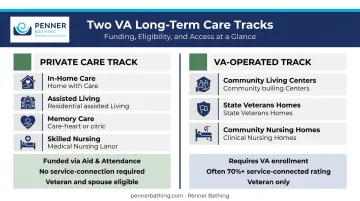
Knowing which track applies matters because eligibility rules differ between them. Most wartime veterans — particularly those without high service-connected disability ratings — access care through the private track.
Private Long-Term Care Options for Veterans and Spouses
The majority of wartime veterans and their spouses receive care through private settings — facilities and services they choose themselves. The VA Aid & Attendance benefit places no restrictions on which provider or facility is used, making this track far more accessible than VA-operated facilities for most families.
In-Home Care
In-home care is typically the first step. A caregiver — a family member, trusted individual, or professional from an agency — assists the veteran or spouse with daily activities at home. The caregiver does not need to be professionally licensed, which makes this option highly flexible.
2024 national median costs for in-home care:
- Non-medical homemaker services: $33/hour, or approximately $6,292/month based on 44 hours per week
- Home health aide: $34/hour, or approximately $6,483/month
For veterans receiving Aid & Attendance, paid in-home attendant expenses — including care provided by a family member — can be reported on VA Form 21P-8416 and used to reduce countable income for pension purposes.
Safe bathing is one of the most common physical barriers to aging in place. Walk-in baths designed for seniors — such as Penner Bathing's Dream Spa Walk-In Bath (starting at $5,950) — allow veterans to bathe safely without caregiver assistance, reducing fall risk and extending time at home.
Assisted Living and Memory Care
Assisted living communities offer residential care for individuals who need daily personal assistance but not 24-hour skilled medical supervision. Couples can move in together even if only one requires care — an important option for veterans whose spouses want to stay together.
Memory care is a specialized, secured form of assisted living for individuals with Alzheimer's, dementia, or cognitive decline. It involves higher staff ratios, structured programming, and safety features designed around cognitive impairment.
2024 cost benchmarks:
- Assisted living: $5,900/month national median
- Memory care: approximately $8,399/month average
Aid & Attendance recognizes cognitive impairment as a qualifying care need. A veteran or spouse who requires supervision or reminders to stay safe — even without a service-connected disability — may meet the clinical threshold for benefits.
Skilled Nursing Facilities
Skilled nursing facilities (nursing homes) provide the highest level of non-hospital care: 24-hour supervision by licensed nursing staff, ongoing medical treatment, wound care, and post-surgical rehabilitation. They serve individuals whose needs go beyond personal assistance into active medical management.
2024 national median costs:
- Semi-private room: $9,277/month
- Private room: $10,646/month
Once a skilled nursing resident's assets are depleted and Medicaid begins covering costs, VA pension payments — including Aid & Attendance — are capped at $90/month for a veteran or surviving spouse with no dependents. This doesn't eliminate the benefit, but it significantly reduces it. Advance planning between Medicaid and VA pension matters.

VA-Operated and VA-Funded Care Options
VA-operated facilities exist specifically for veterans — not spouses — and carry stricter eligibility requirements than the private track. Long-term placement is not guaranteed in most of these settings. For many wartime veterans, these options are simply not accessible.
VA Community Living Centers (CLCs)
CLCs are VA-run nursing homes, typically located within VA Medical Centers, with over 100 locations nationwide. They primarily provide short-term skilled nursing and rehabilitation care, not guaranteed long-term placement.
Key eligibility requirements:
- Enrollment in VA healthcare
- A service-connected disability rating of 70% or higher (or care needed due to a service-connected condition)
- A single disability rated at least 60% with a total rating based on individual unemployability
Veterans who don't meet the mandatory categories may still be admitted based on available space, but co-pays apply. CLC admission is defined in terms of enrolled veterans — there is no standard pathway for surviving spouses.
State Veterans Homes
State Veterans Homes are owned and operated by individual state governments, available in all 50 states and Puerto Rico. Unlike CLCs, they more commonly offer long-term placement — not just short-term rehab.
Eligibility criteria vary by state but generally require state residency and wartime service. Some states also admit spouses, surviving spouses, or Gold Star parents. The VA provides per diem funding to states to help offset costs, often making these facilities significantly cheaper than private nursing homes.
For veterans with a service-connected disability rating of 70% or higher, federal regulations provide that the VA pays the prevailing care rate directly to the state — the facility cannot bill the veteran to supplement that payment.
Waitlists exist at some State Veterans Homes. If this option fits your situation, start the inquiry process well before care is urgently needed. Two additional VA-funded options extend coverage into the community, each with distinct cost and eligibility rules.
VA Community Nursing Homes and Community Residential Care
The VA contracts with private community nursing homes to serve eligible veterans who need care near their communities. For veterans who don't fall into a mandatory eligibility category, VA-paid placement is generally limited to six months per episode, with a possible 45-day extension.
The Community Residential Care (CRC) program is a separate track for veterans who cannot safely live alone but don't require hospital-level care. Key distinctions:
- The VA provides clinical oversight and case management — not room and board
- Costs come from the veteran's personal funds, which may include pension or Aid & Attendance payments
- No direct payment from the VA to the facility for housing costs
The Aid & Attendance Benefit: How It Can Help Pay for Care
Aid & Attendance is a VA pension enhancement (not a healthcare benefit) that provides tax-free monthly payments to wartime veterans and surviving spouses who need help with activities of daily living. It does not require a service-connected disability, which makes it the most accessible VA benefit for the majority of wartime veterans and their families.
Who Qualifies
Basic eligibility requires:
- At least 90 days of active duty with at least one day during a recognized wartime period (WWII, Korean War, Vietnam War, Gulf War era) — for those who entered service before September 8, 1980
- An honorable or other than dishonorable discharge
- A documented need for personal care assistance
- Net worth below the current limit of $163,699 (effective December 1, 2025)
Many families assume they won't qualify because of home ownership or savings. Home equity often doesn't count toward the net worth calculation in the way families expect, and allowable deductions can significantly reduce countable assets. A quick eligibility check — before assuming disqualification — can open doors families didn't know were available.
2025 Maximum Monthly Benefit Rates
| Claimant Status | Annual MAPR | Monthly Equivalent |
|---|---|---|
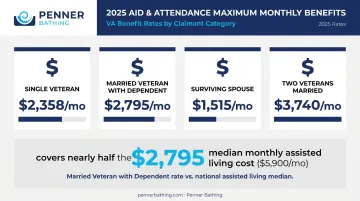
| Single veteran with A&A | $28,300 | $2,358 |
| Married veteran with one dependent | $33,548 | $2,795 |
| Surviving spouse (no child) | $18,187 | $1,515 |
| Two veterans married to each other | $44,886 | $3,740 |
Actual payment equals the MAPR minus countable income — these figures represent the maximum at zero countable income.
Practical illustration: The 2024 national median for assisted living is $5,900/month. A married veteran at the maximum Aid & Attendance rate receives up to $2,795/month — covering nearly half of that cost, leaving approximately $3,105/month from other resources.
Flexibility of Use
Aid & Attendance can be applied toward any qualifying care setting with no restrictions on which provider is chosen:
- In-home care (including family caregivers in some cases)
- Adult day care
- Board and care homes
- Assisted living and memory care
- Skilled nursing facilities
Surviving Spouse Eligibility
The surviving spouse of a qualifying wartime veteran can claim Aid & Attendance independently. Key conditions:
- Has not remarried after the veteran's death
- The veteran held an honorable or other than dishonorable discharge
- The veteran's disability does not need to have been service-connected
- The cause of the veteran's death is not a factor in eligibility
This benefit is widely underused. If you're a surviving spouse who hasn't applied, consulting a VA-accredited claims agent costs nothing and takes less than an hour to determine whether you qualify.
How to Choose the Right VA Long-Term Care Option
No single VA long-term care option fits every veteran or spouse. Three factors typically determine which path makes the most sense:
- Level of care needed — personal assistance only, or 24-hour medical supervision?
- Service-connected disability rating — this determines access to VA-operated facilities and affects cost
- Financial situation — income, assets, and eligibility for Aid & Attendance or Medicaid together determine what's sustainable long-term
Common Application Mistakes to Avoid
- Applying for Aid & Attendance before ongoing care expenses are documented
- Submitting incomplete financial or medical records
- Assuming VA-operated facilities are available without confirming eligibility and current availability
- Overlooking State Veterans Home waitlists until care is already urgent
Practical Next Steps
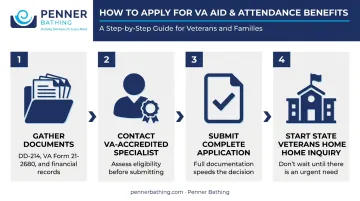
- Gather documents early — DD-214, physician documentation of care needs (VA Form 21-2680), and financial records
- Contact a VA-accredited benefits specialist to assess eligibility before ruling any pathway in or out
- Submit a complete application — complete documentation from the start speeds up the decision timeline
- Start State Veterans Home inquiries now if that's a likely option — don't wait until placement is needed
Frequently Asked Questions
How much does a VA nursing home cost per month?
VA Community Living Centers may be free for veterans with qualifying service-connected conditions, but others may owe co-pays based on their disability status and financial information. Private skilled nursing facilities averaged $9,277/month (semi-private) and $10,646/month (private room) nationally in 2024. State Veterans Homes are often significantly cheaper, with fees potentially fully waived for veterans with a 70%+ service-connected rating.
What is the VA 10-year rule?
After 10 years, the VA generally cannot sever service connection except in cases of fraud or a finding that qualifying service never existed. This rule does not freeze the disability rating percentage, though; that protection applies only after 20 continuous years of a stabilized rating.
Will the VA pay me to be my husband's caregiver?
The VA's PCAFC program may provide a monthly stipend to an approved primary family caregiver for veterans with a 70%+ service-connected disability rating who require at least six months of continuous personal care. Aid & Attendance funds can also be used to pay a family member as a caregiver, provided that person is not the veteran's spouse.
Can a surviving spouse qualify for VA long-term care benefits?
Yes. Surviving spouses of qualifying wartime veterans can receive Aid & Attendance benefits independently, provided they have not remarried after the veteran's death. The current maximum is $1,515/month. No service-connected disability — on the veteran's part or the spouse's — is required.
Does the VA cover assisted living costs?
The VA does not directly pay private assisted living room and board. However, wartime veterans and surviving spouses who qualify for Aid & Attendance receive a monthly tax-free payment they can apply toward assisted living costs at any facility they choose — with no restrictions on which community is selected.
What is the difference between a VA Community Living Center and a State Veterans Home?
CLCs are federally operated VA nursing homes focused primarily on short-term rehabilitation for service-connected veterans. State Veterans Homes are state-operated facilities that more commonly offer long-term placement, may admit spouses in some states, and are partially funded by the VA — with eligibility criteria, costs, and available space varying by state.