Introduction
A nursing care plan (NCP) is a structured, written document that guides individualized patient care — from initial assessment through diagnosis, goal-setting, intervention, and evaluation. It's how nurses organize priorities, coordinate across shifts, and ensure nothing falls through the cracks.
Under 42 CFR 482.23(b)(4), hospital nursing staff are federally required to develop and keep current an NCP for every patient. That regulatory weight reflects what nurses already know in practice: when care isn't documented, it isn't coordinated.
This guide covers what NCPs are, why they matter, how to write one, and why they're especially critical in long-term care and geriatric settings. Whether you're a nursing student drafting your first care plan or an administrator evaluating facility-wide documentation practices, this is your reference.
Key Takeaways:
- NCPs are legally required documents that guide individualized, patient-centered care
- All NCPs follow five core components: assessment, diagnosis, goals, interventions, and evaluation
- NANDA-I (13th edition, 2024–2026) standardizes nursing diagnostic language
- Long-term care NCPs prioritize function, dignity, and quality of life alongside clinical outcomes
- If care isn't documented, it's legally treated as if it never happened
What Is a Nursing Care Plan?
An NCP is a formal, dynamic document that identifies a patient's existing and potential healthcare needs, organizes the nursing team's response, and serves as the central communication tool across all shifts and care providers. It's distinct from a physician's medical plan: where a physician focuses on diagnosing and treating disease, the NCP addresses the patient's response to that disease — pain, anxiety, immobility, nutritional deficits — and how nursing care will meet those needs.
Understanding what an NCP is requires understanding the different forms it takes — from mental strategies nurses develop mid-shift to formal written records that follow a patient across the care team.
Informal vs. Formal Care Plans
Not every care decision starts on paper. Nurses develop informal, mental care strategies constantly — adjusting positioning, anticipating a patient's next need, prioritizing tasks mid-shift. Formal care plans translate that clinical reasoning into a written or digitized record that becomes part of the patient's official health record, accessible to every member of the care team.
Standardized vs. Individualized Care Plans
- Standardized care plans are pre-developed templates for common conditions (pneumonia, hypertension, post-surgical recovery). They ensure baseline consistency and save time.
- Individualized care plans adapt those templates to each patient's specific needs, preferences, cultural background, and goals — improving both care quality and patient satisfaction.
The best care plans combine both: start with a standardized template, then tailor it to the person in front of you.
Care Plan Formats
Three formats are common in practice and education:
| Format | Columns | Used By |
|---|---|---|
| Three-column | Diagnosis / Outcomes / Interventions | Clinical settings |
| Four-column | Diagnosis / Goals / Interventions / Evaluation | Clinical and academic settings |
| Student format | Adds a Rationale/Scientific Basis column | Nursing education programs |
The rationale column is a learning tool — it requires students to articulate why an intervention works, building the critical thinking skills that experienced nurses apply automatically.
Digital and AI-Assisted Care Plans
Electronic health records (EHRs) have made care plans more accessible and harder to lose. AI tools can now auto-suggest diagnoses and interventions based on real-time patient data, with research evaluating outputs from platforms like ChatGPT, Gemini, and DeepSeek across 30 NANDA-I diagnoses.
Research found these tools generally performed well on readability and intervention relevance — but nurses must validate every AI-generated suggestion against hospital policy and the patient's specific condition. Clinical judgment remains the final authority.
Why Are Nursing Care Plans Important?
NCPs are more than administrative paperwork. They're the structure through which nursing's ethical commitments become documented, measurable action. The ANA Code of Ethics (Provision 1.4) affirms patients' moral and legal rights to self-determination — and the care plan is where that commitment shows up in practice.
Continuity of Care
When a patient moves from the night shift to the day shift, or from the ICU to a step-down unit, verbal handoffs alone leave room for error. A current, well-maintained NCP provides every incoming nurse with the same reliable picture: what was assessed, what was planned, what was done, and what changed. That consistency is what continuity actually looks like in practice.
Team Collaboration
An NCP functions as a shared hub — not just a nursing document. When every care team member works from the same plan, goals get pursued consistently and communication gaps shrink.
Contributors typically include:
- Physicians and nurse practitioners
- CNAs managing daily personal care
- Physical and occupational therapists
- Social workers and case managers
- Specialists providing targeted treatment
A physical therapist's mobility goals and a nurse's fall prevention interventions, for example, should be aligned — not accidentally contradictory.
Legal Documentation and Compliance
A well-maintained care plan is legal evidence that care was provided to established standards. As ANA's documentation principles make clear, nursing records are used by legal, regulatory, and accreditation systems.
The practical implication: "if it wasn't written down, it never happened." That's not just a nursing school warning — it directly affects license protection and malpractice defense when audits or legal reviews occur.
Patient Empowerment and Engagement
A 2023 observational study found that patient-centered care was associated with significantly better self-reported physical health (OR 4.154) and mental health (OR 5.642), plus lower readmission odds (OR 0.389). NCPs that involve patients in goal-setting — rather than presenting care as something done to them — directly support those outcomes. Patients who understand and co-create their care plan are more likely to follow through — and those lower readmission odds reflect exactly that difference.
The 5 Components of a Nursing Care Plan
The nursing process is a continuous cycle — not a one-time checklist. Evaluation loops back to assessment, and every step shapes the next. Here's how the ANA's five-stage framework plays out in clinical practice.
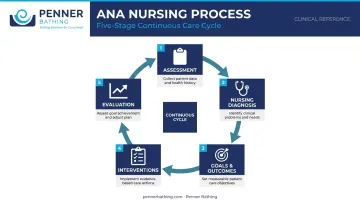
Step 1 – Patient Assessment
Assessment is the data-collection foundation. It draws from two sources:
- Subjective data: Patient-reported symptoms, health history, preferences, concerns
- Objective data: Vital signs, lab results, physical observations, diagnostic findings
The ANA framework calls for relevant patient information spanning physiological, psychological, sociocultural, spiritual, economic, and lifestyle factors. Critically, Joint Commission NPSG.16.01.01 EP 2 now requires organizations to assess patients' health-related social needs (HRSNs) — including food insecurity, transportation barriers, and financial constraints — and connect patients with community resources. Joint Commission NPSG.16.01.01 EP 2 makes this a formal requirement, not a best-practice suggestion.
Step 2 – Nursing Diagnosis
A nursing diagnosis differs from a medical diagnosis. Where a physician identifies a disease or condition, a nurse identifies the patient's response to that condition — what ANA defines as the nurse's clinical judgment about a person's responses to actual or potential health conditions or needs.
NANDA-I (13th edition, 2024–2026) provides the standardized diagnostic language for this step. Once identified, diagnoses are prioritized using Maslow's Hierarchy of Needs: physiological needs first, then safety, belonging, esteem, and self-actualization. Life-threatening problems always move to the top of the list.
Step 3 – Goals and Outcomes
Goals give interventions direction and give evaluation something to measure against. Two timeframes apply:
- Short-term goals: Hours to days — targeting immediate stabilization
- Long-term goals: Weeks to months — targeting recovery, independence, or chronic disease management
Write every goal using the SMART framework: Specific, Measurable, Attainable, Realistic, and Time-oriented. And consider functional goals — ones tied to something the patient actually cares about. "Patient will report pain below 3/10 in order to sleep 6 continuous hours" is more meaningful than "pain will be managed."
Step 4 – Nursing Interventions
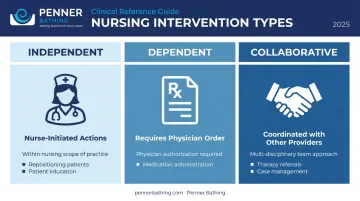
Three intervention types structure nursing action:
| Type | Description | Example |
|---|---|---|
| Independent | Nurse-initiated, within nursing scope | Repositioning, patient education |
| Dependent | Requires a physician's order | Medication administration |
| Collaborative | Coordinated with other providers | Therapy referrals, case management |
Each intervention should start with an action verb, include specifics (frequency, method, duration), and connect directly to the nursing diagnosis. Evidence-based guidelines — such as the 2022 AHA/ACC/HFSA Heart Failure Guidelines or the ADA's Standards of Care in Diabetes — anchor interventions to current clinical standards.
Step 5 – Evaluation
Evaluation measures progress against established goals using objective data and patient feedback. Three outcomes are possible:
- Goal met: Document it, consider whether new goals are needed
- Goal partially met: Adjust the interventions
- Goal not met: Revise the entire plan — reassess, re-diagnose if necessary, and reset goals
Evaluation isn't a final step. It feeds directly back into assessment, keeping the cycle moving as the patient's condition changes.
How to Write a Nursing Care Plan: Step-by-Step
Student care plans and professional care plans serve different purposes — students include rationale columns and exhaustive detail as a learning mechanism, while professional plans stay concise and prioritize clinical utility. Either way, the writing process follows the same core steps.
Collect and Analyze Data
Start with a full client database:
- Physical assessment findings
- Health history interview
- Medical record and diagnostic results
- Input from family or caregivers when relevant
Look for cue clustering — patterns in the data that point toward a specific nursing diagnosis. A patient with labored breathing, SpO2 of 91%, and restlessness isn't just "having a bad day." That cluster points toward impaired gas exchange. Critical thinking distinguishes clinically significant findings from baseline variations.
Formulate Nursing Diagnoses and Set Priorities
Translate your cue clusters into NANDA-approved nursing diagnoses. Then rank them:
- High priority: Life-threatening or physiologically urgent problems
- Medium priority: Problems affecting function, safety, or comfort
- Low priority: Problems that are real but not immediately threatening
Involve the patient in this process. When patients understand why certain problems are being addressed first, compliance improves.
Write SMART Goals with the Patient
A well-structured goal statement includes:
- Subject: The patient
- Action verb: What they will do
- Conditions/modifiers: Under what circumstances
- Performance criterion: How well, how much, by when
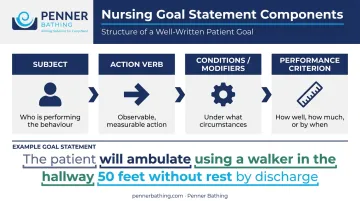
Goal co-creation matters. A patient who sets their own goals has more reason to meet them.
Select and Document Interventions with Rationale
Choose interventions that are specific, evidence-based, and culturally appropriate. Document them with action verbs and specifics — not "reposition patient," but "reposition patient every 2 hours using pressure relief protocol."
For student plans, add the scientific rationale: why does repositioning every 2 hours prevent pressure injury? Because sustained pressure occludes capillary blood flow, causing tissue ischemia. Documenting that reasoning builds clinical judgment over time — and in student plans, it's what separates a completed care plan from a learned one.
Evaluate, Update, and Document Consistently
Revisit the care plan with current patient data at every reassessment. Document responses to interventions accurately. Update goals and interventions as the patient's condition evolves.
Documentation isn't optional — undocumented care is legally considered care not provided. Every update must:
- Follow institutional policy and charting standards
- Become part of the permanent medical record
- Reflect actual patient response, not just planned interventions
Nursing Care Plans in Long-Term Care and Geriatric Settings
Long-term care environments present NCP challenges that acute care doesn't. Residents often live with multiple chronic conditions, slower recovery timelines, and heightened risks for falls, pressure injuries, dehydration, and cognitive decline. CDC data shows more than 1 in 4 US adults aged 65+ falls each year — and in residential care settings, where 44% of residents have diagnosed Alzheimer's disease or another dementia, cognitive impairment compounds every other risk.
Federal regulations structure LTC care planning precisely:
| Milestone | Federal Requirement |
|---|---|
| Baseline care plan | Within 48 hours of admission (42 CFR 483.21(a)) |
| Comprehensive assessment | Within 14 days of admission (42 CFR 483.20(b)) |
| Comprehensive care plan | Within 7 days after comprehensive assessment |
| Quarterly review | At least every 3 months (42 CFR 483.20(c)) |
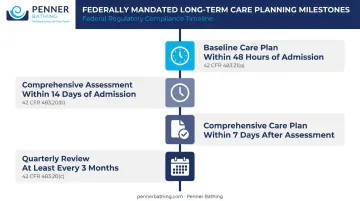
Beyond the regulatory timeline, 42 CFR 483.10 protects residents' dignity, choice, and participation — and 42 CFR 483.24 requires care supporting the resident's highest practicable physical, mental, and psychosocial well-being. These aren't aspirational standards. They're enforceable conditions.
Those regulatory requirements translate directly into clinical priorities. Long-term goals in geriatric NCPs cover mobility, nutrition, cognitive engagement, social connection, and personal hygiene. Hygiene-related interventions — bathing, skin care, positioning — are critical: consistent, safe bathing directly supports skin integrity, fall prevention, and resident dignity.
Facilities that invest in purpose-built therapeutic bathing systems are better positioned to execute these interventions consistently. Penner Bathing's systems, for example, are designed around the specific demands of geriatric care plans:
- Superior system: motorized lifting mechanism, mobile transfer chair, auto-fill and auto-disinfection, integrated bath oil and shampoo dispensers, and a built-in weight scale — features that address safe transfers, skin care, and nutritional monitoring
- Contour system: height-adjustable transfer support, three entry configurations, and rail-free design for residents with limited mobility
For facilities building NCP-driven hygiene protocols, equipment aligned to those interventions closes the gap between what's documented and what staff can realistically deliver.
Effective LTC care plans must also incorporate family and caregiver involvement, discharge planning where applicable, and be reviewed and revised after every comprehensive and quarterly assessment — not just at admission.
Best Practices: Do's and Don'ts for Nursing Care Plans
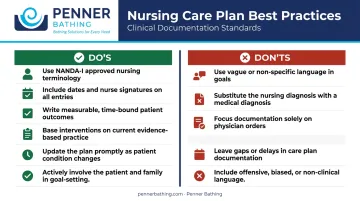
Do's for Effective Care Planning
- Write clearly using accepted NANDA-I terminology — avoid improvised labels
- Include dates, times, and signatures on all entries
- Focus on patient-centered, measurable outcomes
- Draw interventions from current evidence-based practice guidelines
- Update the care plan after every significant patient interaction or condition change
- Involve the patient in goal-setting and priority decisions
Don'ts to Avoid Common Errors
- Don't use vague language — "patient will feel better" tells no one anything useful
- Don't substitute medical diagnoses for nursing diagnoses (the NCP addresses responses, not diseases)
- Don't make the plan physician-centric — it should reflect holistic nursing judgment
- Don't leave gaps in documentation — undocumented care has no legal standing
- Don't use offensive, judgmental, or personal language in any care plan entry
Communication and Accessibility
A care plan locked in a filing cabinet or memorized by a single nurse isn't functional. It must be accessible to every relevant stakeholder: nurses, physicians, CNAs, patients, families, and insurers. Documenting the plan in the EHR ensures real-time access across shifts and departments. Verbal handoffs alone don't hold up — regulatory standards and legal precedent require written, accessible records to support care continuity.
Frequently Asked Questions
What is the main purpose of the nursing care plan?
An NCP documents a patient's needs and the nursing interventions designed to meet them, ensures consistent care across all team members and shifts, and creates a legally recognized record of care provided. Functionally, it serves as a clinical tool and a regulatory requirement under federal law.
What is an example of a nursing care plan?
Consider a patient with impaired gas exchange — SpO2 of 91%, dyspnea, and restlessness. The nursing diagnosis is impaired gas exchange related to mucus accumulation. Interventions include respiratory assessments every 2 hours, deep breathing exercises, and head-of-bed elevation, with the goal of restoring a normal respiratory rate.
What are the 5 components of a nursing care plan?
The five components are patient assessment, nursing diagnosis, goals and expected outcomes, nursing interventions, and evaluation. Together, they move from identifying the patient's condition and response to measuring whether care achieved its intended result.
What is the difference between a nursing diagnosis and a medical diagnosis?
A medical diagnosis identifies the disease or condition and is made by a physician or advanced practice provider. A nursing diagnosis, formulated by the nurse using NANDA-I approved terminology, focuses on the patient's response to that condition — not the condition itself.
How often should a nursing care plan be updated?
In acute care, NCPs should be updated after each significant assessment, condition change, or goal evaluation. In long-term care, federal regulations require review after every comprehensive and quarterly assessment — not just at admission or discharge.