
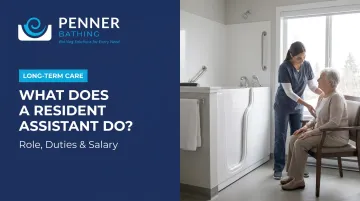
Demand for this kind of direct-care work isn't slowing down. The Bureau of Labor Statistics projects 17% growth from 2024 to 2034 for home health and personal care aides — adding nearly 740,000 jobs — and AARP reports that 56% of people turning 65 between 2021 and 2025 are expected to need long-term services and supports at some point in their lives.
This guide covers exactly what a resident assistant does day-to-day, where they work, what qualifications the role requires, and what they earn.
Key Takeaways
- RAs provide hands-on personal care, safety support, and emotional assistance to residents in long-term care settings
- No medical license is required, though facility training is standard, and the role differs from a CNA in scope
- Daily duties span bathing assistance, grooming, mobility support, meal help, and light documentation
- National mean pay for comparable direct-care roles is $16.12/hour ($33,530/year), per BLS May 2023 data
- Many RAs use this role as a launching pad toward CNA, LPN, or RN credentials
What Is a Resident Assistant?
A resident assistant (RA) is an unlicensed direct-care worker who helps elderly or disabled residents with activities of daily living (ADLs): bathing, dressing, eating, and similar tasks. RAs work under the supervision of licensed nursing staff across nursing homes, assisted living facilities, and similar care settings.
What an RA Is Not
Three roles share similar names or the same acronym, and the confusion is worth clearing up directly:
- CNA (Certified Nursing Assistant): State-certified, can perform clinical tasks like vital signs and catheter care; RAs cannot
- LPN (Licensed Practical Nurse): A licensed clinician; no comparison to an RA's scope
- College Resident Advisor: An entirely different role in student housing — same acronym, no overlap
What the Role May Be Called
Depending on the state and facility, you might see this position listed as:
- Personal care aide
- Care assistant
- Resident aide
- Direct support professional
The title varies by state and facility type, but the core responsibilities stay the same regardless of what's on the job posting.
What Does a Resident Assistant Do?
While the specifics vary by facility, the RA role consistently centers on helping residents maintain safety, comfort, and dignity through hands-on daily support. Here's how that breaks down in practice.
Personal Care and Hygiene Assistance
Bathing, grooming, dressing, oral care, toileting — these tasks make up the core of most RAs' daily workloads. They're also among the most physically demanding.
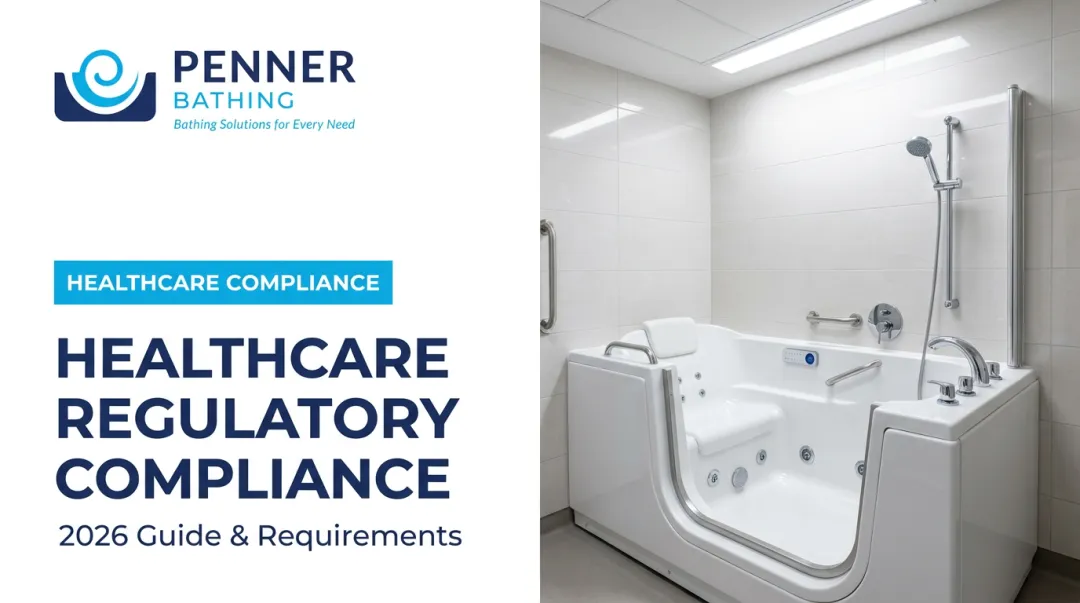
The quality of equipment in a facility directly shapes how safely and efficiently RAs can carry out these routines. Purpose-built bathing systems — like those offered by Penner Bathing, which has served long-term care facilities since 1980 — address several of the most common strain points in bathing workflows:
- Height-adjustable designs reduce bending and awkward posturing that cause back injuries
- Integrated transfer chairs (rated to 400 lbs standard, 600 lbs bariatric) minimize manual lifting during bed-to-bath transitions
- Fast-fill reservoirs cut time-on-task per bathing session, reducing cumulative fatigue across a shift
- Rail-free designs allow caregivers to position closer to the resident, reducing reach distance and shoulder strain
- Automatic disinfection cycles eliminate the need for manual scrubbing between residents, cutting both physical labor and infection control variability
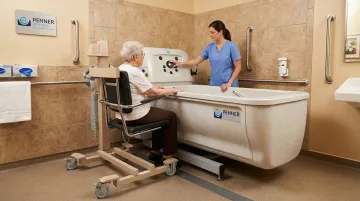
For RAs who may assist with multiple bathing routines per shift, this kind of infrastructure isn't a luxury — it's a meaningful factor in whether staff can sustain safe, consistent care throughout the day.
Mobility, Safety, and Fall Prevention
RAs assist residents with transfers — bed to wheelchair, wheelchair to toilet — as well as ambulation and repositioning to prevent pressure injuries. Fall prevention is one of the highest-stakes responsibilities in this role.
The numbers explain why. AHCA has cited more than 37 million annual falls among older adults nationally, including 9 million injuries and 36,000 deaths. RAs are often the staff member present when a fall risk is highest — during transfers, ambulation, or transitions between positions.
That's why facilities require RAs to follow strict protocols and use assistive equipment correctly. Mechanical aids like ceiling patient lifts (Penner Bathing distributes Vancare and Vanderlift systems, which allow single-staff transfers of residents up to 450 lbs) reduce injury risk for both the resident and the caregiver during high-risk transfer moments.
Mealtime and Nutrition Support
At mealtimes, RAs often serve trays, assist residents who have difficulty self-feeding, monitor food and fluid intake, and flag concerns — like changes in appetite or swallowing difficulty — to nursing staff. Nutritional monitoring carries genuine clinical weight: what an RA observes at the table can trigger dietary assessments, speech therapy referrals, or physician follow-up.
Emotional and Social Support
RAs spend consistent, close time with residents — which puts them in a strong position to notice changes in mood, behavior, or mental state. Recognizing when a resident seems withdrawn, confused, or distressed, and reporting it to a supervisor, is a core professional responsibility. That same proximity also makes RAs a source of companionship: conversation, a familiar face, and the kind of daily human contact that shapes quality of life in a care setting.
Documentation and Teamwork
The administrative side of the role is real. RAs work within an interdisciplinary team that typically includes nurses, social workers, and therapists — and documentation is how that team stays aligned. This typically includes:
- Recording care tasks completed each shift
- Logging food and fluid intake observations
- Noting changes in resident behavior or physical condition
- Flagging concerns for nursing review
Accurate, timely records protect residents by ensuring nothing gets missed in handoffs, and they protect staff by creating a clear account of care delivered.
Where Resident Assistants Work
RAs are employed across a range of care settings. Argentum reports roughly 1.4 million seniors currently living in more than 31,000 U.S. assisted living communities, and more than 1.3 million residents live in nursing homes on any given day, per AHCA data. Each setting shapes the role differently:
- Nursing homes — highest supervision structure; RAs work closely with CNAs and licensed nurses
- Assisted living facilities — residents have more independence; RAs support ADLs within a less clinical environment
- Memory care units — requires additional communication skills specific to dementia; about 18% of assisted living communities have a dementia unit, wing, or floor (AHCA/NCAL, 2024)
- Rehabilitation centers — residents may be recovering from surgery or neurological events; RAs may take on more therapeutic support tasks
- Adult day programs — daytime care only; residents return home in the evenings
- Private home care — more independent work with less direct supervision; scope varies widely by client
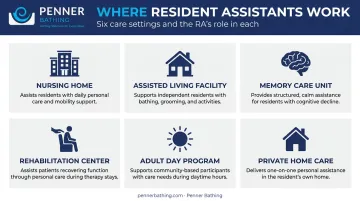
Understanding which environment fits your strengths — clinical and structured versus independent and community-based — is one of the most practical decisions when pursuing an RA role.
How to Become a Resident Assistant
Minimum Requirements
Most facilities require:
- A high school diploma or GED
- Completion of a facility-based orientation or training program
- Background check and health screening (required in most states)
- No formal state licensure — unlike CNAs, RAs are not regulated through a state certification process
CMS defines nursing-facility workers by what they do, not what they're called. An RA performing nurse-aide-level tasks in a federally certified nursing facility may need to meet CNA training requirements regardless of their job title. State rules for assisted living vary and should be checked directly.
Key Skills
Beyond minimum requirements, strong RAs bring a specific set of interpersonal and physical skills to the role:
- Stamina for a physically demanding shift — lifting, repositioning, and assisting with mobility are routine
- Patience during personal care tasks that residents may find uncomfortable or embarrassing
- Sharp observational skills to catch subtle changes in a resident's condition before they escalate
- Clear, consistent communication with residents, families, and the nursing team
- Genuine comfort with daily personal care — bathing, toileting, and grooming are core to the job, not exceptions
Career Pathway
The RA role is a legitimate entry point into healthcare. A common progression looks like this:
- Resident Assistant — gain hands-on experience in direct care
- Certified Nursing Assistant (CNA) — complete a state-approved training program (federal minimums require 75 clock hours) and pass a competency exam
- LPN or RN — advance through further education and licensure
Some facilities actively support this path through on-the-job CNA preparation or tuition assistance programs.
Resident Assistant Salary: What to Expect
National Baseline
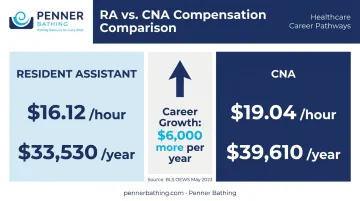
BLS doesn't publish a standalone "Resident Assistant" occupation. The closest proxy is SOC 31-1120 (Home Health and Personal Care Aides), which reported a mean hourly wage of $16.12 and a mean annual wage of $33,530 (BLS OEWS, May 2023). Since that figure isn't RA-specific, cross-referencing other sources gives a clearer picture:
- PayScale reports an average of $15.58/hour for RAs with assisted living skills, with total pay ranging from $26,000 to $41,000 annually (2026, 83 self-reported profiles)
- AHCA compensation data shows a state range of $14.77/hour (Tennessee) to $21.29/hour (Minnesota) as of 2026
What Affects Your Pay
| Factor | Impact |
|---|---|
| Geographic location | Highest gap — coastal and upper Midwest states pay more |
| Facility type | Nursing homes vs. assisted living vs. home care all differ |
| Experience | Pay typically increases with tenure |
| Shift differentials | Night and weekend shifts carry premiums at many facilities |
RA vs. CNA Pay Comparison
Upskilling to CNA carries a meaningful pay difference. BLS May 2023 OEWS data for SOC 31-1131 (Nursing Assistants) shows:
- Mean hourly wage: $19.04
- Mean annual wage: $39,610
That's roughly $6,000 more per year. For RAs already working in long-term care, the CNA credential is one of the fastest ways to increase pay without changing facilities.
Frequently Asked Questions
How much do resident assistants in nursing homes get paid?
BLS May 2023 data puts the national benchmark at $16.12/hour ($33,530/year) for home health and personal care aides. AHCA's assisted-living data shows state-level RA pay ranging from $14.77/hour (Tennessee) to $21.29/hour (Minnesota), depending on facility type and experience.
What does a resident assistant do in a nursing home?
RAs assist residents with bathing, grooming, dressing, toileting, mobility, and meals — and report changes in a resident's physical or emotional condition to nursing staff. Because they're present across every shift, RAs are often the first to notice and flag subtle changes in a resident's condition.
What is the difference between a CNA and a resident assistant in a nursing home?
CNAs hold state certification and can perform clinical tasks including vital signs and catheter care. RAs are unlicensed and focus on activities of daily living (ADL) support. CNAs also earn more — roughly $19.04/hour nationally versus $16.12/hour for comparable direct-care roles.
What do resident assistants wear in nursing homes?
RAs typically wear scrubs provided or approved by the facility, along with slip-resistant footwear. Color-coded scrubs are common for distinguishing staff roles, though no national dress code standard exists.
Do you need a certification to become a resident assistant?
Most states don't require formal certification for the RA role. Facilities typically require completion of an internal orientation program before working independently. Requirements differ if the RA performs tasks that fall under the federal nurse-aide definition in a certified nursing facility.
Can a resident assistant become a CNA?
Yes. Most RAs transition by completing a state-approved nurse-aide training program (minimum 75 clock hours federally) and passing a competency exam. Some facilities actively support this path through scheduling accommodations or tuition assistance.
![Patient Care Assistant Duties & Responsibilities [2026]](https://file-host.link/website/pennerbathing-uj4awa/assets/blog-images/5c287aad-642d-4e45-a141-820e109015bd/1784185585478548_c4bfbe2b16c843369cd487bf4bb383d6/1080.webp)