Introduction
In long-term care, mobility isn't confined to physical therapy. It plays out during every transfer, every trip to the bathroom, every bathing routine — and how well a facility supports those moments directly shapes resident health outcomes. For aging populations in nursing homes and assisted living, the difference between assisted movement and full dependency can determine whether a resident recovers function or loses it.
The problem is that mobility gets documented in care plans but deprioritized in practice. Stretched schedules make full-dependency assists feel faster than mobility support — and facilities absorb the cost of that tradeoff through fall incidents, caregiver injuries, accelerating resident decline, and regulatory scrutiny.
This article breaks down what mobility means in clinical settings, what facilities lose when it's treated as secondary, and how care teams can build mobility support into the systems and environments that drive patient outcomes.
Key Takeaways
- Mobility in healthcare directly drives patient safety, independence, and care costs — prioritizing it is a clinical and financial necessity
- Falls cost U.S. hospitals an average of $35,365–$36,776 per incident; prevention programs can generate net savings of $14,600 per 1,000 patient-days
- Roughly 30% of hospitalized adults aged 65+ experience measurable functional decline before discharge
- Patient handling injuries account for 34.4% of total workers' compensation medical costs in skilled nursing and assisted living facilities
- Effective mobility programs combine consistent assessment, purpose-built equipment, staff training, and an environment designed for safer movement
What Is Mobility in Healthcare?
In clinical terms, mobility refers to a patient's ability to move purposefully and safely — whether independently or with staff assistance. That includes walking, transferring between surfaces, repositioning in bed, and completing daily living tasks like bathing, dressing, and toileting.
Mobility becomes a healthcare priority wherever functional movement affects patient safety and quality of life:
- Hospital recovery units — where bed rest accelerates functional decline
- Long-term care and assisted living facilities — where preserving independence is the primary goal
- Rehabilitation centers — where restoring movement is the therapeutic objective
- Home care settings — where fall risk and caregiver capacity intersect
A patient who moves more safely requires less intensive intervention, maintains more dignity, and places less cumulative demand on care staff. That compounding effect — across months and years — is why mobility deserves treatment as a clinical priority, not a checkbox.
CMS regulations reinforce this explicitly: Medicare- and Medicaid-certified nursing facilities are required to maintain or improve residents' ADL function and provide services, equipment, and assistance to support maximum practicable mobility independence.
Key Advantages of Prioritizing Mobility in Patient Care
Advantage 1: Reduced Fall Risk and Improved Patient Safety
Falls are among the most costly and preventable adverse events in healthcare. U.S. hospitals record roughly 3–5 falls per 1,000 bed-days, totaling 700,000 to 1 million patient falls annually. A 2023 matched analysis across eight U.S. hospitals found that each fall added $35,365 in adjusted costs for non-injurious falls and $36,776 for injurious ones — while an evidence-based prevention program produced $14,600 in net avoided costs per 1,000 patient-days.
Regular movement, assistive devices, and safe transfer protocols build the strength, balance, and coordination that prevent falls during daily activities. Multifactorial fall prevention interventions show a meaningful reduction in fall rates — hospital programs have demonstrated a relative risk reduction of 31% (RR 0.69, 95% CI 0.49–0.96).
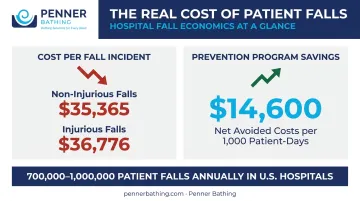
High-risk mobility moments deserve particular attention. Among 776 serious sentinel fall events reported to the Joint Commission in 2024, 18% occurred during toileting — a pattern that reflects what care teams see during bathing and transfers as well. Bathing environments represent one of the most addressable of these risk points.
Penner Bathing's commercial healthcare bathing systems — including the Premier Transfer and Cascade series — are designed with features like rail-free entry, height-adjustable transfer mechanisms, and mobile transfer chair compatibility. Each of these features is an engineering decision aimed at reducing physical risk during one of the most common fall scenarios in long-term care.
KPIs impacted: Fall rate per 1,000 patient days, fall-related injury rate, adverse event reports, liability costs
Advantage 2: Enhanced Patient Independence and Quality of Life
Supporting mobility helps patients retain autonomy over daily activities — moving through their environment, participating in social programs, managing personal hygiene. That autonomy is directly tied to mental health outcomes.
A 2023 review of physical activity interventions in older adults in care settings found a statistically significant improvement in depressive symptoms (Hedges g = 0.25, 95% CI 0.11–0.38). Physical activity also improved functional independence and mobility scores — meaning the same interventions that reduce fall risk also support psychosocial health.
Functional decline, when it occurs, compounds quickly. Research in residents with dementia entering long-term care found that Timed Up and Go performance worsened by 4.02 seconds within just 60 days — a meaningful loss of functional mobility in a short window. Mobility-focused care planning slows that trajectory.
The regulatory and reputational dimensions matter too. CMS quality measures for nursing homes include long-stay residents whose ability to walk independently worsened and whose need for ADL assistance increased. Facilities that can demonstrate preserved resident independence perform better on satisfaction surveys, state inspections, and CMS star ratings.
Independence in personal hygiene — particularly bathing — is especially tied to resident dignity. When mobility supports are inadequate, residents who could participate partially in their own bathing become fully dependent on staff. That dependency affects both the resident's self-perception and the care team's workload.
Accessible bathing systems that allow residents to engage at their current functional level — rather than defaulting to full-assist protocols — protect both.
KPIs impacted: ADL scores, resident satisfaction scores, depression screening outcomes, readmission rates
Advantage 3: Reduced Caregiver Burden and Improved Care Efficiency
When patients move with appropriate support, staff spend less time on high-effort manual assists. That shift has measurable operational consequences.
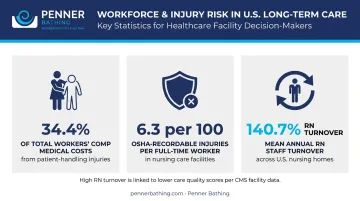
An analysis of 8,309 workers' compensation claims from skilled nursing, continuing-care, and assisted-living facilities found that patient-handling and mobility claims accounted for 34.4% of total medical costs. In 2024, nursing-care facilities recorded 6.3 OSHA-recordable injuries or illnesses per 100 full-time workers — the industry's injury burden remains significant.
Staff injury and turnover are closely connected. Across more than 15,000 U.S. nursing homes, mean annual nursing staff turnover runs approximately 128% overall — and 140.7% for RNs. CMS has directly stated that higher nursing staff turnover is associated with lower care quality. Reducing the physical demands placed on staff during patient handling is one lever facilities can pull to improve both retention and care consistency.
Reducing that physical burden starts with the equipment staff use every shift. Penner Bathing's fast-fill reservoir systems, automatic disinfection, and integrated dispensers across the Premier, Cascade, and Pacific bathing lines reduce the number of manual steps staff must manage during each bathing session.
Fewer manual steps mean less time per patient, lower physical burden per shift, and more capacity redirected toward higher-acuity care tasks.
KPIs impacted: Staff injury rate, caregiver turnover rate, time-per-patient for assisted tasks, labor cost per resident day
What Happens When Mobility Is Overlooked in Care Settings
Deprioritizing mobility stalls patient progress and accelerates measurable physical decline.
Clinical Consequences
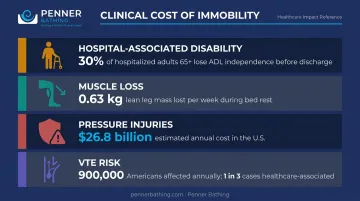
- Approximately 30% of hospitalized adults aged 65 or older experience hospital-associated disability — measurable loss of ADL independence — between admission and discharge
- Older adults lose roughly 0.63 kg of lean leg mass per week during bed rest, a rate that makes functional recovery progressively harder
- Prolonged immobility is a recognized risk factor for pressure injuries, with hospital-acquired pressure injury costs estimated at over $26.8 billion annually in modeled U.S. estimates
- The CDC estimates up to 900,000 Americans are affected by VTE each year, with more than one-third of annual cases classified as healthcare-associated — hospitalization and limited movement are documented risk factors
Safety and Liability Consequences
Facilities without consistent mobility assessment and support protocols see higher fall rates, more adverse events, and greater regulatory exposure. An HHS OIG review found that nursing homes failed to report 43% of falls involving major injury and hospitalization among Medicare-enrolled residents — a compliance risk that compounds when mobility protocols are weak.
The Financial Case for Prevention
That compliance exposure also has a direct financial dimension. Treating a fall injury, managing complications of prolonged immobility, and onboarding replacement staff after caregiver injuries all carry costs that outpace what structured mobility support requires.
The $14,600 in net avoided costs per 1,000 patient-days from a well-implemented fall prevention program is not a best-case projection — it's a documented outcome from real-world hospital data.
How Healthcare Facilities Can Better Support Patient Mobility
Effective mobility support is a system. It requires consistent assessment, appropriate equipment, trained staff, and an environment designed for safer movement. Four areas, addressed together, determine whether that system actually holds.
Start with Validated Assessment Tools
Care teams should use recognized tools to establish baseline mobility levels, track changes over time, and adjust care plans accordingly:
- Timed Up and Go (TUG) — measures time to stand, walk 3 meters, turn, return, and sit; assesses gait, balance, and fall risk
- Barthel Index — scores ten ADLs on a 0–100 scale to indicate functional dependence levels
- Berg Balance Scale — 14 tasks scored up to 56 points across both static and dynamic balance challenges
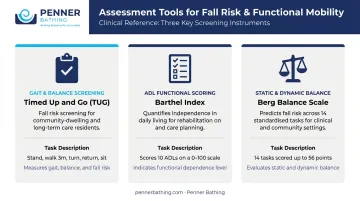
These tools aren't just clinical formalities. They create the documented baseline that allows care teams to detect declining mobility before a fall or injury occurs — and to demonstrate measurable resident outcomes to surveyors and families.
Build Mobility Into Daily Routines
Mobility support that only happens during scheduled therapy sessions doesn't produce lasting results. Facilities should embed movement into daily care:
- Scheduled ambulation before and after meals
- Repositioning protocols for bed-bound or chair-bound residents
- Encouraging self-assisted hygiene and dressing where safe and feasible
- Walking to activities rather than defaulting to wheelchair transport
Design the Physical Environment for Safer Movement
Hallway handrails, non-slip flooring, accessible bathroom layouts, and appropriately sized equipment all determine whether mobility support produces safer outcomes on the floor. Flooring research shows that compliant surfaces can reduce fall-related injury risk by 59% when falls do occur.
The bathing environment deserves specific attention. It's a high-risk area that combines wet surfaces, transfer demands, and resident vulnerability. Facilities serving elderly or mobility-impaired residents benefit from dedicated bathing systems designed for that context. Penner Bathing's commercial systems, for example, are built specifically for long-term care — with rail-free entry designs and height-adjustable transfer features that reduce staff strain while maintaining resident dignity.
Train All Staff, Not Just Therapists
Mobility-supportive care only works consistently when every care team member understands proper transfer techniques, correct use of mobility aids, and early warning signs of functional decline. That means CNAs, nurses, and support staff — not just physical therapists. High staff turnover in long-term care makes this a continuous need, not a one-time training event.
Conclusion
Mobility in healthcare is a core driver of patient safety, dignity, functional independence, and facility efficiency. Its value compounds when addressed consistently rather than reactively — built into daily routines rather than bolted on after problems emerge.
Facilities that embed mobility into assessments, staff training, and physical environments consistently see better outcomes: lower fall rates, higher resident independence scores, reduced caregiver burden, and stronger operational performance.
The evidence supports the investment. Regulatory standards require it. Most importantly, residents deserve care systems built around their capacity to move — not systems that wait for that capacity to decline.
Frequently Asked Questions
What is mobility in health?
Mobility in health refers to a person's ability to move safely and purposefully — including walking, transferring between surfaces, and completing daily activities like bathing and dressing. It serves as a key indicator of functional health, particularly for older adults and those managing chronic conditions or disability.
Why is mobility important in healthcare?
Mobility directly affects patient safety, quality of life, recovery speed, and caregiver workload. Facilities that actively support mobility see measurable improvements in fall rates, ADL scores, and caregiver injury rates.
What happens in a mobility assessment?
A clinician evaluates gait, balance, transfer ability, and range of motion using validated tools such as the Timed Up and Go test, Barthel Index, or Berg Balance Scale. Results guide mobility goals, fall risk identification, and selection of appropriate assistive equipment.
What are common mobility aids used in healthcare settings?
Common aids include canes, walkers, wheelchairs, transfer boards, ceiling or mobile patient lifts, and assistive bathing equipment. The appropriate aid depends on the patient's functional level, strength, transfer risk profile, and care setting.
How can long-term care facilities reduce fall risk related to mobility?
Effective fall reduction combines consistent mobility assessments, safe transfer protocols, staff training, and environmental modifications such as handrails and non-slip surfaces. Adaptive equipment in bathrooms and transfer zones — where falls most frequently occur — is especially critical.
What is the connection between immobility and health complications in care settings?
Prolonged immobility can lead to pressure injuries, muscle atrophy, deep vein thrombosis, increased depression, and accelerating functional decline — all of which raise care costs and reduce patient quality of life. These complications are preventable with consistent mobility support built into daily care routines.